
Trunk comparison: Renault Clio vs VW ID.4
Main Differences (highlighted: >10%)
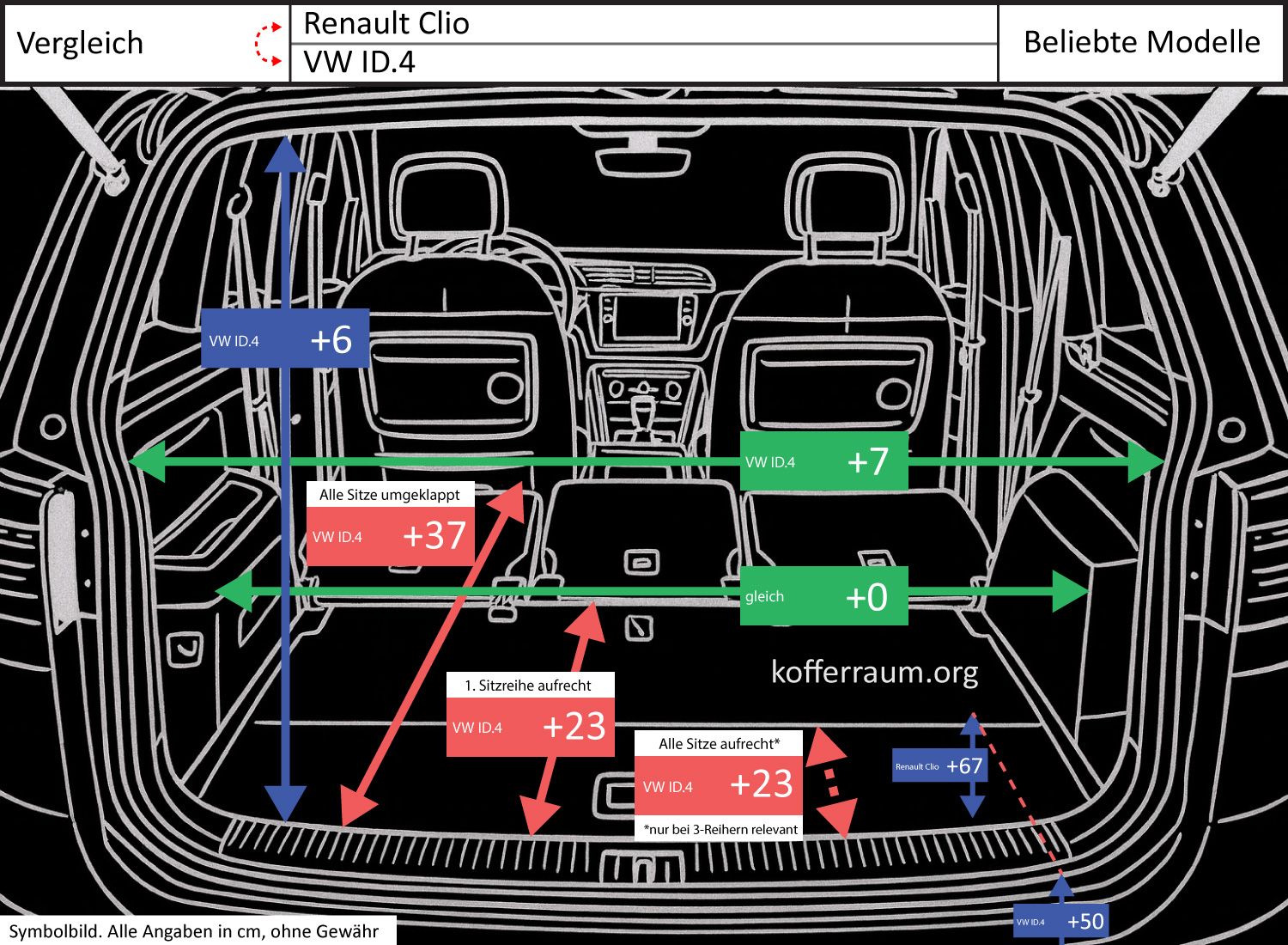
Significant deviations well over 10% in trunk dimensions concern length, loading edge height, and interior depth:
- VW ID.4 has a trunk that is 14.6 in (≈28%) longer with the seats folded down compared to the Renault Clio.
- VW ID.4 is 9.1 in (≈32%) longer with the first row of seats upright than the Clio.
- The depth from the loading edge to the trunk floor is 26.4 in (≈670%) greater in the Renault Clio than in the ID.4.
- The loading edge of the VW ID.4 is about 19.7 in (≈208%) higher above the road than that of the Clio.
The differences in trunk opening height (+2.4 in / 8%) and opening width (+2.8 in / 7%) are less than 10% and are not highlighted here; the narrowest width is the same for both.
Impact on Usability
Space for long items: Due to the significantly greater loading length (ID.4: +28% / +32%), the ID.4 is clearly better suited for long items such as slats, skis, long boxes, or assembled furniture. Those who frequently transport long, bulky cargo have clear advantages in the ID.4.
Loading and unloading / physical strain: The loading edge of the ID.4 is significantly higher (≈19.7 in). This means heavy boxes or groceries must be lifted higher in the ID.4 — which increases strain during loading and unloading. The Clio has advantages when lifting heavy loads due to its lower loading edge.
Trunk floor and usability of cargo volume: In the Clio, the distance from the loading edge to the trunk floor is much greater.
Practically, this means the Clio has a deeper "well" below the loading edge. Advantages: flat, wide items or luggage can be stored hidden and lower down; additionally, there can be more usable volume for lower items.
Disadvantages: when loading, items often have to be lifted over the loading edge and then lowered into the deeper well — this can complicate handling, especially when the loading edge is lower to the road but the floor sits significantly deeper.
Width and opening: Since the narrowest width is the same and the differences in opening width are <10%, width and opening dimensions bring hardly any practical differences when transporting bulky widths.
Conclusion
If you frequently transport long or bulky items (skis, long boxes, assembled furniture), the VW ID.4 has a clear advantage due to its significantly greater loading length.
If, on the other hand, you often load heavy, individually lifted loads or daily groceries and prefer a low loading edge, the Renault Clio is more practical — despite its shorter trunk, it offers a different form of usable volume through the deep loading area. Width limitations play hardly any role for either.