
Trunk comparison: Renault Clio vs VW Polo

Key Differences and Impact on Usability
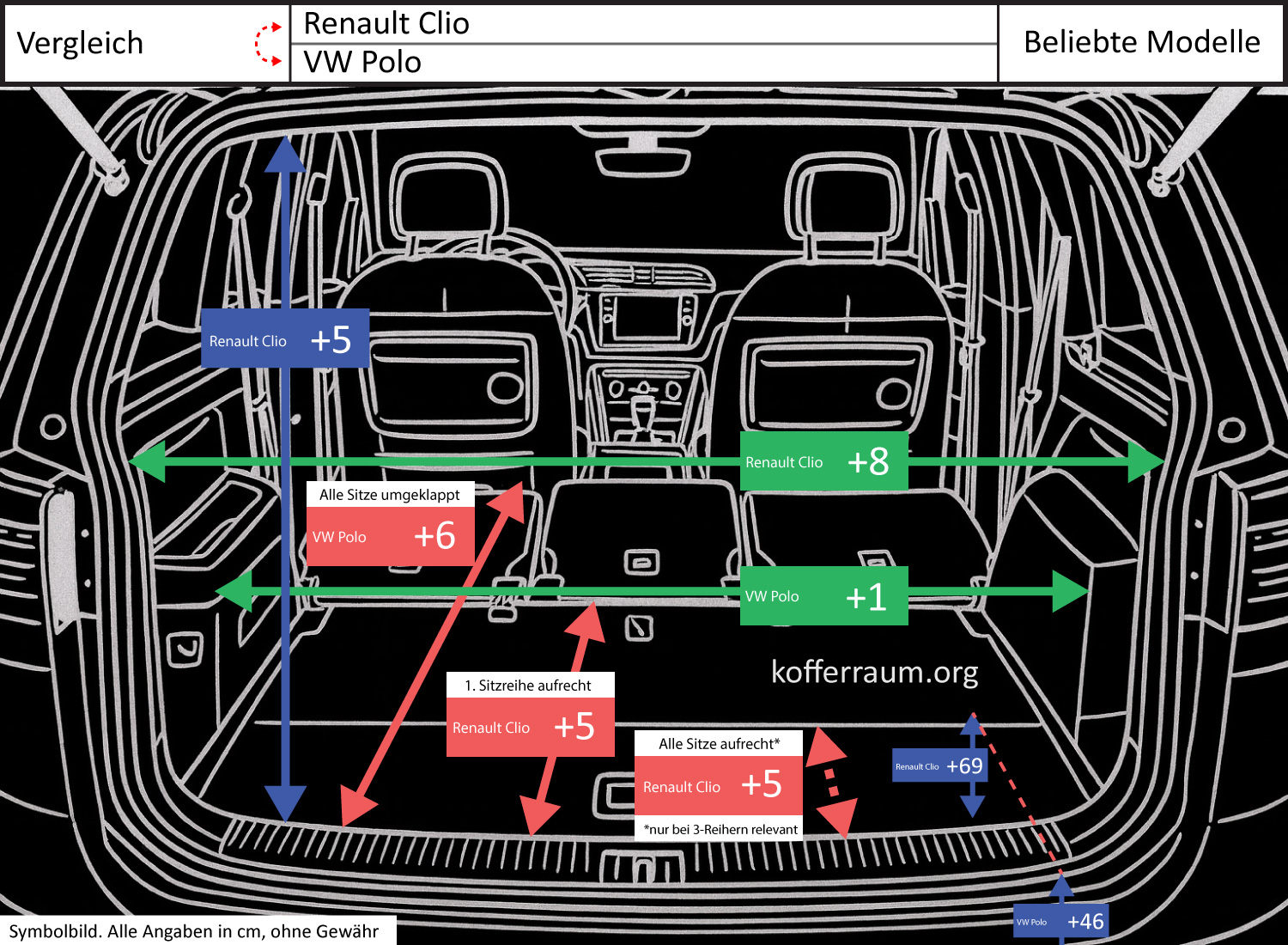
The most noticeable difference concerns the depth of the trunk: the Renault Clio has a trunk depth that is 27.2 in (+863%) greater (measured from the loading edge to the trunk floor).
Practically, this means for users: the Clio offers significantly more usable interior height and volume vertically, is better suited for tall or bulky items, and allows easier stacking.
Items lie deeper in the cargo space, which provides more protection and room, but with very heavy parts may require slightly more lifting into the interior.
Secondly, the loading edge on the VW Polo is significantly higher: the Polo's loading edge is 18.1 in (+192%) higher above the road than the Clio's.
This affects usability: with the Polo, you have to lift heavy items higher when loading and unloading, making handling more strenuous. A higher loading edge can be advantageous for ground clearance or loading onto a trailer hitch, but is less ergonomic for frequent lifting or using a dolly.
Combined, this means: the Clio offers a more practical, ergonomic solution for frequent loading of heavy or tall items due to its deeper cargo floor and lower loading edge. The Polo's higher loading edge makes lifting more difficult and the trunk less comfortable for demanding transport tasks.
Other Differences (less than 10%)
The remaining values differ only slightly: the Polo has 2.4 in (5%) more loading length with seats folded down, the Clio has 2 in (8%) more with the front seat row upright.
The Clio's trunk opening is 2 in (7%) higher and 3.1 in (9%) wider; at the narrowest point, the Polo is only 0.4 in (1%) wider. These deviations are usually negligible in everyday use and only affect usability in borderline cases (very long or very wide-long items).