
Trunk comparison: Seat Leon vs Durchschnitt Compact SUV

Comparison and Highlighted Differences
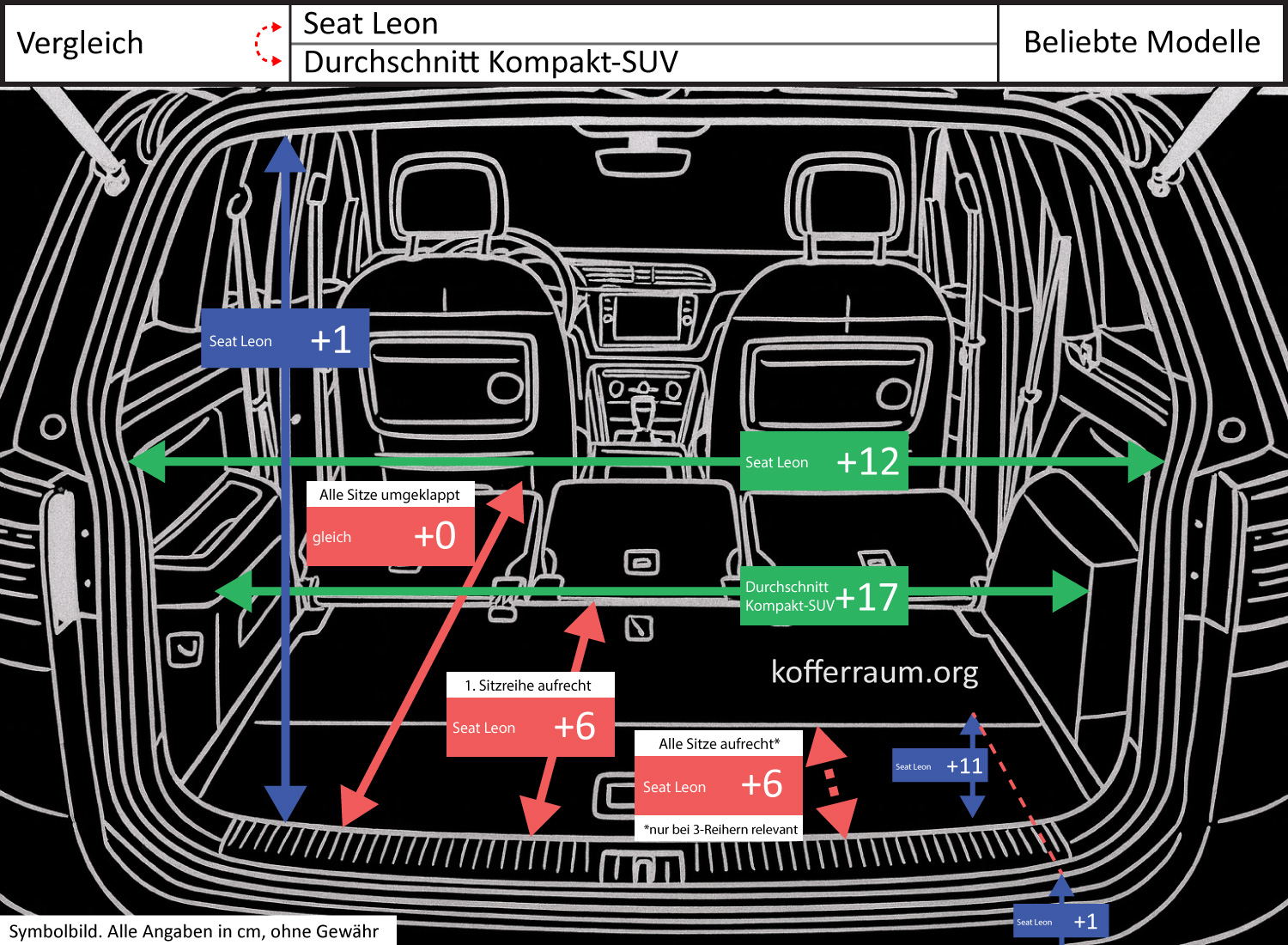
The trunk is the same length in both vehicles with the seats folded down. However, with the first row of seats upright, the SEAT Leon is slightly longer (+2.4 in / +8%). Noticeable differences (>10%) exist in trunk depth, the narrowest trunk width, and the width of the trunk opening: the SEAT Leon has a significantly greater trunk depth (+4.3 in / +79%), while the narrowest interior width is larger in the average compact SUV (+6.7 in / +21% in favor of the SUV), and the width of the trunk opening is larger in the Leon (+4.7 in / +12%). The height of the opening and the loading edge differ by only about 1% (each +0.4 in) and are practically negligible.
What Are the Practical Implications?
The significantly greater trunk depth of the SEAT Leon means that longer items can be pushed further back — advantageous for long skis, roof box contents in terms of depth, or elongated construction and garden materials. The larger width of the trunk opening in the Leon also makes it easier to slide wider cargo through the rear opening. On the other hand, the larger narrowest interior width of the average SUV means that wide or bulky items (e.g., bulky boxes, strollers placed sideways, or wide furniture parts) fit better inside the compact SUV, even if the opening is larger on the Leon. Practically, this means: Leon = better for long, deeply loaded items and for inserting wide parts through the opening; compact SUV = better for very wide loads that require space in the interior cross-section. Since the folded-down seat rows result in the same length, both vehicles are comparable in maximum cargo space. Minor differences like the loading edge and opening height (~0.4 in) hardly affect handling. Overall, the type of cargo (long/deep vs. wide/voluminous) determines which model fits better in everyday use.