
Trunk comparison: Seat Leon vs VW T-Roc


Key Points
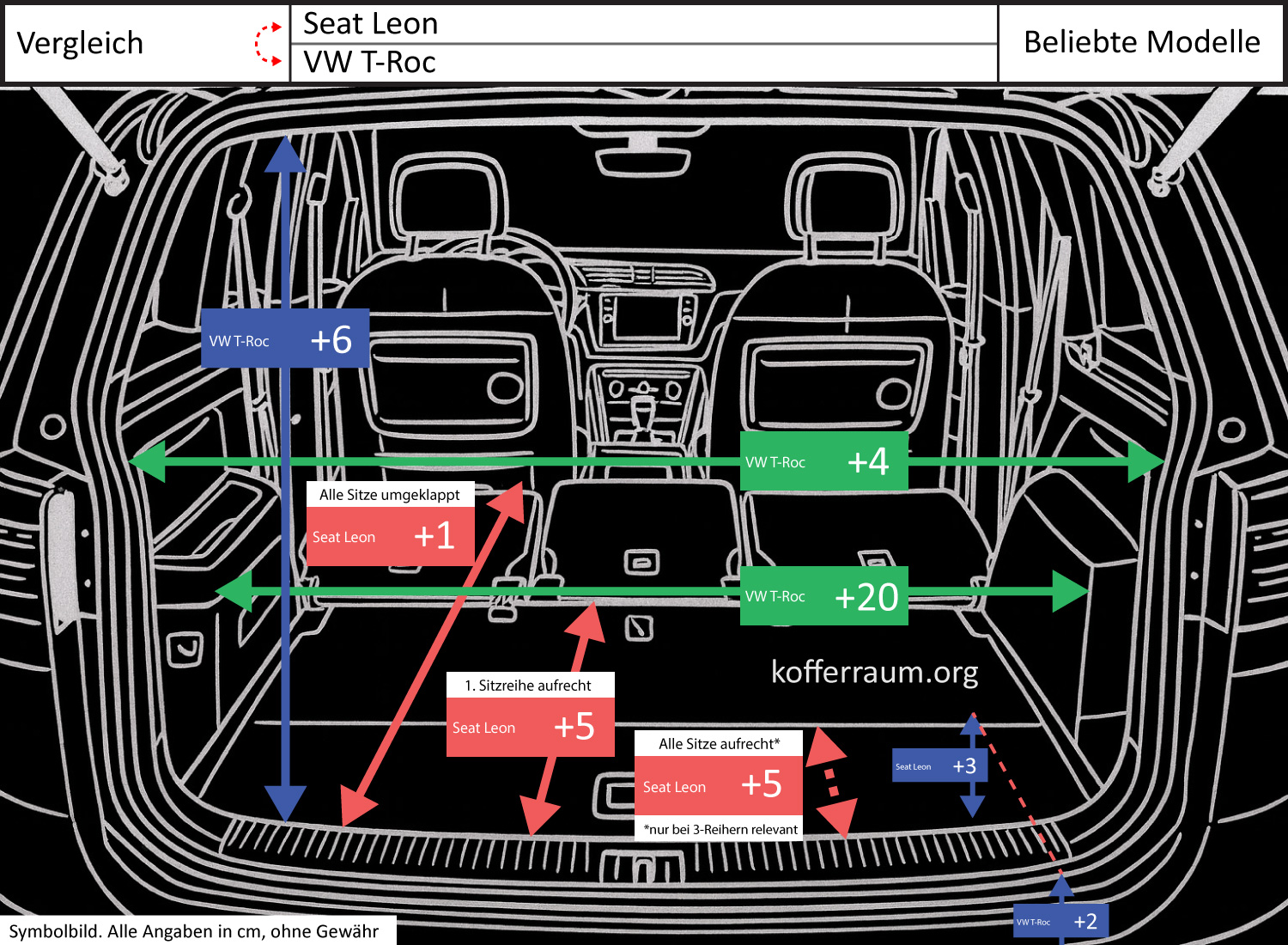
Both models have similar basic dimensions but differ in two crucial areas: the trunk depth and the usable width at the narrowest point.
Biggest Differences (highlighted)
Seat Leon: trunk depth +14%
The depth from the loading edge to the trunk floor is 1.2 in (+14%) greater in the Seat Leon than in the VW T‑Roc. This means more "vertical volume" under the loading edge and more space to stack items or accommodate bulky, taller cargo sections.
VW T‑Roc: narrowest width +25%
At its narrowest point, the VW T‑Roc's trunk is 7.9 in (+25%) wider than the Seat Leon's. This allows for transporting significantly wider items (e.g., large moving boxes, wide suitcases, parts with greater lateral extension).
Implications for Usability
Seat Leon — Advantages:
- Greater depth makes stacking suitcases and boxes easier and better accommodates taller items behind the loading edge.
- With seats folded down, the Leon is minimally longer (+0.4 in/1% or +2 in/6% with the first row upright), providing slightly more usable length overall, though this is barely noticeable.
- The slightly lower loading edge height compared to the T‑Roc makes lifting heavy items marginally easier.
VW T‑Roc — Advantages:
- The significantly greater width at the narrowest point makes the T‑Roc better suited for wide or irregularly shaped cargo that won’t fit or only fits diagonally in the Leon.
- A higher trunk opening (+2.4 in/8%) and wider opening width (+1.6 in/4%) facilitate loading tall or bulky items, even though these differences are under 10%.
- The loading edge is slightly higher (+0.8 in/3%), which can make sliding heavy items in a bit more difficult, but accessibility for wide items is better.
Conclusion
For users who frequently transport taller or stackable cargo (e.g., suitcases, boxes, bulky but not very wide goods), the Seat Leon is advantageous due to its greater depth.
Those who often carry wide, bulky items (large boxes, wide sports equipment, furniture parts) benefit more from the VW T‑Roc because of its significantly greater width at the narrowest point and the somewhat larger opening height.