
Trunk comparison: Skoda Kamiq vs Durchschnitt Subcompact

Key Differences
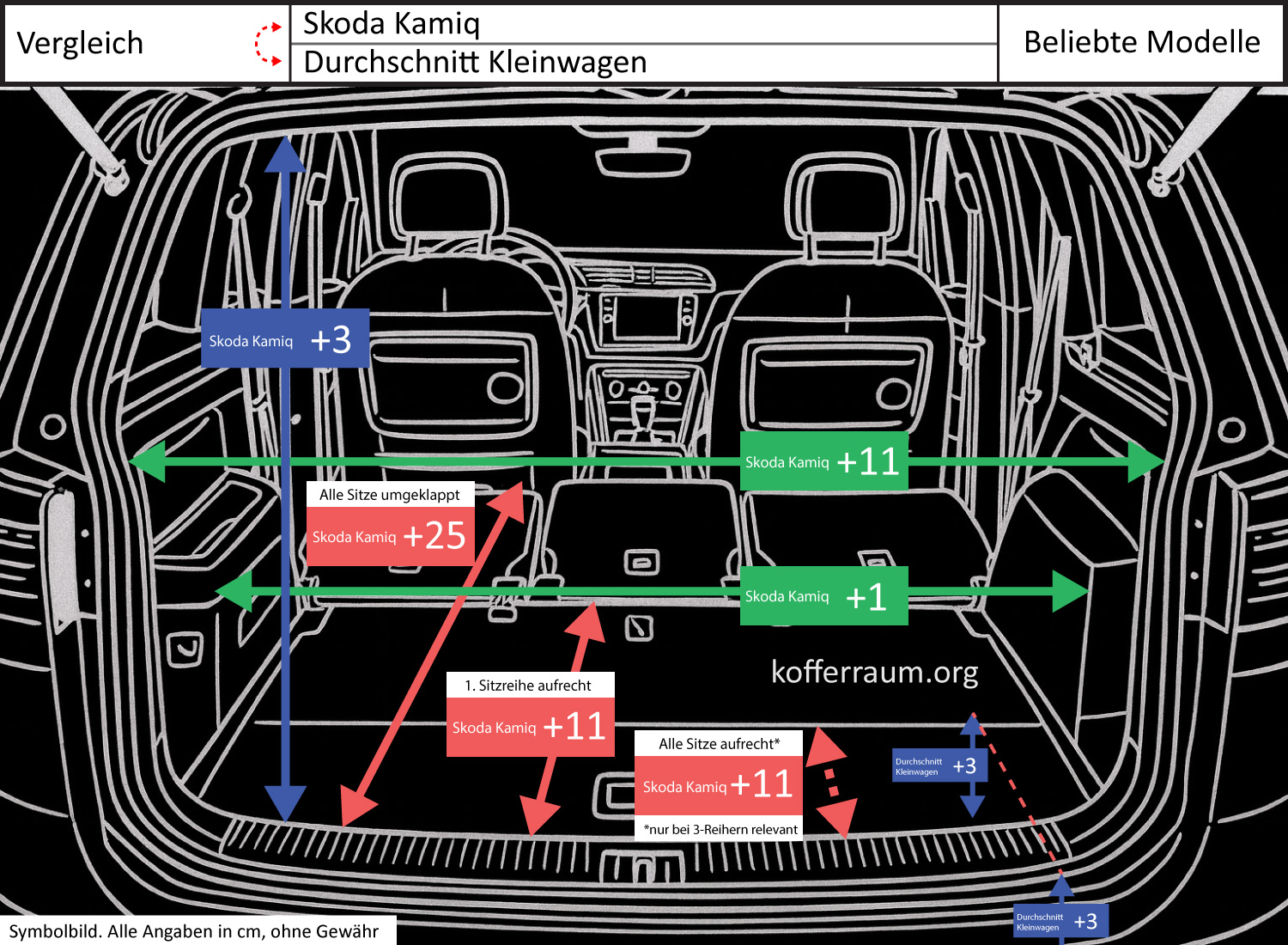
The Skoda Kamiq offers a significantly longer cargo space with the seats folded down: +9.8 in (+20%) compared to the average subcompact. Even with the rear seat upright, the Kamiq is longer: +4.3 in (+17%). The width of the trunk opening is also noticeably larger on the Kamiq: +4.3 in (+12%).
In contrast, the loading depth (distance from loading edge to trunk floor) is 1.2 in (+19%) greater on the average subcompact than on the Kamiq (meaning the Kamiq's trunk is shallower).
Smaller differences include a 1.2 in (4%) higher trunk opening and a 1.2 in (4%) higher loading edge on the average, as well as only a +0.4 in (1%) narrower narrowest point on the Kamiq — these values are below the 10% threshold and thus less relevant.
Impact on Usability
The longer loading floor of the Kamiq (both with folded seats and with the rear seat upright) makes it significantly more practical for long items such as slats, long boxes, or skis, as well as for larger luggage when the rear seats are folded down.
The wider trunk opening facilitates loading and unloading bulky or wide-format objects (strollers, wide suitcases, furniture parts) and reduces the risk of hitting the edges when lifting items in.
The shallower depth of the Kamiq's trunk means less usable height from the floor to the loading edge; this limits the safe stacking of tall items and can reduce capacity for bulky but tall cargo.
Practically, this means: the Kamiq is better suited for long and wide loads, while a typical subcompact has an advantage for very tall or highly stackable cargo.
The smaller differences (trunk opening height, loading edge height, narrowest width) are hardly noticeable in everyday use.
Overall, the Kamiq is more advantageous in daily life when long or wide goods are regularly transported; those who more often need tall or highly stackable cargo benefit more from the somewhat deeper trunk typical of subcompacts.