
Trunk comparison: Skoda Karoq vs VW Taigo

Summary of the Biggest Differences
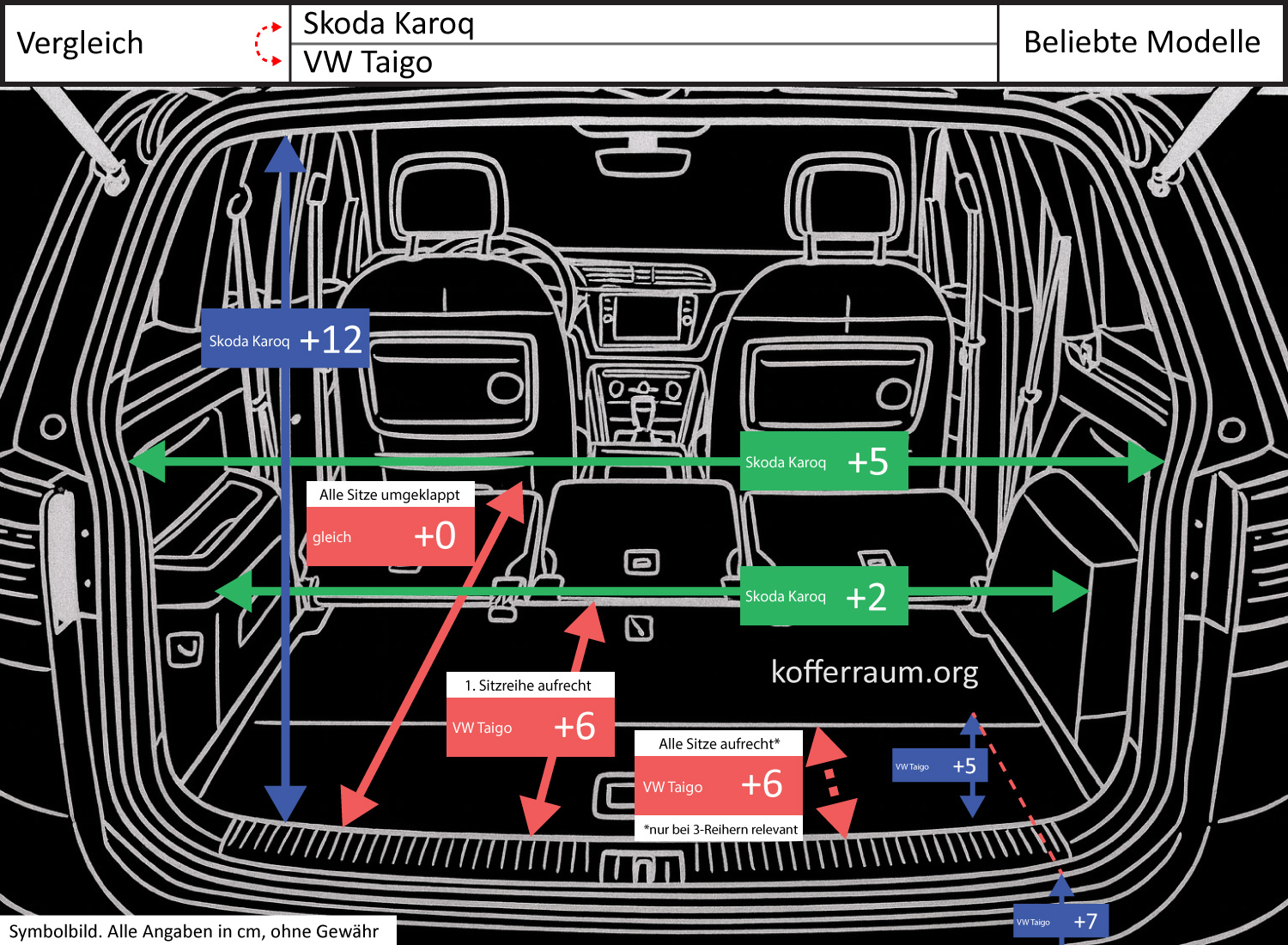
The most noticeable differences concern the vertical space distribution: the height of the Škoda Karoq's trunk opening is 4.7 in (15%) larger, and the depth of the trunk in the Volkswagen Taigo (measured from the loading edge to the trunk floor) is 2 in (33%) larger.
When all seats are folded down, the loading length of both models is the same; with the rear seat upright, the Taigo is 2.4 in (8%) longer.
Other smaller differences: the Taigo's loading edge is 2.8 in (10%) higher above the ground, the narrowest width is 0.8 in (2%) larger in the Karoq, and the opening width is 2 in (5%) larger in the Karoq.
Impact on Usability
The higher opening clearance of the Karoq makes it easier to slide in and stand tall or bulky items: those who often transport furniture, plants, or boxes with greater height benefit from the Karoq.
Together with the slightly larger opening width and the minimally wider narrow point, this makes loading bulky items easier.
The Taigo, on the other hand, offers significantly more depth in the cargo space. This means, with a comparable folded seat surface, more usable volume vertically and easier storage of longer or deeper loads in the floor area.
However, this is offset by the higher loading edge of the Taigo: the loading edge is 2.8 in higher, which makes lifting heavy items more difficult and handling less comfortable when frequently loading heavy cargo.
Additionally, the trunk opening in the Taigo is lower, so especially tall objects fit less well than in the Karoq.
Practical consequence: For regularly transporting tall or bulky items, the Škoda Karoq is overall more practical.
For more deep or "stacked" cargo or somewhat longer items with the rear seat upright, the Volkswagen Taigo offers advantages – but at the cost of a higher loading edge effort and somewhat lower opening height.