
Trunk comparison: Skoda Octavia Wagon vs Toyota Corolla Wagon


Summary
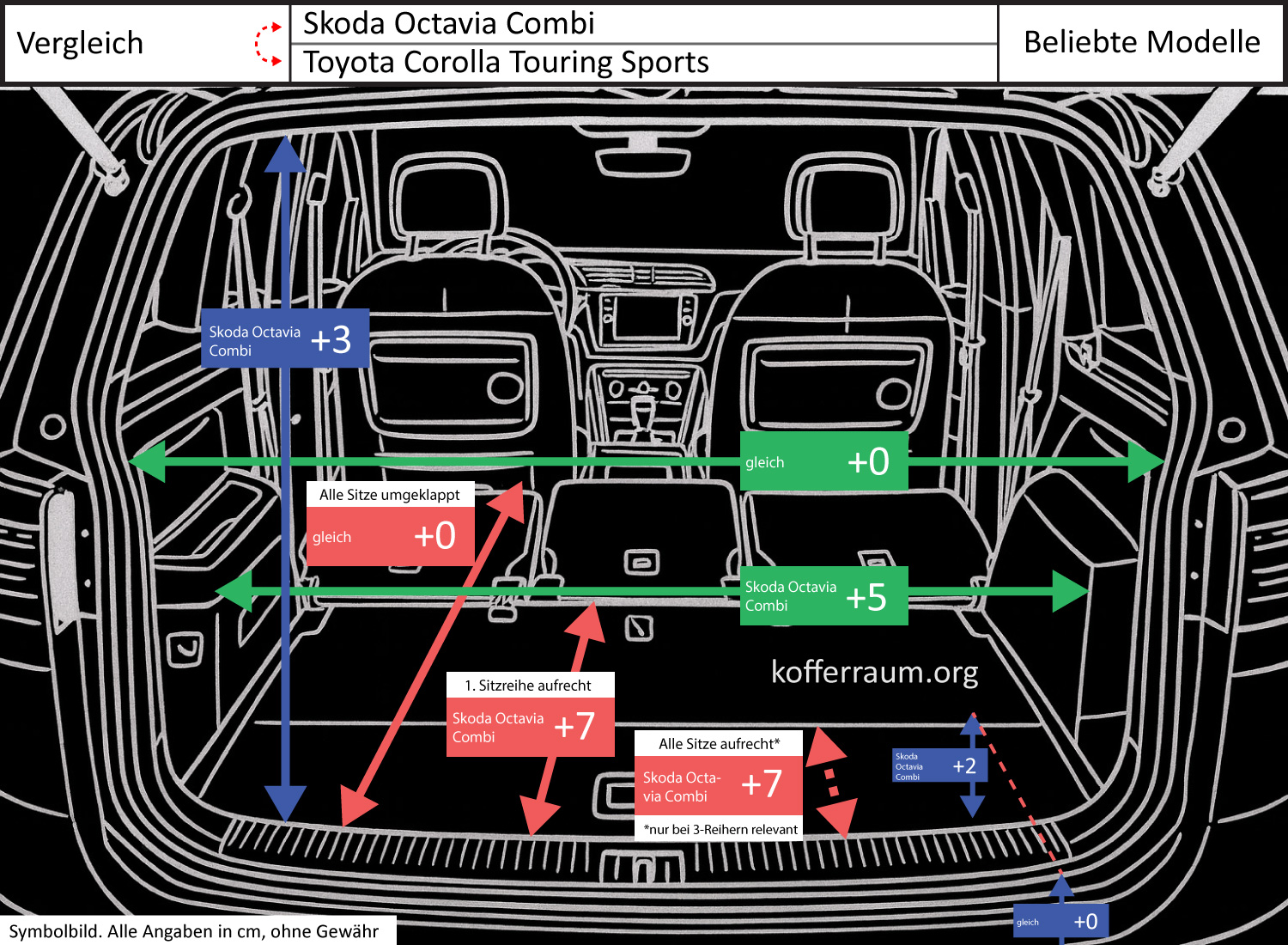
With the rear seats folded down, the trunk lengths of both models are the same size. With the rear seats upright, the Škoda Octavia Wagon has a cargo space that is 7% (+2.8 in) longer than the Toyota Corolla Touring Sports.
Other differences are minor: the trunk opening of the Octavia is +1.2 in (4%) higher, and the narrowest trunk width of the Octavia is +2 in (5%) larger. The loading edge height and the width of the trunk opening are identical.
Most Significant Difference
The depth of the trunk (loading edge to trunk floor) is 0.8 in or 25% greater in the Škoda Octavia Wagon. This difference exceeds 10% and is therefore the most relevant advantage of the Octavia over the Corolla Touring Sports.
Impact on Usability
The greater trunk depth of the Octavia means that items in the cargo area can sit deeper. Practically, this means: with the same loading edge height, more usable volume remains below the loading edge, bulky or higher-stacked items can be stored better, and the load sits more stably overall.
For transporting crates, beverage boxes, or irregularly shaped luggage, the Octavia is noticeably more practical in everyday use.
The 7% longer cargo floor with the rear seats upright makes the Octavia better suited for longer items (e.g., slats, skis, or longer packages) when only the front row of seats is used.
The slightly higher trunk opening (+1.2 in) marginally eases fitting tall cargo when lifting it in, and the somewhat larger narrowest width (+2 in) helps when loading wider items through tight spots.
Because both models are equally long with the seats folded down, their capabilities for large-area transport (e.g., flat furniture parts) in this configuration are similar. The same loading edge height means a similar effort is required when lifting items into the vehicle.
Conclusion
The Škoda Octavia Wagon offers a noticeable everyday advantage in storing taller or irregularly shaped cargo, mainly due to the significantly greater trunk depth. Smaller advantages in length, opening height, and narrowest width support this but remain below the 10% mark and are therefore less decisive.