
Trunk comparison: Tesla Model 3 vs Durchschnitt Subcompact
Key Differences (>10%)
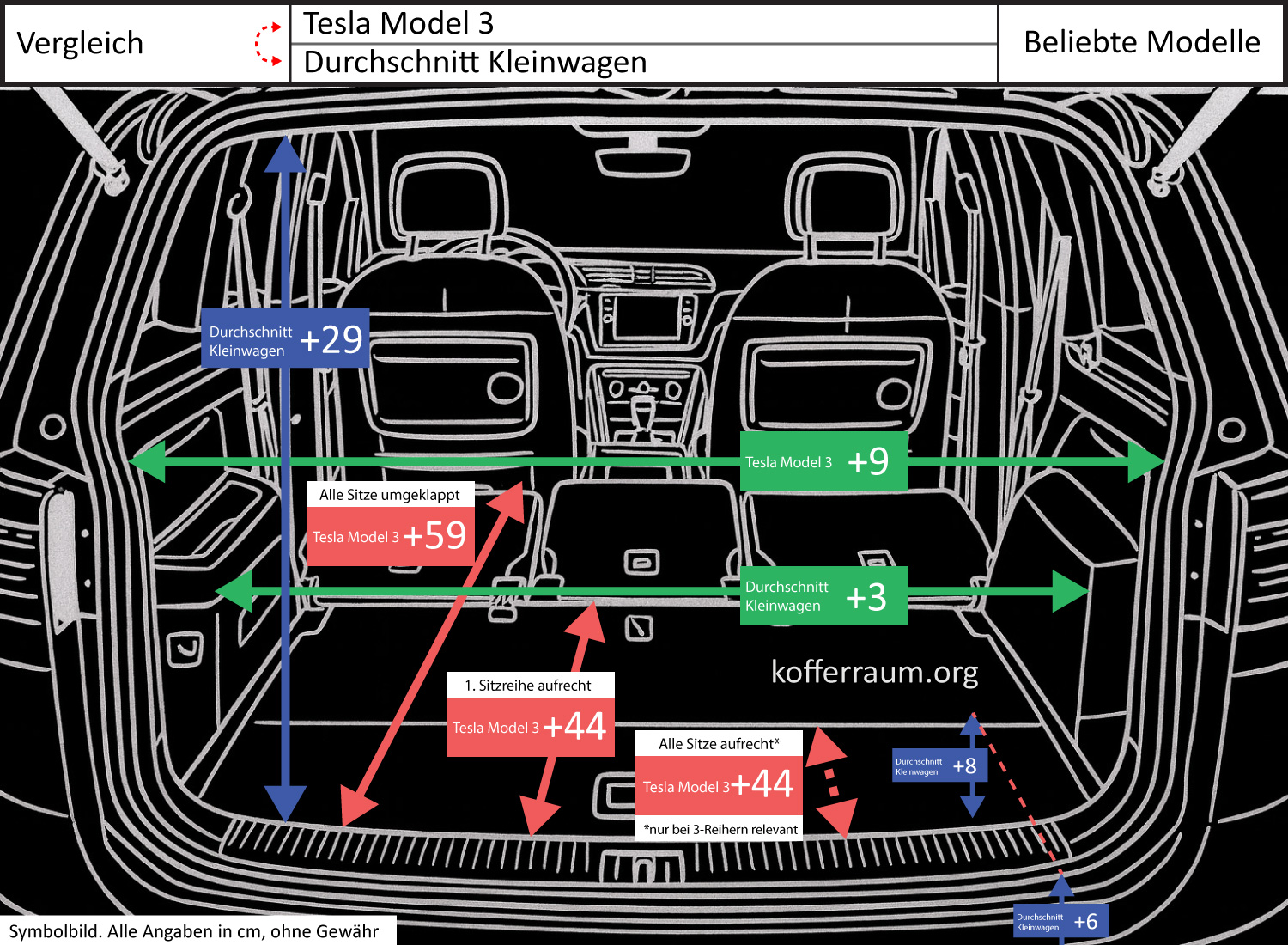
The Tesla Model 3 offers significantly more cargo length: with the seats folded down, the trunk is 23.2 in (46%) longer and with the front seats upright, 17.3 in (70%) longer than the average subcompact.
In contrast, the trunk opening on the average subcompact is 11.4 in (56%) higher than on the Model 3, and the depth (measured from loading edge → trunk floor) is 3.1 in (73%) greater on the subcompact.
Impact on Usability
More cargo length in the Model 3 means: long, flat items (e.g., slatted bed bases, long furniture parts, skis without much inclination) can be transported more easily and often without disassembly. Loading longer cargo over the folded rear seats is also more comfortable.
The higher trunk opening and greater depth in the average subcompact have a positive effect for tall or bulky items: bulky boxes, crates, or furniture pieces that need to be loaded upright fit more easily through the higher opening and stand more stably because more depth/volume is available.
This makes loading and unloading large, tall items more practical.
Small differences that are less relevant: The loading edge of the subcompact is only slightly higher (+2.4 in / 9%) than on the Model 3, and the narrowest width is minimally larger (+1.2 in / 3%) on the subcompact.
The Tesla Model 3 also has a slightly wider trunk opening (+3.5 in / 10%), which can make it easier to load wide items at the entrance (but this value does not exceed the 10% threshold).
Conclusion: For regular transport of long, flat loads, the Tesla Model 3 is more practical. Those who often need to load tall or bulky items upright are better served by an average subcompact.