
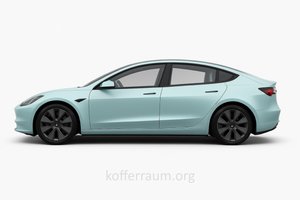
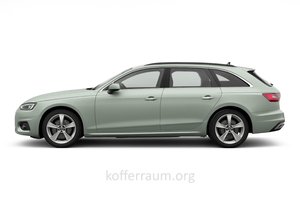
Trunk comparison: Tesla Model 3 vs Durchschnitt Wagon
Key Differences
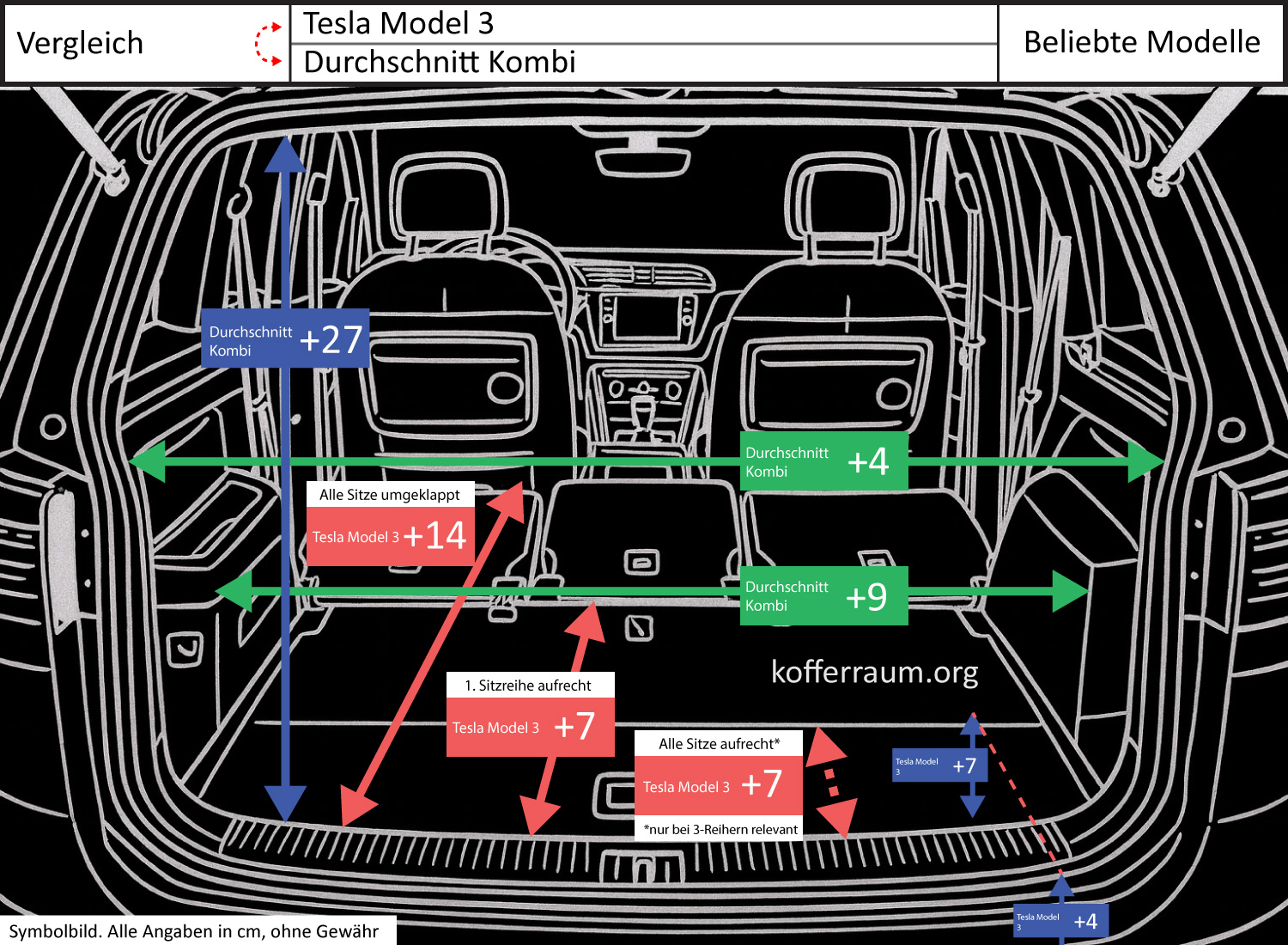
In summary, the biggest deviations are: The Tesla Model 3 offers a slightly longer total cargo length with folded seats (+5.5 in / 8%) and with the first row upright (+2.8 in / 7%).
However, significant differences exist in the trunk opening and the depth of the cargo space: the trunk opening of the average wagon is 10.6 in (52%) higher than that of the Tesla Model 3, while the depth of the trunk (loading edge to floor) in the Tesla Model 3 is 2.8 in or 175% greater.
Other smaller deviations: the loading edge of the Tesla is 1.6 in (6%) higher above the road, the narrowest loading width of the wagon is about 3.5 in (9%) larger, and the opening width of the wagon is about 1.6 in (4%) larger.
Impact on Usability
Higher trunk opening in the wagon (+52%) makes loading tall or bulky items significantly easier (e.g., large boxes, furniture parts, upright bicycles). Those who regularly transport tall or bulky cargo clearly benefit from a wagon: fewer tipping, lifting, and placement issues when passing through the opening.
Deeper cargo well in the Tesla (+175%) means the Model 3 has a significantly deeper cargo cross-section. This creates more usable volume vertically below the loading edge and is better suited for longer, flat-lying items or discreet storage of smaller parts.
Disadvantage: items lie deeper, lifting heavy loads requires more effort, and tall items often do not fit through the lower opening.
The slightly higher loading edge of the Tesla (+1.6 in) makes lifting heavy loads slightly more difficult compared to the wagon. The smaller width advantages of the Model 3 (narrower bottleneck and opening) slightly limit loading wide items but are less decisive within the stated values.
Conclusion
For regular transport of tall or wide-format cargo, the classic wagon is better suited due to the significantly higher opening and larger width.
For longer, flat-lying, or voluminous cargo that can be placed low, the Tesla Model 3 plays to its strengths with greater depth and longer loading surface. For everyday use (shopping, luggage), both variants are practical, each with specific strengths depending on the type of cargo.