
Trunk comparison: Tesla Model 3 vs Volvo V90
Key Differences (highlighted: >10%)
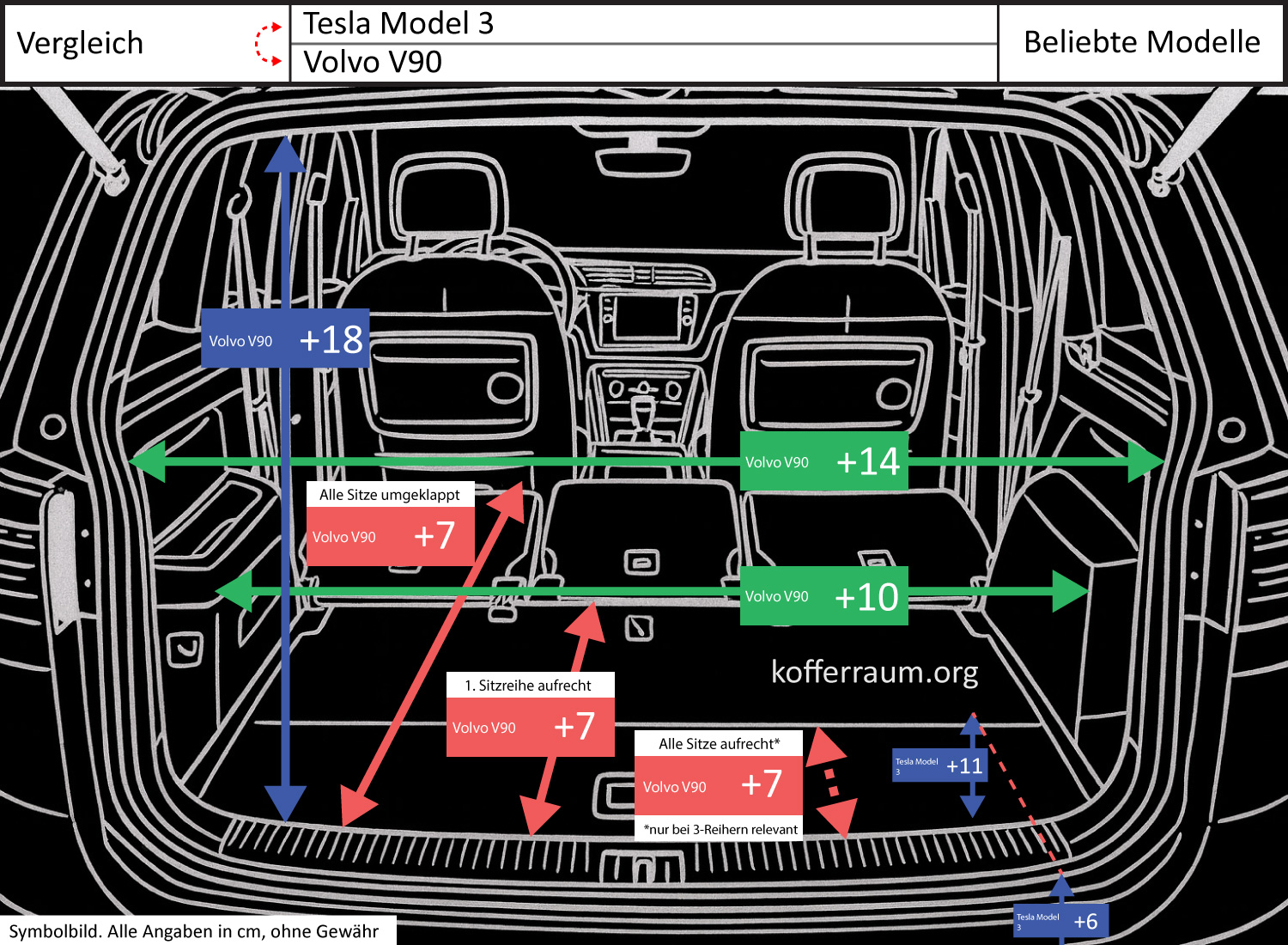
Two clear advantages of the Volvo stand out from the data: The height of the trunk opening is 7.1 in (35%) larger, and the width of the trunk opening is 5.5 in (14%) wider than in the Tesla Model 3. Additionally, the usable width at the narrowest point of the trunk in the Volvo is 3.9 in (11%) larger.
The Tesla shows a significantly greater depth of the cargo area: the distance from the loading edge to the trunk floor is 4.3 in (1000%) larger than in the Volvo.
Implications for Usability
Volvo V90 – better for wide and tall cargo: The larger opening height and width as well as the greater narrowest width make loading bulky, wider, or taller items significantly easier.
Large boxes, furniture parts, or wide objects are more likely to fit through the opening, and the higher opening dimension reduces the risk of hitting the threshold.
The slightly longer dimensions with folded or upright seats (each +2.8 in) additionally support loading longer items but have less impact than the larger differences mentioned above.
Tesla Model 3 – stronger "depth" advantage but limited accessibility: The significantly greater depth from the loading edge to the trunk floor means more vertical space below the loading edge – this can be advantageous when stacking flat luggage or hiding cargo in the lower compartment.
Practically, however, this also means: the loading edge sits higher above the ground (in the text +2.4 in), and the interior lies deeper, so heavy items must be lifted higher and lowered further. Combined with a narrower opening and lower opening height, this restricts the transport of very wide or tall parts.
Summary: For frequent loading of bulky, tall, or wide goods, the Volvo V90 is better suited (larger opening and width).
The Model 3 offers more interior depth, which provides space advantages for flat stackable cargo but requires more lifting effort when loading and is limited by the smaller opening and lower opening height for bulky items.