
Trunk comparison: Tesla Model 3 vs VW ID.3
Key Differences (Highlight: >10%)
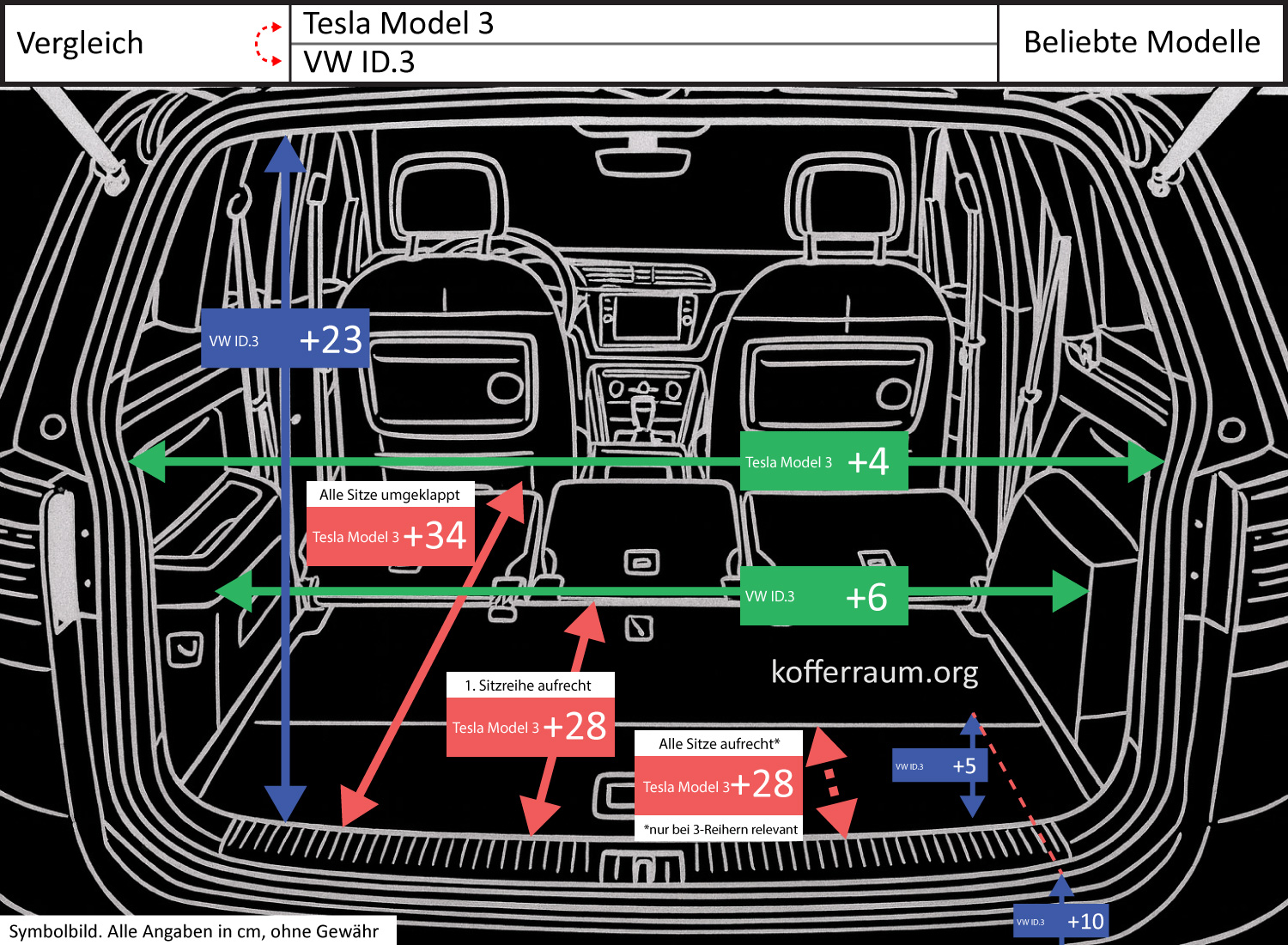
Clear focuses emerge in usable cargo volume and dimensions: The Tesla Model 3 offers a longer cargo floor, especially when seats are folded down — +13.4 in (22%) longer with folded seats and +11 in (35%) more length with the first row upright compared to the VW ID.3. The VW ID.3, on the other hand, scores with more vertical space and a different trunk geometry: the opening height is +9.1 in (44%) higher, the depth from the loading edge sill to the trunk floor is +2 in (45%) greater, and the loading edge stands overall +3.9 in (15%) higher above the road than on the Tesla.
Smaller differences such as the 6% wider narrow point in the ID.3 or the 4% larger opening width on the Tesla remain under 10% and are therefore less relevant.
Impact on Usability
The longer cargo floor of the Tesla Model 3 makes it more practical for long items (e.g., skis, slats, long furniture parts) and for applications where the rear seats are folded down more often.
With the seat row upright, the Model 3 gains significantly in usable depth (+11 in / 35%), which facilitates transporting bulky or elongated items without folding seats.
The higher and deeper cargo space of the VW ID.3 offers advantages for vertically larger cargo (e.g., tall boxes, plants, stacked suitcases). The increased opening height (+9.1 in / 44%) and greater interior height/depth utilization (+2 in / 45%) make loading tall or bulky objects easier.
However, the higher loading edge (+3.9 in / 15% above the road) also means more lifting effort when placing heavy loads inside and can make loading more strenuous for a single person.
In summary: For elongated loads and flexible seat folding, the Tesla Model 3 is more practical. For bulky, tall, or stackable cargo, the VW ID.3 has the advantage.
Smaller width differences hardly matter in everyday use; the decisive usability influences come from length (Tesla) versus height/depth and loading edge height (ID.3).