
Trunk comparison: Tesla Model 3 vs VW ID.4
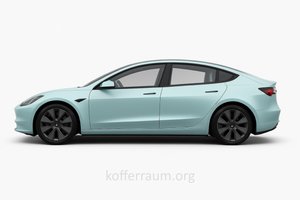
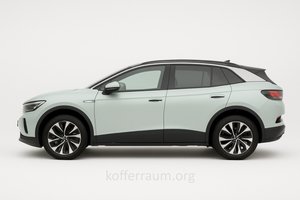
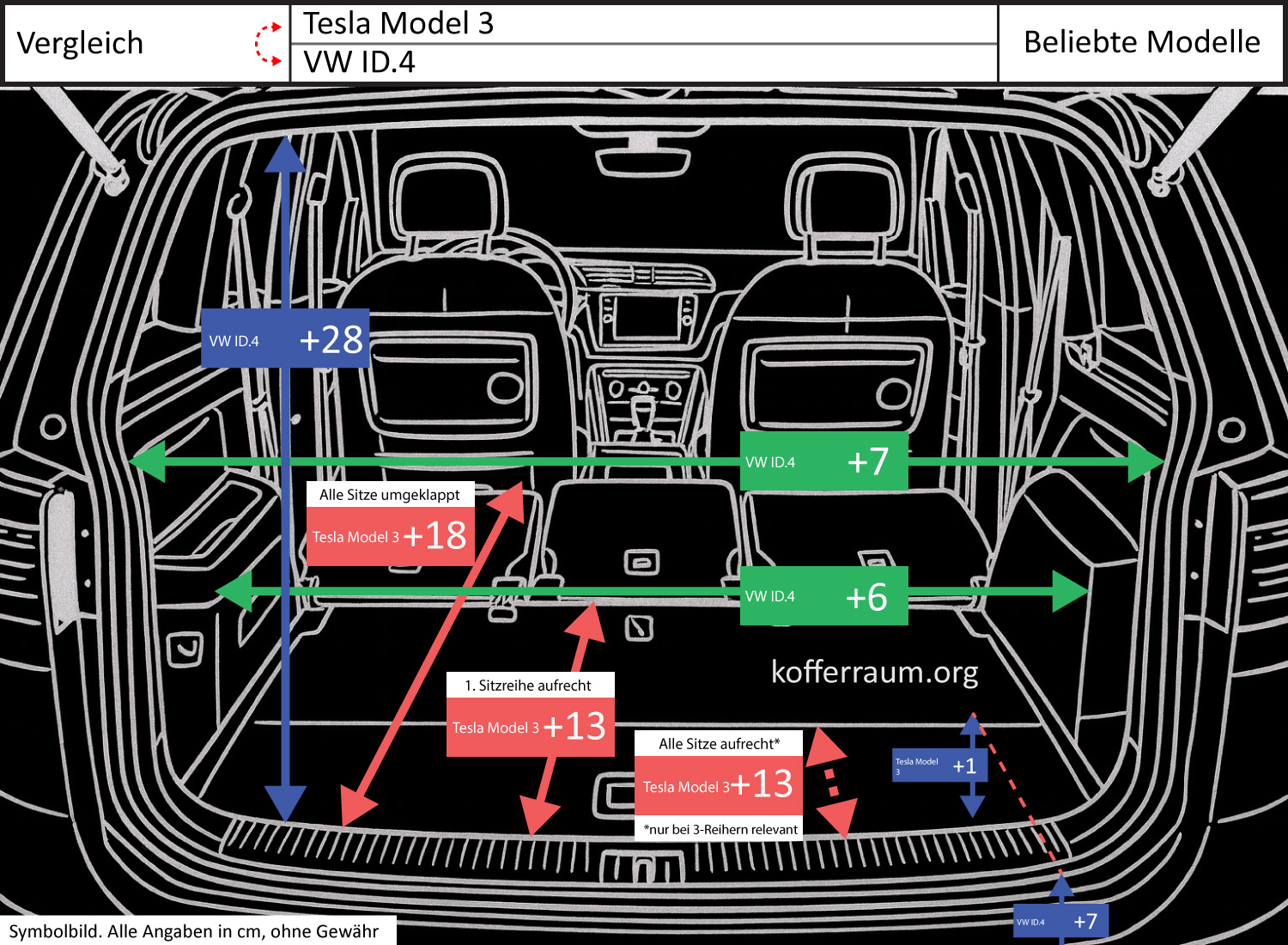
Key Differences (highlighted: >10%)
The Tesla Model 3 offers a 7.1 in (11%) longer cargo floor length with the seats folded down and a 5.1 in (14%) longer cargo floor length with the first row upright compared to the VW ID.4. Conversely, the VW ID.4 has a 11 in (54%) taller trunk opening than the Model 3. Other smaller differences: the depth from the loading edge sill to the trunk floor is slightly greater in the Model 3 (+0.4 in / 10%), the loading edge of the ID.4 sits somewhat higher (+2.8 in / 10%), and the ID.4 is a few centimeters wider at the narrowest point as well as in opening width (+2.4 in / 6% and +2.8 in / 7%, respectively).
Implications for Usability
Because the Model 3 offers longer interior dimensions (both with folded seats and with the first row upright), it is better suited for long items such as slatted bed bases, boards, skis, or flat furniture. The additional length makes it easier to store bulky, long cargo without complicated angling or fitting.
The significantly taller trunk opening of the ID.4 pays off especially with tall or bulky items: boxes, tall camping or gardening equipment, or larger plants can be loaded and unloaded more easily because more vertical space is available.
However, the higher loading edge of the ID.4 (about +2.8 in) also means that heavy items must be lifted higher – which can make loading more difficult for a single person.
The smaller differences (slightly greater depth in the Model 3; moderate extra width and larger opening width in the ID.4) mean: wide items fit somewhat easier through the opening in the ID.4 and are less constricted inside at the narrowest point, while the Model 3 offers minimally more usable depth behind the loading edge.
Overall: for elongated cargo, the Model 3 is more practical; for taller or bulkier cargo and easier front access, the ID.4 scores points, albeit at the cost of a higher lift height. The decision thus depends on typical transport tasks (long vs. tall/bulky).