Trunk comparison: Volvo V90 vs Durchschnitt SUV

Key Differences
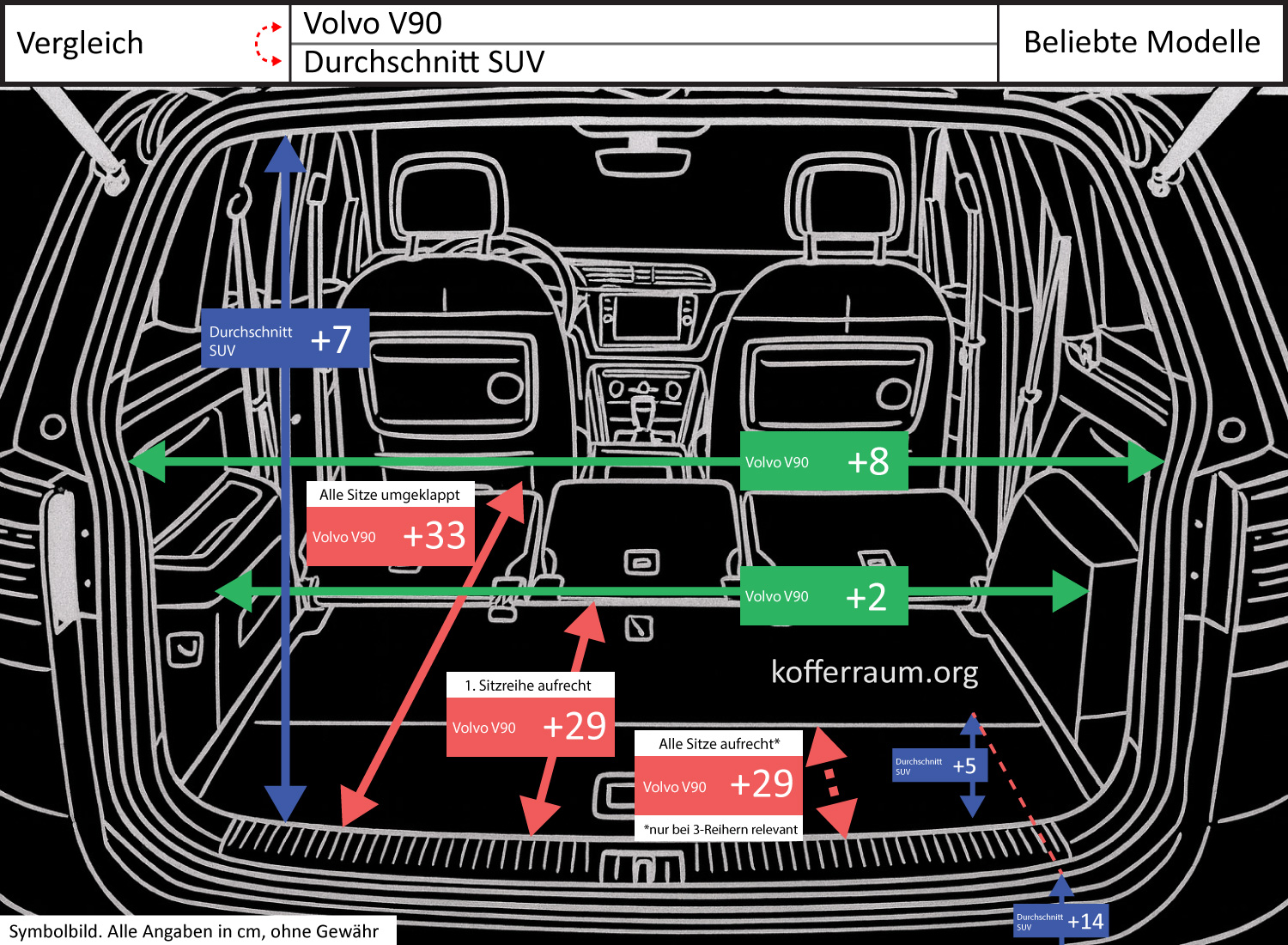
The Volvo V90 offers a significantly longer loading length: with the seats folded down, the trunk is 13 in (≈20%) longer, and with the first row of seats upright, even 11.4 in (≈34%) longer than the average SUV.
The loading edge of the average SUV is 5.5 in (≈23%) higher above the road than that of the V90. Additionally, the depth of the trunk (loading edge to trunk floor) in the average SUV is 2 in (≈400%) greater than in the V90.
Impact on Usability
Length advantage of the V90: The significantly longer loading length makes the V90 more practical for long items (e.g., slats, skis, furniture parts) and for transport with folded seats. Those who frequently transport long, flat loads benefit from the greater extendability of the cargo floor.
Lower loading edge in the V90: The 5.5 in lower loading edge makes loading and unloading heavy or bulky items easier because less lifting is required. Combined with the longer loading surface, this provides an ergonomic advantage for regular transport of heavy loads.
Deeper cargo well in the SUV: The greater depth in the SUV means that cargo sits deeper in the vehicle — this can be advantageous when items need to lie stably or for volume packed deeper.
However, combined with the higher loading edge, this also means heavy lifting over a higher edge into a deeper cargo space — less comfortable than in the V90.
Vertical limitation and opening: Although the height of the trunk opening (+2.8 in in the SUV) and the width differences (V90 opening +3.1 in, minimum width +0.8 in) are below the 10% threshold, they influence everyday usability: The SUV is somewhat better suited for very tall items, while the V90, with its wider opening and longer loading surface, is better for wide/long cargo.
Conclusion: For long or heavy cargo and frequent lifting, the Volvo V90 is more practical due to the longer loading surface and lower loading edge.
The average SUV offers advantages in vertical accommodation (higher opening, deeper cargo well) and is better suited for very tall or bulky cargo but has ergonomic disadvantages when lifting heavy loads.