
Trunk comparison: Volvo V90 vs Volvo XC60


Key Differences and Impact on Usability
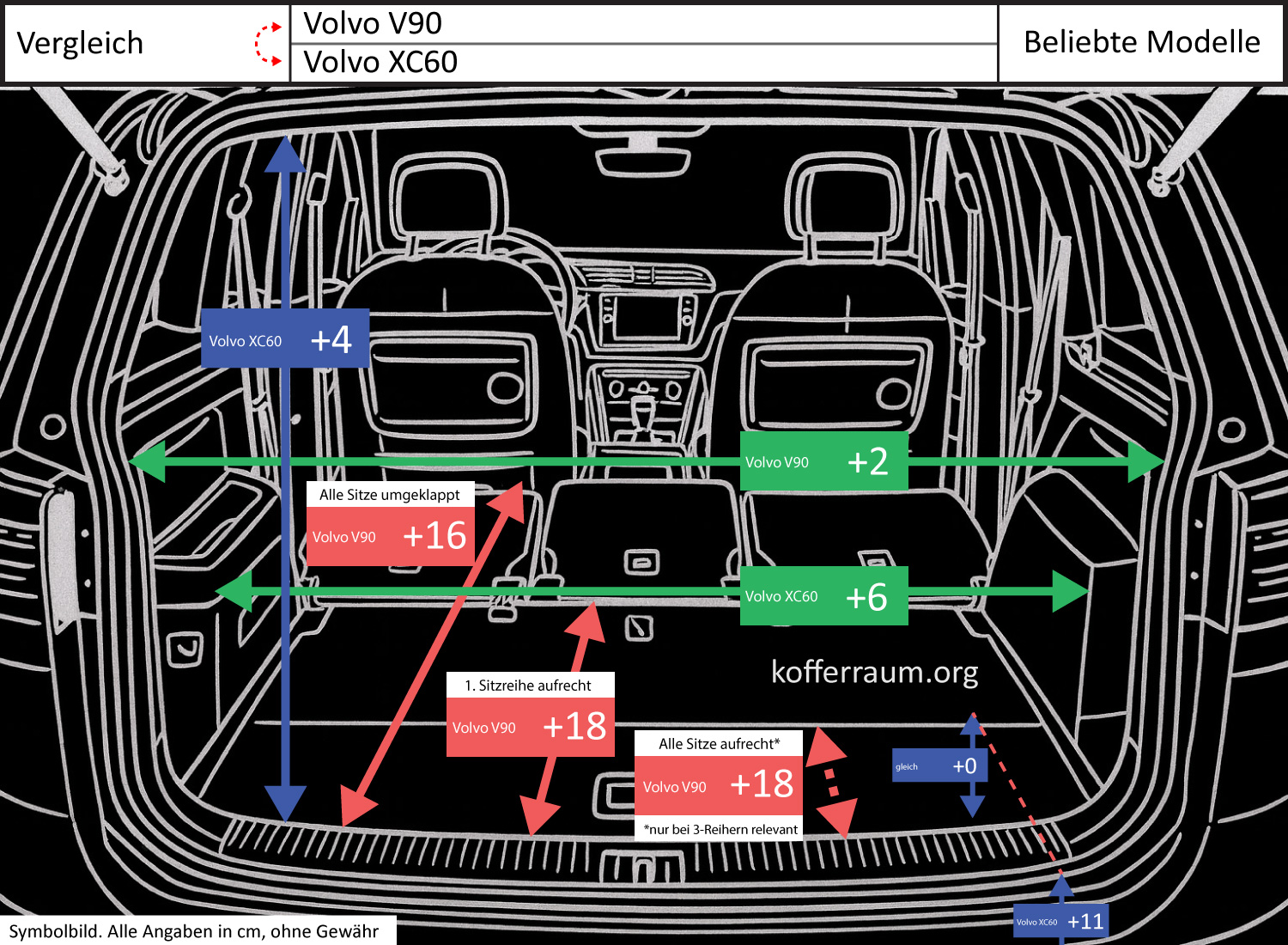
The Volvo V90 offers a slightly longer loading length with the seats folded down (+6.3 in / 9%), but the difference becomes much more noticeable when the rear seat remains upright: the V90 has a loading surface that is +7.1 in (19%) longer than the XC60. The depth of the trunk (loading edge to floor) is the same in both models.
The loading edge of the XC60 is +4.3 in (18%) higher above the road than that of the V90, making it more strenuous to lift heavy or bulky items when loading. At the same time, the height of the trunk opening in the XC60 is +1.6 in (6%) larger, allowing taller items to pass through the opening more easily.
The models differ only slightly in width: the XC60 is +2.4 in (6%) wider at the narrowest point in the trunk, while the trunk opening of the V90 is +0.8 in (2%) wider. These width differences are moderate and only relevant for very wide loads.
Practical implications: For long items (e.g., skis, long boards, furniture edges), the V90 is clearly advantageous in everyday use, especially when the rear seat is used — the nearly 20% greater length significantly increases flexibility.
For frequently lifting heavy packages or bulky loads, the lower loading edge of the V90 is much more comfortable; the higher loading edge of the XC60 noticeably complicates loading.
When it comes to getting tall items through the opening, the XC60 has a slight advantage due to the somewhat larger opening height, and its slightly greater interior width at the narrowest point helps with wider cargo.
Overall, the V90 is the better choice for longer and heavier loads, while the XC60 scores points with somewhat more interior width and marginally larger opening height.