
Trunk comparison: Volvo V90 vs VW Golf Wagon (Mk5)
Key Differences (highlighted when >10%)
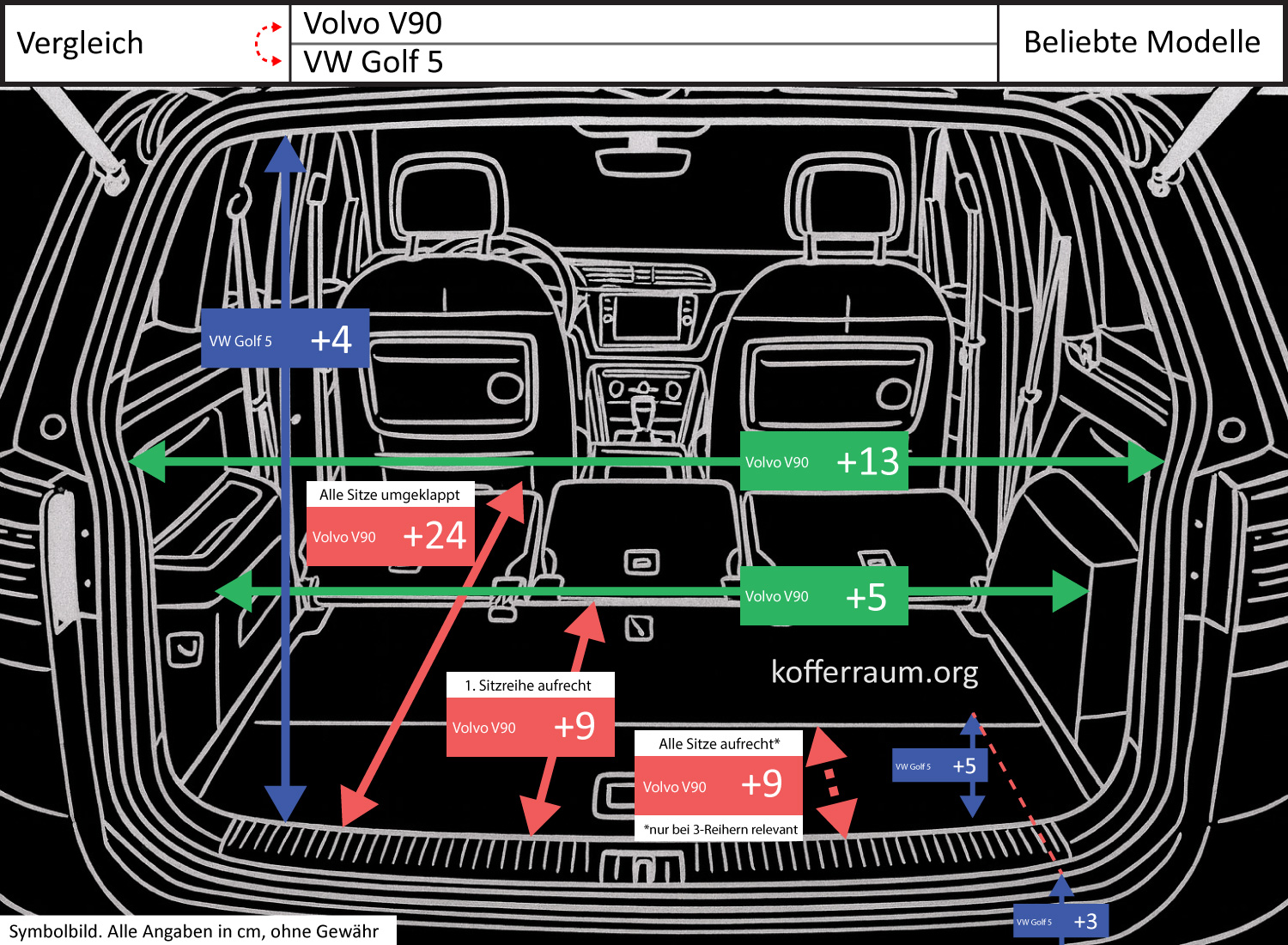
The Volvo V90 offers a 9.4 in (14%) longer cargo space with the seats folded down compared to the VW Golf 5. The width of the trunk opening is 5.1 in (13%) larger on the Volvo. In contrast, the usable depth of the trunk (loading edge to trunk floor) is 2 in (400%) greater on the Golf than on the Volvo.
Implications for Usability
The greater length with folded seats and the wider opening on the Volvo V90 clearly make it better suited for long or wide items (e.g., slats, skis, boards, wide furniture parts). The wider opening makes it easier to position and rotate bulky cargo; the longer cargo space allows longer loads to be fully accommodated.
The significantly greater depth in the VW Golf 5 means that the interior below the loading edge is more recessed (deeper "trunk well").
This can provide more usable volume for smaller or less delicate items and hold items more securely against shifting, but it complicates sliding in long, flat parts and makes lifting heavy cargo somewhat more cumbersome.
Combined with the slightly higher loading edge of the Golf (minor difference), handling heavy items is a bit more strenuous than in the Volvo.
Other, smaller differences: The Volvo has about 3.5 in more length (≈9%) with the first row of seats upright and about 2 in more width at the narrowest point, offering additional room for everyday practicality and flexible loading.
The higher trunk opening of the Golf (+1.6 in) slightly eases sliding through very tall items but is overall a minor effect.
Practical Conclusion
For transporting long or wide items, the Volvo V90 is the more practical choice (longer cargo space, wider opening). The VW Golf 5 offers a deeper cargo area due to its significantly greater depth, which can be advantageous for stacked or lower-lying loads but complicates handling heavy or very flat items.