
Trunk comparison: Volvo XC40 vs Durchschnitt Compact SUV


Key Differences
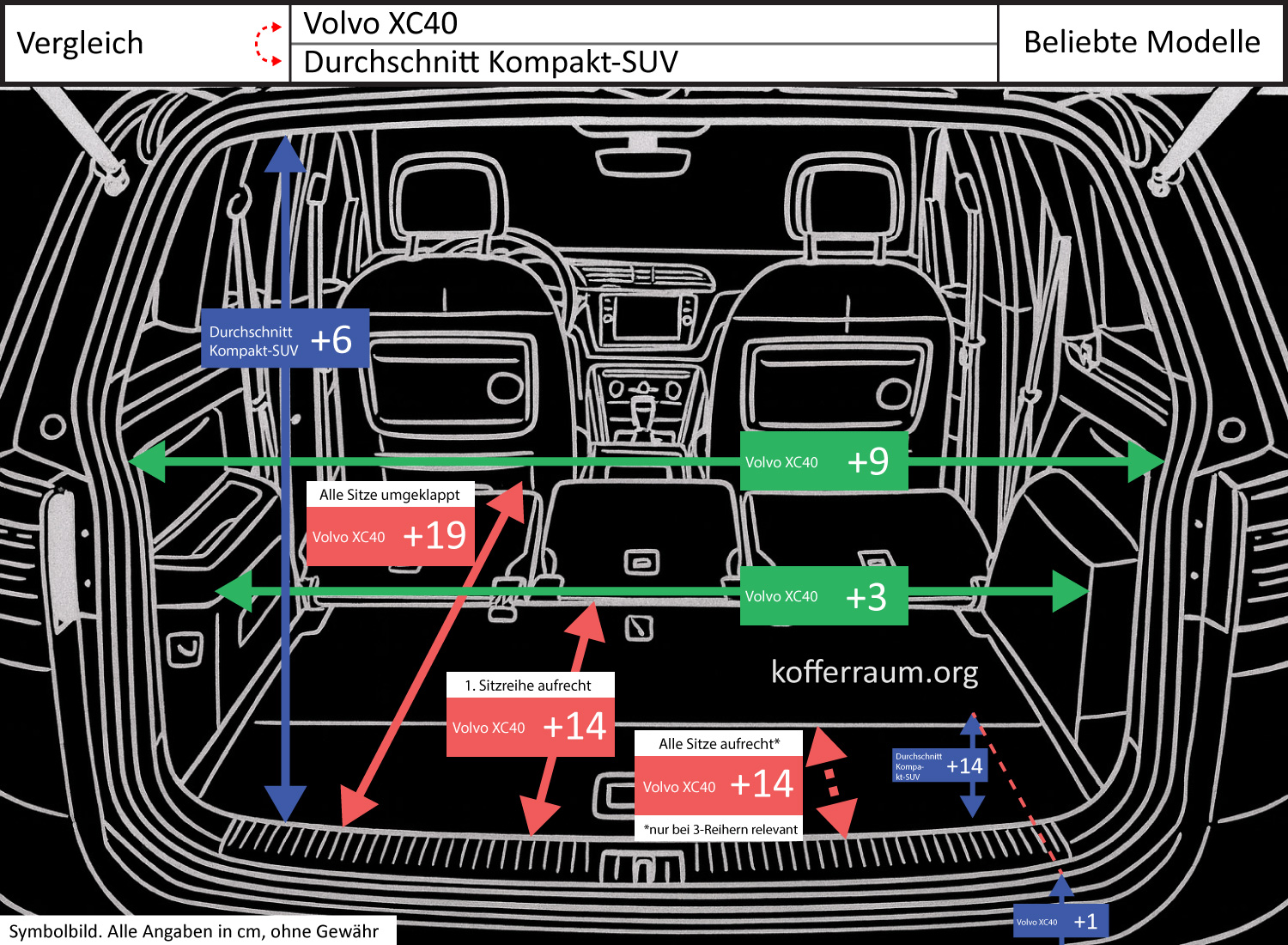
The Volvo XC40 offers a longer loading length in the trunk: with the seats folded down it is 7.5 in (+13%) longer and with the first row upright it is 5.5 in (+18%) longer than the average compact SUV.
In contrast, the trunk depth (measured from the loading edge to the trunk floor) is significantly greater in the average SUV: it is 5.5 in (+1300%) above the Volvo XC40's value.
Concrete Effects on Usability
More loading length in the Volvo XC40 means specifically: longer items (e.g., slats, skis, long boxes) can be transported more easily, both when the rear seat is folded down and in many cases with the seat row upright. For users who frequently load long, flat, or bulky items, this is a clear advantage.
The significantly greater depth in the average SUV means: the trunk floor lies further below the loading edge. This has two effects: first, more volume "deep in the trunk" for bulky or large-volume items; second, better possibility to store luggage below the loading edge without it protruding.
In the Volvo, the lower depth can limit usable volume for tall or bulky loads and items may more easily protrude over the loading edge.
Smaller differences (below the 10% threshold) exist in trunk opening height (on average +2.4 in higher in competitors), in the width of the opening (+3.5 in in favor of the Volvo), and in the narrowest trunk width (+1.2 in in favor of the Volvo).
These have only moderate effects: the Volvo has a somewhat wider opening, which facilitates loading wider items, while the higher opening of the average SUV favors loading very tall items.
Conclusion
The Volvo XC40 scores mainly due to the greater loading length — a clear advantage for long, flat loads. The average SUV offers more usable volume through greater depth and better options to store cargo below the loading edge.
The choice therefore depends on whether you more often transport long items (XC40) or bulky/tall cargo (average SUV).