
Trunk comparison: Volvo XC40 vs VW T-Cross

Key Differences
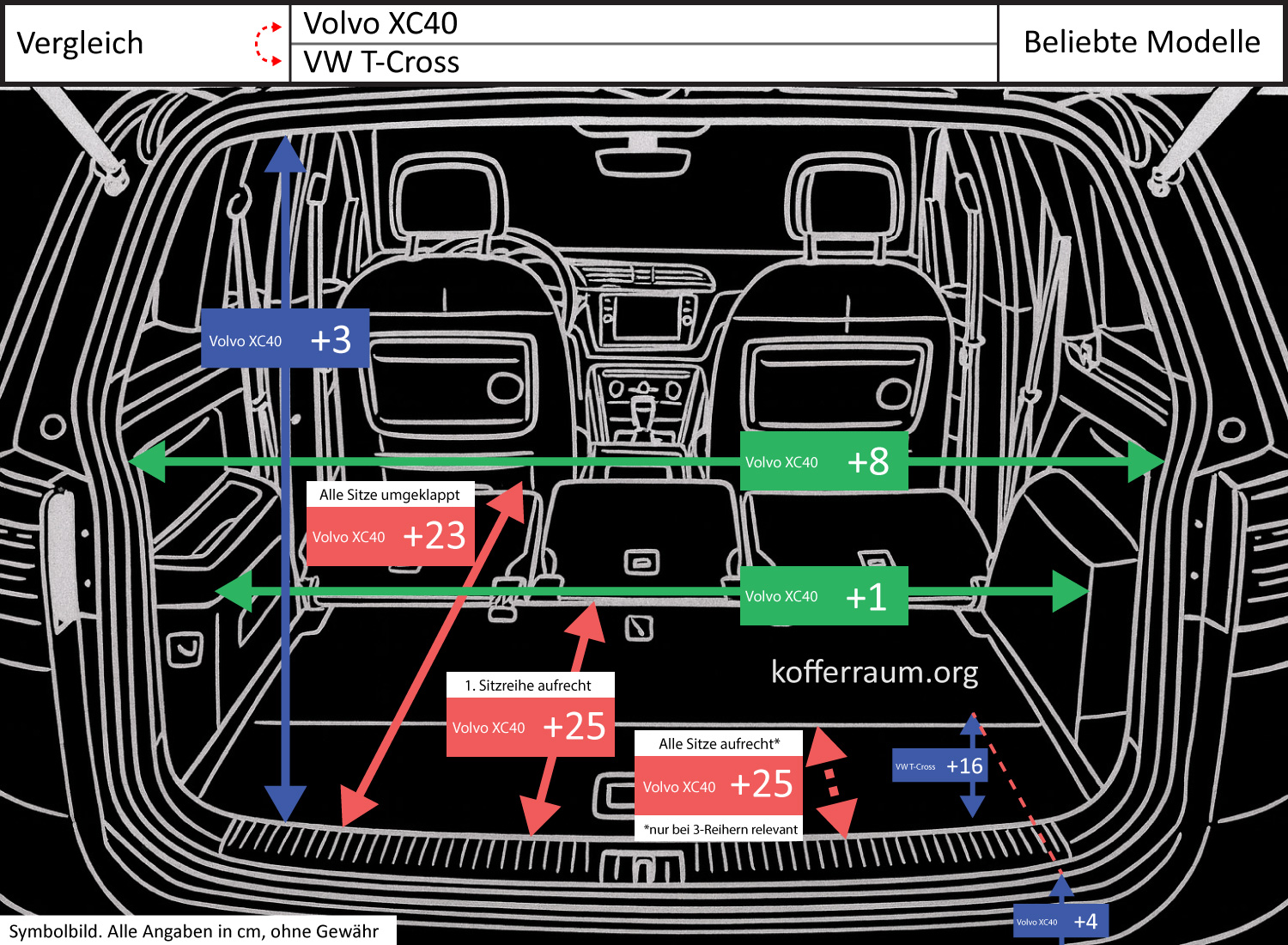
The clearest differences concern the cargo length and trunk depth. With the seats folded down, the trunk of the Volvo XC40 is 9.1 in (16%) longer than that of the VW T-Cross. With the front seats upright, the Volvo is even 9.8 in (38%) longer.
In contrast, the depth (loading edge to trunk floor) is 6.3 in (1500%) greater in the VW T-Cross, meaning it is significantly deeper than the Volvo.
Smaller differences: The trunk opening of the Volvo is 1.2 in (4%) higher, and the loading edge of the Volvo is 1.6 in (6%) higher above the ground. The narrowest trunk width differs by only 0.4 in (1%), and the opening width is 3.1 in (8%) wider on the Volvo compared to the VW.
Impact on Usability
Volvo XC40 — Advantage in length and flexibility: Due to the significantly greater cargo length (both with folded seats and with the front seats upright), the XC40 is better suited for long items (e.g., furniture parts, skis, long boxes) and transport tasks where the full vehicle length must be utilized.
The slightly larger opening width supports loading wider items.
VW T-Cross — Advantage in depth and handling heavy loads: The significantly greater depth of the T-Cross creates a deeper cargo area, which is better suited for stacking tall or bulky items.
Combined with the slightly lower loading edge of the T-Cross (the Volvo is 1.6 in higher), loading heavy or bulky pieces is ergonomically easier. However, the shorter length of the T-Cross limits the transport of very long items.
Conclusion: For longer, flat-lying cargo and maximum usable length, the Volvo XC40 is the better choice.
For tall, bulky, or frequently lifted loads (due to the deeper cargo area and lower loading edge), the VW T-Cross is more practical. Smaller differences in opening height and width exist but have only minor practical effects.