
Trunk comparison: Volvo XC60 vs Durchschnitt Wagon


Main Differences (strongly relevant >10%)
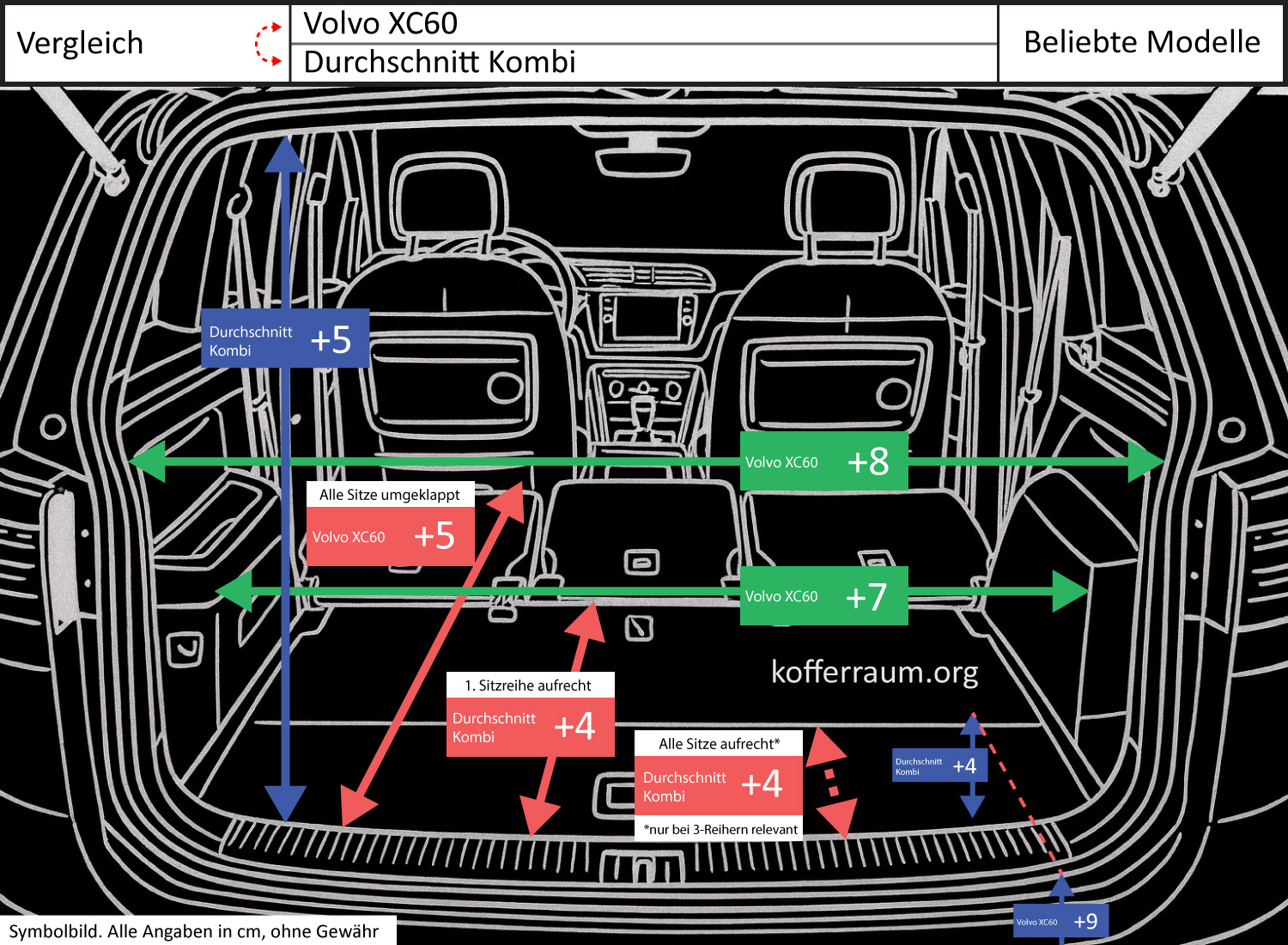
The depth between the loading edge and the trunk floor is significantly greater in the average wagon (+1.6 in, data: +300%). Practically, this means that the wagon offers more space below the loading edge — bulky or taller items can sit deeper without protruding far above the loading edge.
This makes it easier to securely store voluminous cargo, especially when it needs to be pushed far forward.
The loading edge of the Volvo XC60 is noticeably higher above the road (+3.5 in, +14%). This results in more effort being required to lift heavy items over the edge into the trunk.
For users who frequently load heavy or low-floor cargo (e.g., furniture, boxes), this is a disadvantage. Conversely, a higher loading edge can protect when entering and exiting in some situations (e.g., less water ingress on slight ground unevenness), but it is less often an advantage when loading.
Other, smaller differences and usability
With the rear seats folded down, the Volvo XC60 has a slightly longer cargo area (+2 in / 3%), which offers a small advantage when transporting long items. With the front seats upright, the average wagon has a somewhat larger trunk (+1.6 in / 4%), which means a slight increase in usable volume for normal use.
The trunk opening of the average wagon is higher (+2 in / 7%) than that of the XC60; this helps when sliding in tall items but falls below the 10% threshold.
The width at the narrowest point is +2.8 in (7%) greater in the XC60 and the opening width is +3.1 in (8%) wider — both advantageous when loading wide items, though also not in the strongest category.
Practical conclusion
For frequent loading of heavy cargo or frequent lifting, the average wagon is more practical due to the lower loading edge and significantly greater depth.
For loading wider items and for users who benefit from the larger opening width/interior width, the Volvo XC60 is better suited. Smaller length and height differences only marginally affect everyday usability.