
Trunk comparison: Volvo XC60 vs VW T-Roc


Key Differences
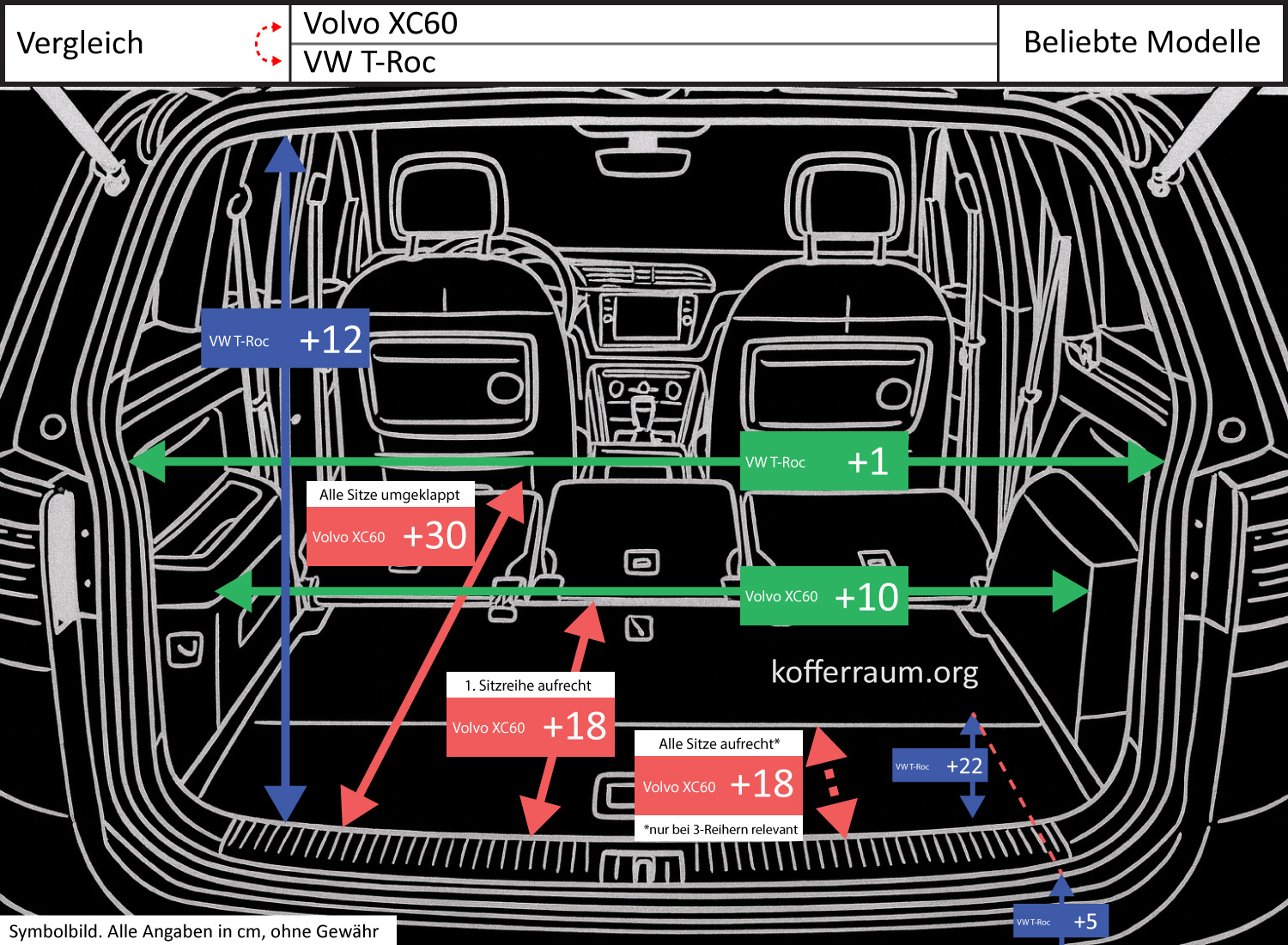
The Volvo XC60 offers significantly more cargo space in length: with the seats folded down, the trunk is +11.8 in (20%) longer, and with the first row of seats upright, it is still +7.1 in (23%) longer than in the VW T-Roc.
The VW T-Roc, on the other hand, has a higher opening: the height of the trunk opening is +4.7 in (16%) larger in the T-Roc.
Additionally, the depth from the loading edge to the trunk floor is +8.7 in (2100%) greater in the T-Roc.
Less relevant are smaller differences: the loading edge of the T-Roc is only slightly higher (+2 in, 7%), the narrowest width is 3.9 in (10%) larger in the XC60, and the width of the opening is only 0.4 in (1%) larger in the T-Roc.
Impact on Usability
Because the XC60 offers significantly longer cargo area lengths, it is better suited for long items (e.g., boards, slats, skis, or furniture parts) and for transports with partially folded seats.
The slightly larger narrow point in the Volvo (3.9 in wider at the narrowest spot) also improves the ability to load bulky or wide items into the vehicle.
The T-Roc scores points for vertical storage: the higher opening makes it easier to slide in tall boxes or bulky crates, and the significantly greater depth from the loading edge to the trunk floor creates more "depth space" for stackable cargo.
However, the higher loading edge (even if only +2 in) combined with the deeper well means that heavy items must be lifted more strongly or lifted over a higher threshold before they can be lowered onto the deeper cargo floor.
In short: those who frequently transport long or wide loads benefit more from the Volvo XC60; those who need more vertical storage space and a larger loading height for tall luggage find the VW T-Roc to be the more practical solution — at the cost of a slightly higher loading edge and a deeper cargo floor when loading heavy items.