
Trunk comparison: VW Caddy Wagon vs Durchschnitt SUV

Key Differences (Brief Summary)
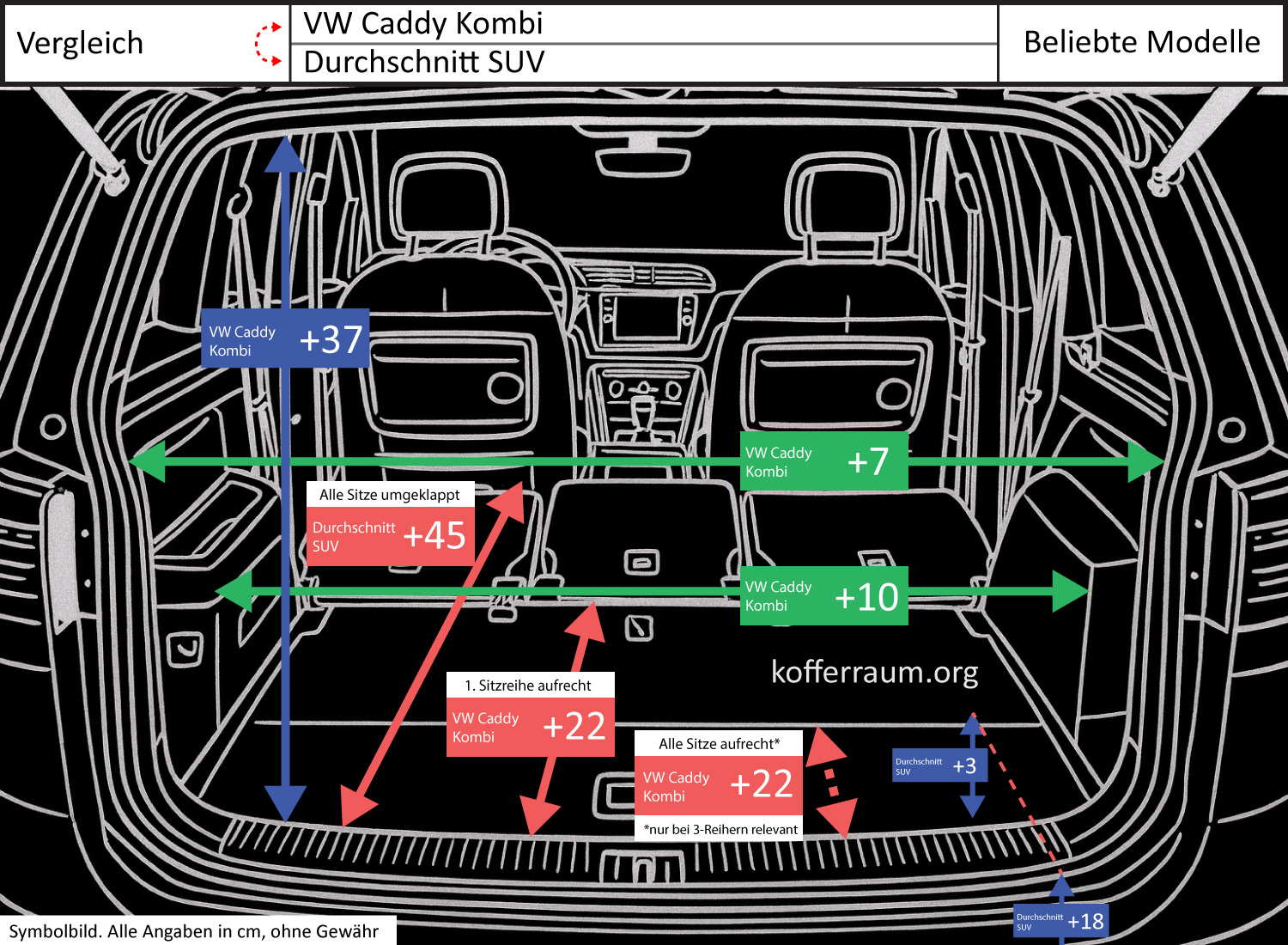
The comparison shows clear differences in cargo space. When all seats are folded down, the average SUV has a 17.7 in (39%) longer trunk than the VW Caddy Wagon.
However, with the front seats upright, the VW Caddy Wagon offers a 8.7 in (26%) longer cargo space. The height of the Caddy's trunk opening is significantly larger than the SUV's at +14.6 in (48%).
The depth of the trunk (loading edge to trunk floor) is +1.2 in (150%) higher in the SUV — this is a large percentage but only 1.2 in in absolute terms.
Additionally, the SUV's loading edge is +7.1 in (32%) higher above the ground. Smaller differences not highlighted: the narrowest width is 3.9 in (10%) larger in the Caddy, and the width of the trunk opening is 2.8 in (7%) larger in the Caddy.
Impact on Usability
For very long items with folded seats, the SUV is the more practical choice: the significantly greater overall length (39% more) makes it easier to transport slats, pipes, or long furniture parts.
However, if passengers are regularly carried and a lot of cargo needs to be transported behind the first row, the Caddy has the advantage because it offers 26% more cargo space with the front row upright.
The Caddy's 48% higher trunk opening greatly facilitates loading tall or bulky items (e.g., boxes, plants, cabinets). The SUV's higher loading edge (+7.1 in / 32%) makes lifting heavy loads into the trunk more strenuous and can complicate loading without assistance; here, the Caddy scores with its lower lift height.
The slightly greater depth of the SUV (only +1.2 in absolute, large percentage) has hardly any noticeable effect on capacity in practice; the effect is rather theoretical because it is a very small absolute value.
The SUV's 3.9 in narrower narrowest point can restrict loading wider items but is less dominant compared to the differences mentioned above.
Conclusion: Choose the SUV for regular transport of very long items with folded seats. Choose the VW Caddy Wagon for frequent combinations of passengers and cargo, frequent loading of tall/bulky items, and when a lower loading edge is preferred.