
Trunk comparison: VW ID.3 vs Durchschnitt Compact SUV
Key Differences
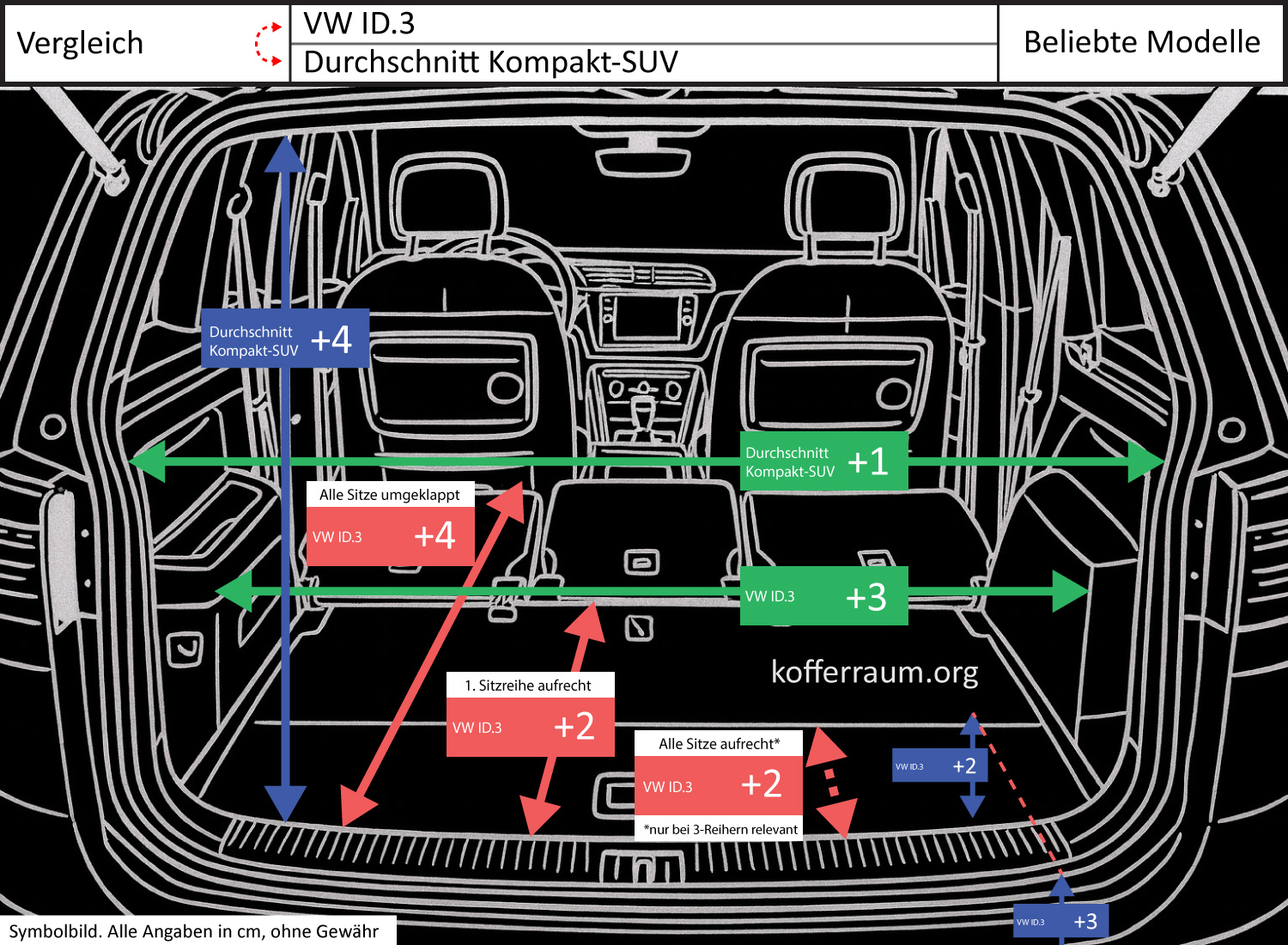
The most noticeable difference is the depth of the Volkswagen ID.3's trunk: the distance from the loading edge to the trunk floor is 0.8 in or 14% greater than the average compact SUV.
All other deviations are within the range of 1–5%: the ID.3 offers +1.6 in (3%) longer cargo space with the seats folded down and +0.8 in (3%) with the first row of seats upright.
The trunk opening of the average SUV is +1.6 in (5%) higher than that of the ID.3. The loading edge of the ID.3 is +1.2 in (4%) higher above the ground. The narrowest width in the trunk is +1.2 in (3%) greater in the ID.3; the opening width is +0.4 in (1%) larger in the average SUV.
Impact on Usability
The significantly greater depth (14%) in the ID.3 means more usable interior volume vertically: flat or low luggage can be stored further down, and there is more space for stacked or longer items in the trunk footwell.
At the same time, the slightly higher loading edge of the ID.3 (+1.2 in) affects handling: heavy cargo must be lifted somewhat higher when loading or unloading because the floor lies deeper below the loading edge.
Combined with the slightly lower opening height of the ID.3 (−1.6 in compared to the SUV), this reduces suitability for very tall or bulky items that need to be inserted through the opening.
The smaller length differences (+2–1.6 in) are hardly noticeable in everyday use but slightly increase the capacity of the ID.3 with folded seats.
The somewhat greater narrowest width in the ID.3 (+1.2 in) makes loading wider items easier compared to the average SUV, while the marginally larger opening width of the SUV (+0.4 in) is practically negligible.
Conclusion: The ID.3 offers advantages in storing flat and wide items as well as stacking due to its greater depth and slightly more interior width.
Those who frequently load very tall or bulky items through the rear opening or prefer a lower loading edge for lifting heavy loads are better served by the average compact SUV.