Trunk comparison: VW ID.3 vs VW Passat Wagon
Key Differences
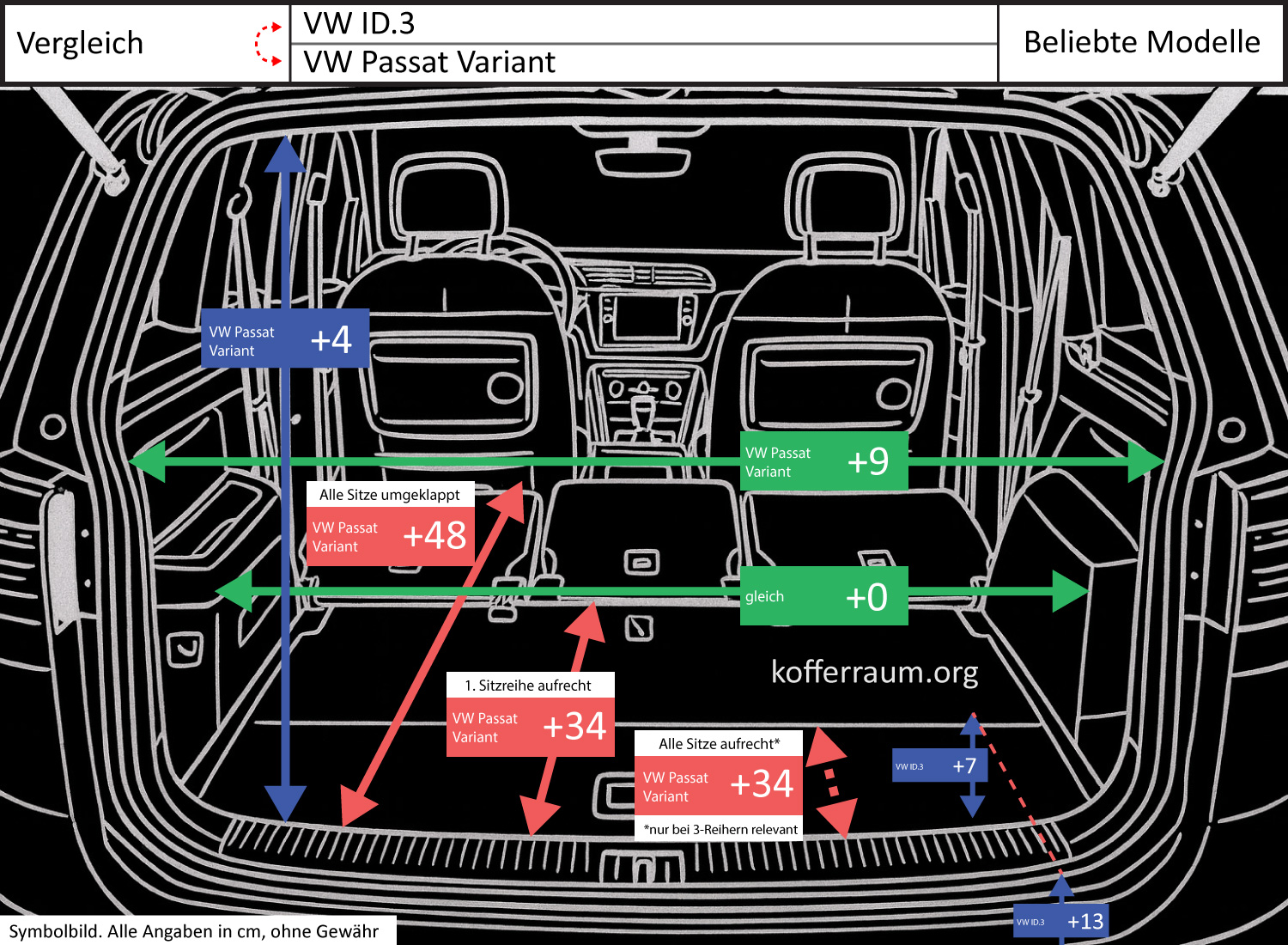
The VW Passat Wagon offers significantly more loading length: with the seats folded down, the trunk is +18.9 in (31%) longer, and with the front row upright, it is even +13.4 in (43%) longer than in the VW ID.3. The ID.3, on the other hand, stands out with a significantly greater depth between the loading edge and the trunk floor: this is +2.8 in (78%) higher in the ID.3. Additionally, the loading edge of the ID.3 is +5.1 in (20%) higher above the road than in the Passat Wagon.
Impact on Usability
The greater loading length of the Passat Wagon makes it more practical for long items (e.g., slats, long furniture parts, plywood sheets) and for transports where the rear seats need to be partially or fully folded down.
Even with the front row upright, the Passat remains significantly more versatile for longer cargo, making it overall better suited for users who regularly transport long or bulky items.
The greater depth in the ID.3 means that the trunk floor lies further below the loading edge — this creates a deeper cargo volume beneath the loading edge, allowing items to be "sunk" in.
This can be advantageous when carrying a lot of stacked or volume-oriented cargo that does not need to extend above the loading edge.
At the same time, the +5.1 in higher loading edge makes handling heavy or bulky items less practical: lifting and stowing require more effort, and loading and unloading are less ergonomic than with the lower Passat.
Smaller differences such as the Passat's trunk opening being 1.6 in higher or its opening width being 3.5 in wider are below the 10% threshold and have only minor practical effects; the width at the narrowest point is the same in both models.
Conclusion: Those who frequently transport long or bulky items clearly benefit from the Passat Wagon. Those who prefer a deeper, usable trunk bed in depth and can live with a higher loading edge will find advantages in the ID.3.