
Trunk comparison: VW ID.4 vs VW Passat Wagon
Key Differences and Their Impact on Usability
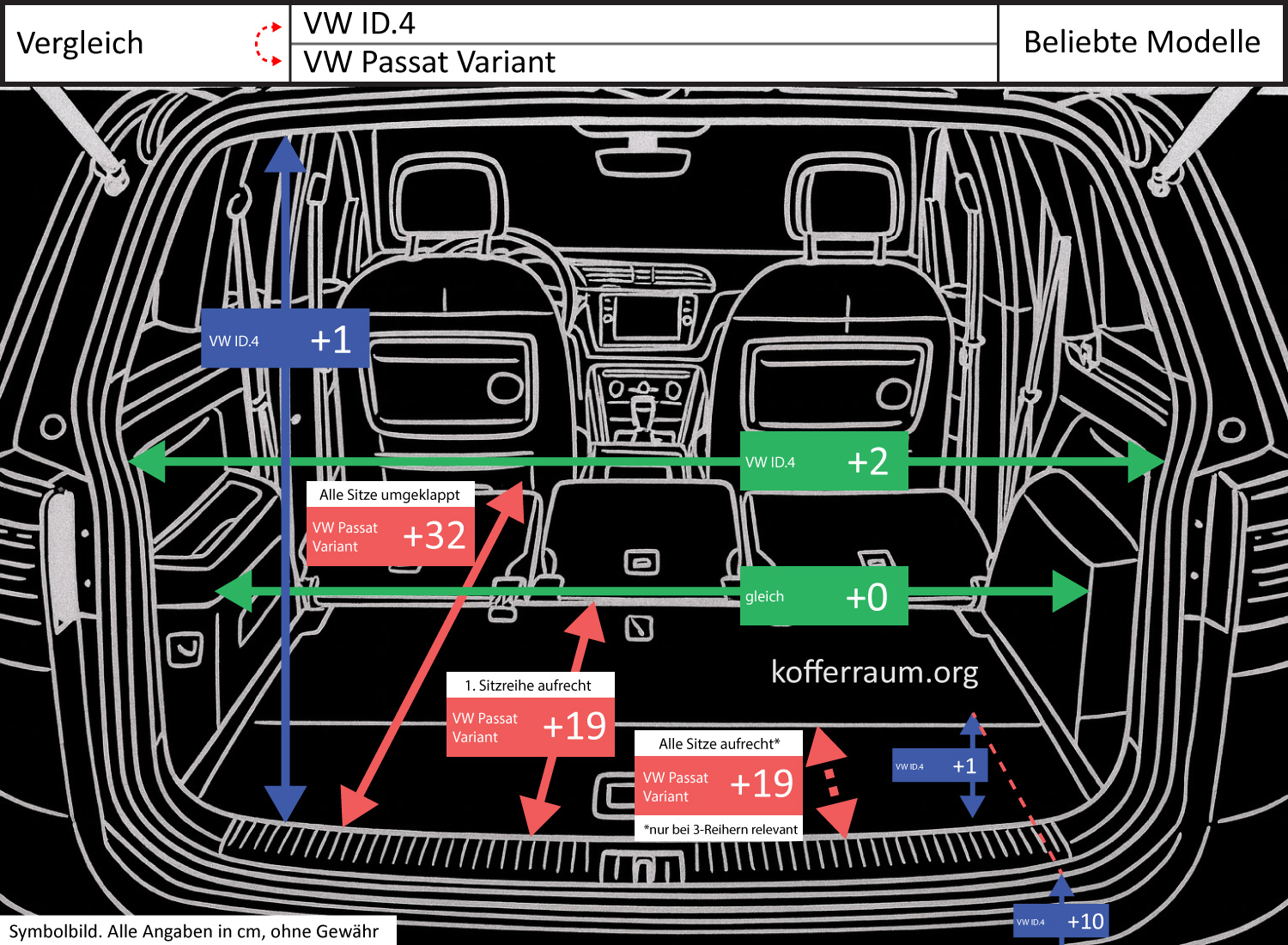
The biggest differences concern the loading length and the height of the loading edge.
The VW Passat Wagon offers a significantly longer loading area: with the seats folded down, the trunk is 12.6 in (≈19%) longer, and with the first row of seats upright, it is 7.5 in (≈20%) longer than in the VW ID.4. Practical consequence: the Passat is noticeably better suited for long items (e.g., furniture, slats, skis) and for users who frequently transport longer cargo with folded down or partially folded seats.
The VW ID.4 has a higher loading edge: the loading edge is 3.9 in (≈16%) higher above the road. This makes lifting heavy items into the trunk more strenuous and complicates repeated loading and unloading, but is less relevant when simply pushing or sliding long, light parts.
Additionally, the depth (loading edge → trunk floor) of the ID.4 is 0.4 in (≈11%) greater — nominally a difference over 10%, but practically very small (only 0.4 in), so the impact on usability is minor.
Width and opening: The width at the narrowest point is the same, the trunk opening of the ID.4 is only 0.8 in (≈2%) wider and the opening height 0.4 in (≈1%) higher — both negligible.
Overall, this means: those who primarily transport long cargo or want very easy handling when loading and unloading benefit from the Passat.
Those who can live with frequent crosswise transport and a somewhat taller vehicle find a practical solution in the ID.4 but must expect the higher loading edge when lifting heavy loads.