Trunk comparison: VW Passat Wagon vs VW T-Cross
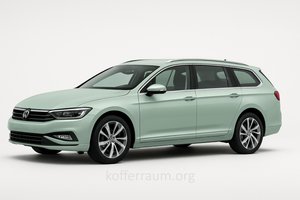
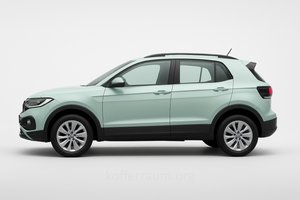
Summary of the Biggest Differences
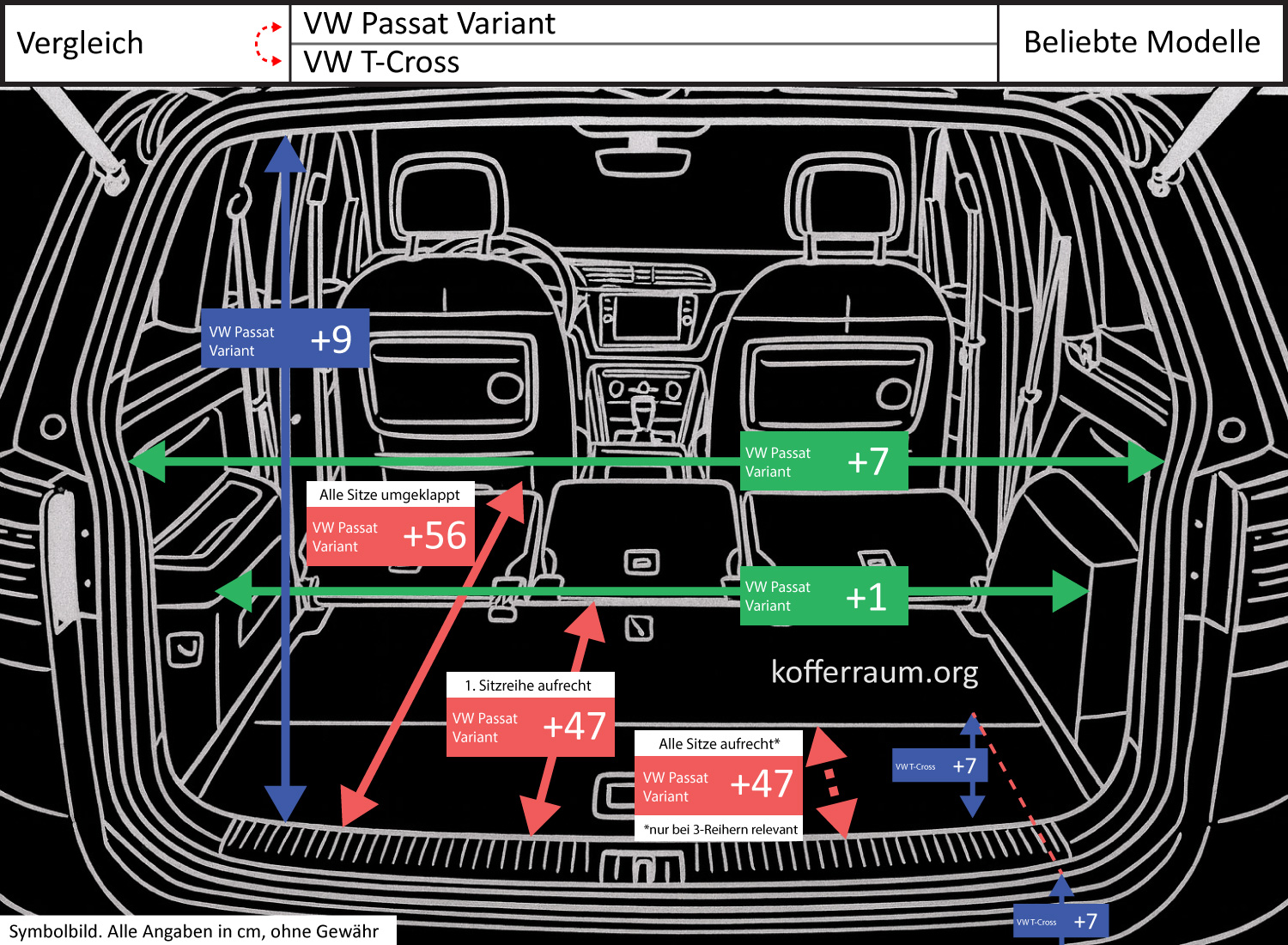
The VW Passat Wagon offers significantly more usable loading length: with the seats folded down, the trunk is 22 in (+39%) longer, and with the first row of seats upright, it is 18.5 in (+71%) longer than in the VW T-Cross.
The height of the Passat's trunk opening is 3.5 in (+13%) higher, which facilitates access for taller items.
In the T-Cross, the depth from the loading edge to the trunk floor is 2.8 in (+78%) higher, and the loading edge itself is 2.8 in (+11%) higher above the road than in the Passat. Differences in width (narrowest point +1% and opening width +7%) are below the 10% mark and thus less relevant.
What Are the Implications for Usability?
Due to the significantly greater loading length in the Passat, longer and bulky items (e.g., furniture parts, slatted frames, long boxes) can be transported more easily and flatter.
The higher trunk opening supports loading tall objects without pinching. Overall, the Passat is more practical for people who regularly transport long or bulky cargo or need as flat and long a loading surface as possible.
The T-Cross has a different usage characteristic due to the higher trunk depth and higher loading edge: The greater depth means more usable volume below the loading edge but can make loading long, flat items more difficult because the base area is deeper.
The higher loading edge (+11%) makes lifting heavy loads somewhat more strenuous but can have advantages when loading with carts or trolleys if an edge is desired as a boundary. Overall, the T-Cross is better suited for everyday shopping, smaller luggage, and a higher seating position, less so for long, bulky cargo.
Conclusion: Those who regularly transport long or bulky goods benefit significantly from the Passat Wagon. Those who mostly drive in urban areas with more compact loads and prefer an SUV-like design will find the T-Cross a suitable choice.