
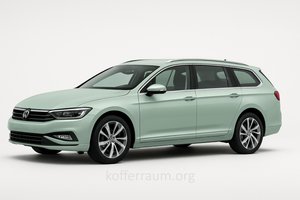
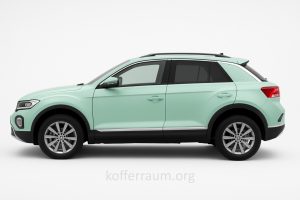
Trunk comparison: VW Passat Wagon vs VW T-Roc
Biggest Differences
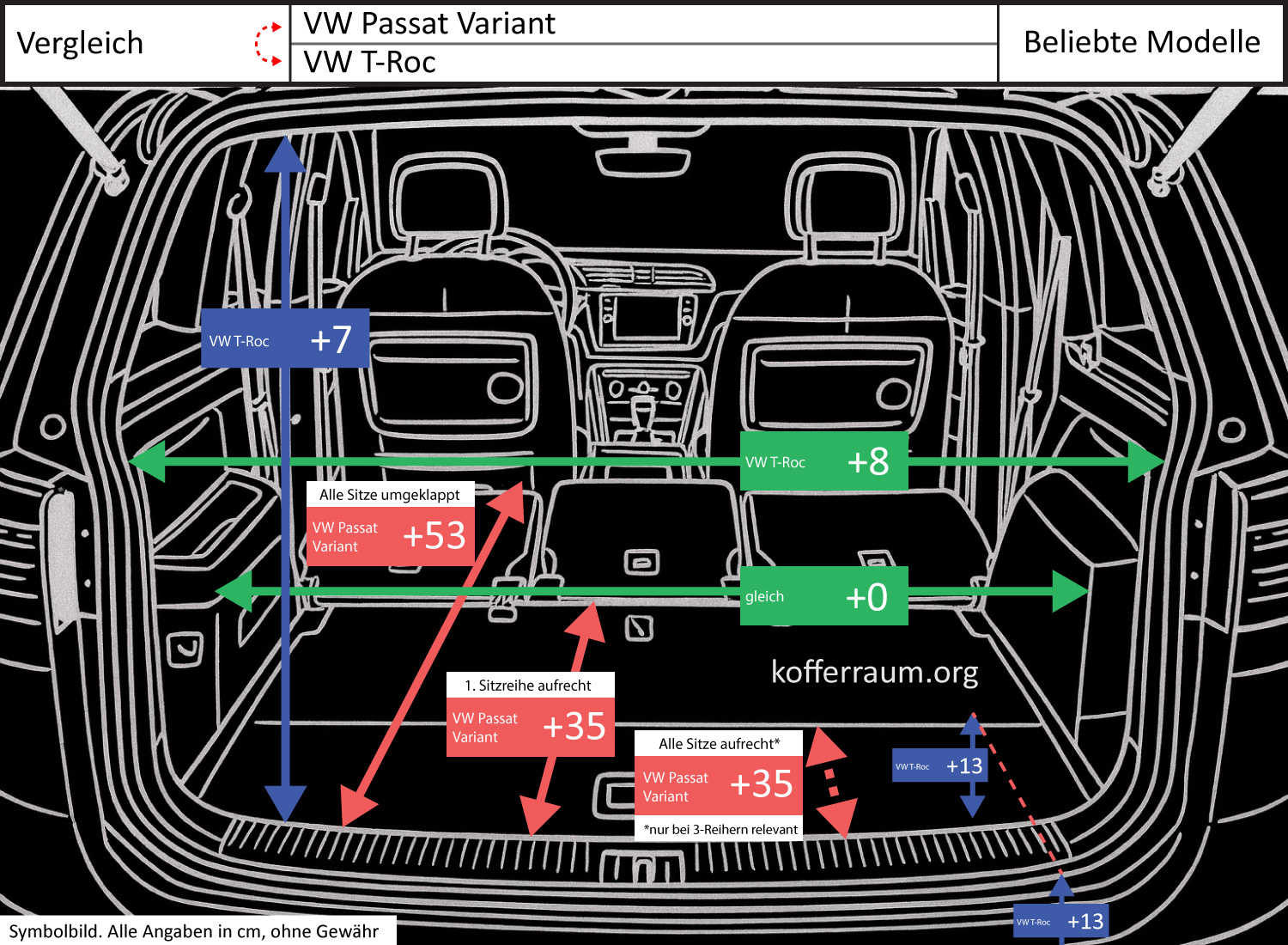
The Passat Wagon offers significantly more cargo length: with the seats folded down, the trunk is 20.9 in (≈36%) longer, and with the first row upright, it is 13.8 in (≈45%) longer than the T-Roc.
The T-Roc, on the other hand, has a significantly higher loading sill (+5.1 in, ≈20%) and a much greater depth between the loading sill and trunk floor (+5.1 in, ≈144%).
The width at the narrowest point is the same, and differences in opening height (+2.8 in, 9%) and opening width (+3.1 in, 8%) are minor (<10%) and therefore less relevant.
Impact on Usability
The longer loading dimensions of the Passat Wagon make it more practical for long items and large loads: furniture parts, skis, long boxes, or multiple suitcases can be stored more easily and space-efficiently. For users who regularly transport long or bulky goods, the Passat is clearly advantageous.
The higher loading sill and greater depth in the T-Roc, however, mean more lifting effort when loading: heavy items must be lifted over a higher loading sill, and there is a larger gap between the loading sill and trunk floor.
This increases the effort required to lift and makes sliding very heavy, flat loads inside more difficult. On the positive side, a lower trunk floor can allow easier access to items stored inside or a lower loading height within the cargo area, but the practical effect depends on the specific geometry.
Since the narrowest width is identical and the opening only slightly different, width and entry openings play little role in the choice.
Recommendation: those who primarily need long or bulky cargo should choose the Passat Wagon; those who prefer a more compact SUV format with a higher loading sill (e.g., easier top access, SUV character) should choose the T-Roc—with the drawback of higher lifting effort when loading.