Trunk comparison: VW T-Cross vs Durchschnitt SUV
Summary of the Biggest Differences
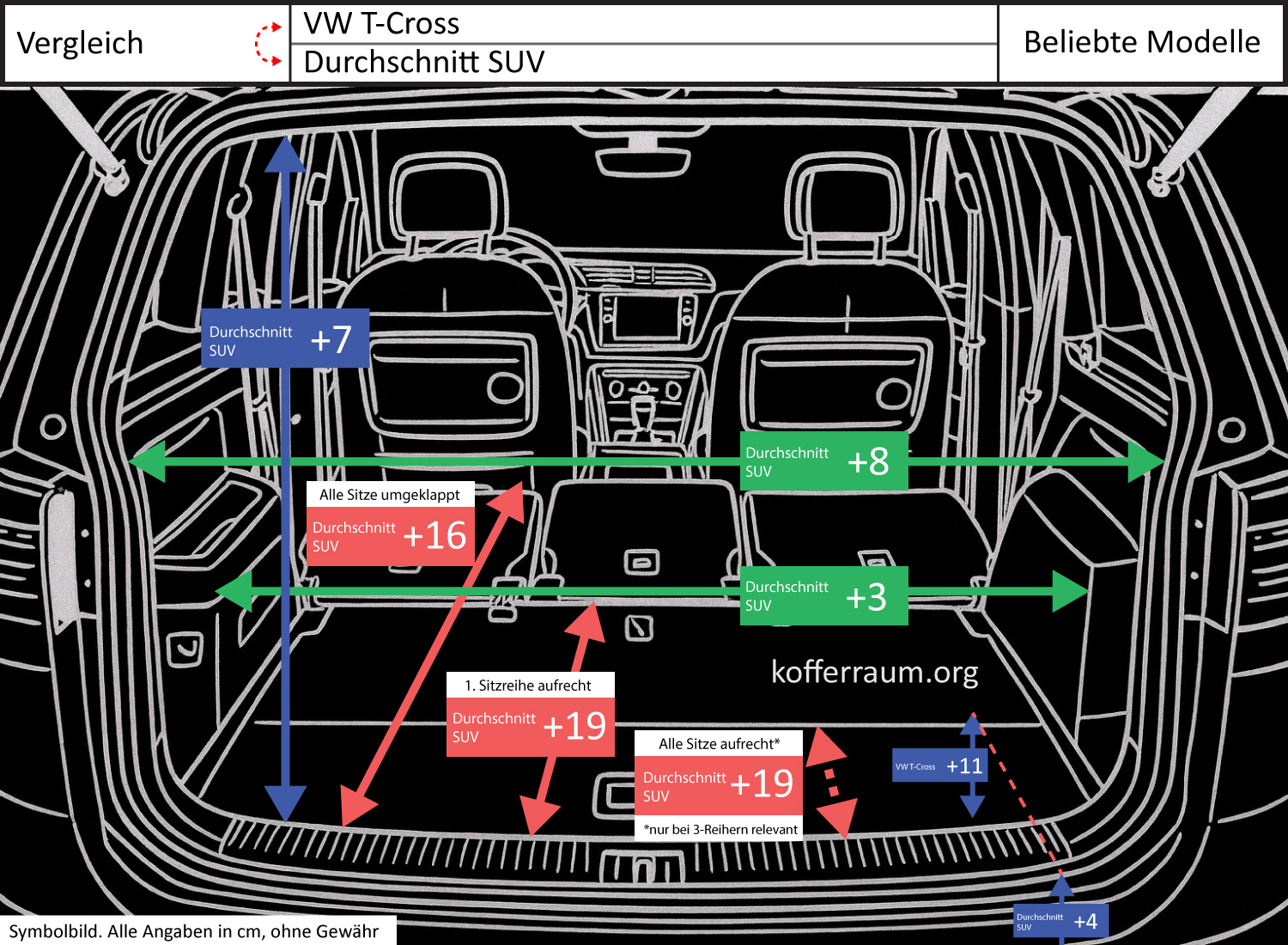
Clear strengths appear on both sides regarding the volume and usability of the trunk space: The average SUV offers more cargo length — with +6.3 in (11%) when seats are folded down and with +7.5 in (29%) with the first row upright — allowing for longer items and more usable loading area.
In contrast, the VW T-Cross's trunk floor sits significantly lower in the vehicle: the depth (loading edge → trunk floor) is +4.3 in (220%) greater in the T-Cross, which means a deeper cargo well.
Other differences are moderate: The trunk opening of the average SUV is 2.8 in (10%) higher, the loading edge of the average SUV is 1.6 in (6%) higher above the road, the narrowest width is only 1.2 in (3%) larger in the average SUV, and the loading width is 3.1 in (8%) larger.
What Are the Practical Implications?
The longer loading surface of the average SUV makes it clearly superior when regularly transporting long items (skis, planks, furniture parts) or when carrying a lot of luggage with four people: The +7.5 in with the upright seat row means noticeably more usable trunk space without folding seats.
Also, with folded seats, the +6.3 in length provides more flexible loading.
The deeper trunk floor of the VW T-Cross brings other advantages: The cargo well offers better use of vertical space and keeps luggage better "below" the loading edge – useful for safely securing shifting or stackable cargo.
Combined with the 1.6 in lower loading edge compared to the average SUV, loading heavy items is generally easier (less lifting onto the sill). A downside is that items lying deep in the floor are harder to reach, requiring more reaching into the trunk or bending down further.
The remaining differences (opening height, widths) are minor and hardly noticeable in most everyday scenarios: a slightly higher loading channel or a few extra centimeters in width make maneuvering larger boxes easier but do not fundamentally change usability.
Conclusion: Those who often transport long or large items and need maximum loading length with the seat row occupied are better served by the average SUV. Those who value a deeper cargo well, easier handling of heavy loads above the road, and more compact city suitability benefit more from the VW T-Cross.