
Trunk comparison: VW Taigo vs Durchschnitt SUV


Core Differences
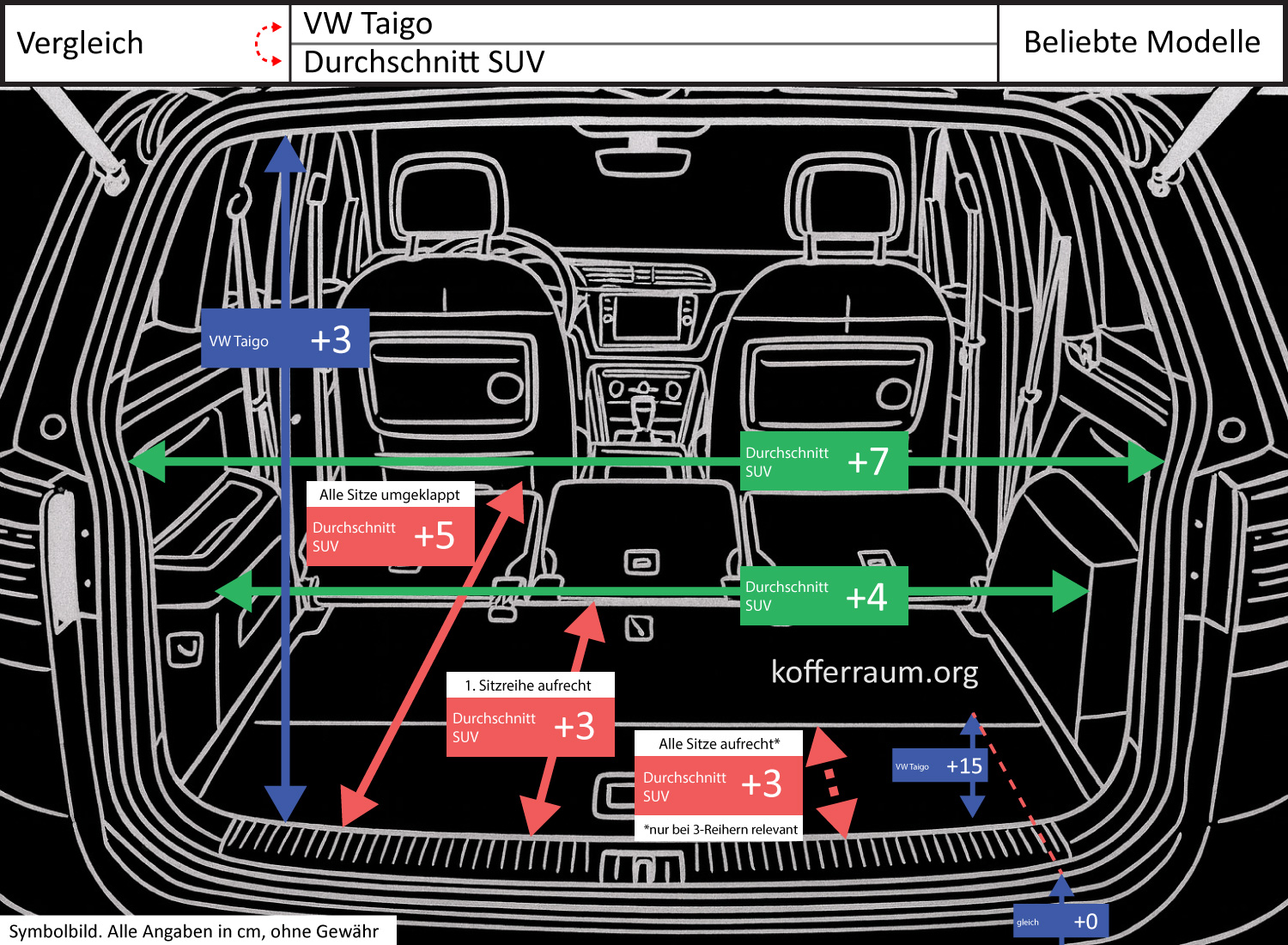
A clear, significant advantage of the VW Taigo stands out in the depth of the trunk: the distance from the loading edge to the trunk floor is +5.9 in (+300%) greater in the Taigo than in the average SUV. This is the only difference over 10% and thus the most important point in the comparison. Most other deviations are small: the average SUV offers a loading surface that is 2 in (≈3%) longer with folded seats and 1.2 in (≈4%) more length with the first row upright; the trunk opening of the Taigo is 1.2 in (≈4%) higher; the narrowest width in favor of the average SUV is +1.6 in (≈4%) and the opening width of the average SUV is +2.8 in (≈7%) larger.
The loading edge height of both vehicles is the same.
Impact on Usability
The significantly greater depth of the Taigo (loading edge → trunk floor) makes it practically superior for transporting tall or bulky items that need to stand deep inside (e.g., tall boxes, plants, bulky crates).
Because the depth is significantly greater, such loads can be positioned more stably and, if necessary, stacked better.
The smaller differences (≤ 7%) have a moderate effect: an average SUV offers slightly more usable length with folded seats and with the first row upright — this helps when transporting long items (skis, slats, longer furniture parts), but is only marginally better than in the Taigo.
The slightly greater width and wider opening of the average SUV make it easier to load wider items, making loading there somewhat more flexible. Conversely, the slightly higher trunk opening of the Taigo helps when loading/unloading very tall cargo.
In summary: For users who frequently transport tall or deep-standing cargo, the VW Taigo is clearly advantageous due to the significantly greater trunk depth.
Those who more often load very long or wide items benefit slightly from the average SUV — however, the differences here are small and hardly noticeable in everyday use.