
Trunk comparison: VW Tiguan vs Durchschnitt SUV
Key Differences
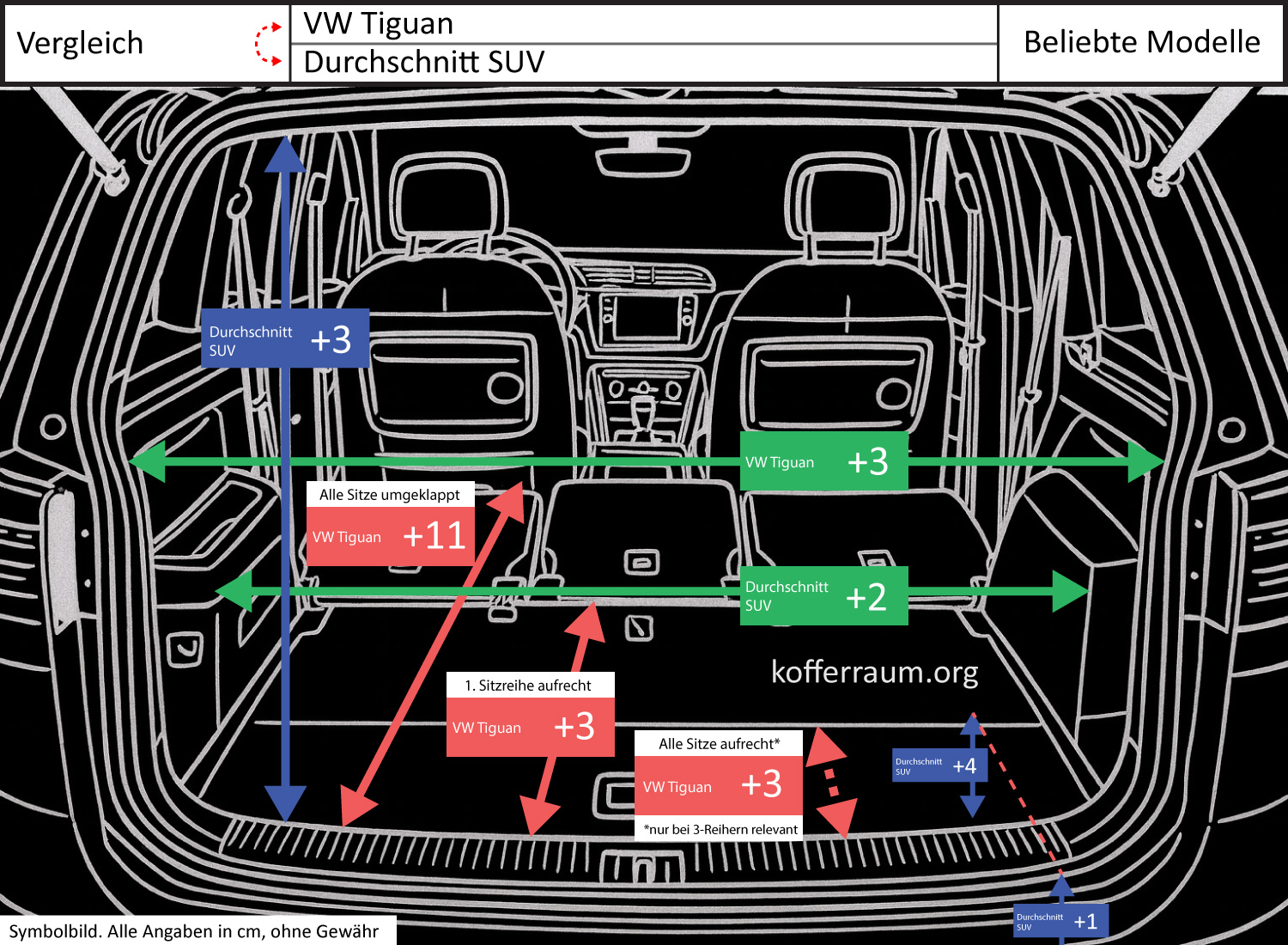
In a direct comparison, most deviations are within single-digit percentages: The VW Tiguan offers +4.3 in (7%) more cargo length with the seats folded down and +1.2 in (4%) more length with the first row upright than the average SUV.
The height of the trunk opening of the average SUV is +1.2 in (4%) higher, the narrowest trunk width is +0.8 in (2%) larger in the average SUV, the width of the trunk opening is +1.2 in (3%) larger in the Tiguan, and the loading edge is only +0.4 in (1%) higher in the average SUV.
A clear outlier feature is the depth of the trunk (loading edge to trunk floor): the average SUV is +1.6 in (400%) "deeper" here than the VW Tiguan.
Impact on Usability
The large relative difference in trunk depth has practical consequences: A deeper trunk floor in the average SUV means more vertical space below the loading edge. This increases the usable volume for tall or stacked cargo and can improve storage space for bulky items.
At the same time, loading heavy or bulky loads requires more lifting power because they must be lowered or raised further below the loading edge — this can make loading and unloading less convenient.
The Tiguan scores with a slightly larger opening width (+1.2 in) and more length with folded seats (+4.3 in). This makes it easier to load wide or very long items and is more practical when sliding in boxes and furniture.
The slightly higher opening height and the slightly larger narrow width of the average SUV (+1.2 in and +0.8 in respectively) make it easier to load tall or slightly bulky cargo.
In summary: For users who need more usable volume in depth and space for tall stacks, the average SUV is advantageous. For those who want to load wide and long items more easily or lift less deeply, the VW Tiguan is more practical.