
Trunk comparison: VW Tiguan vs VW T-Roc

Key Differences
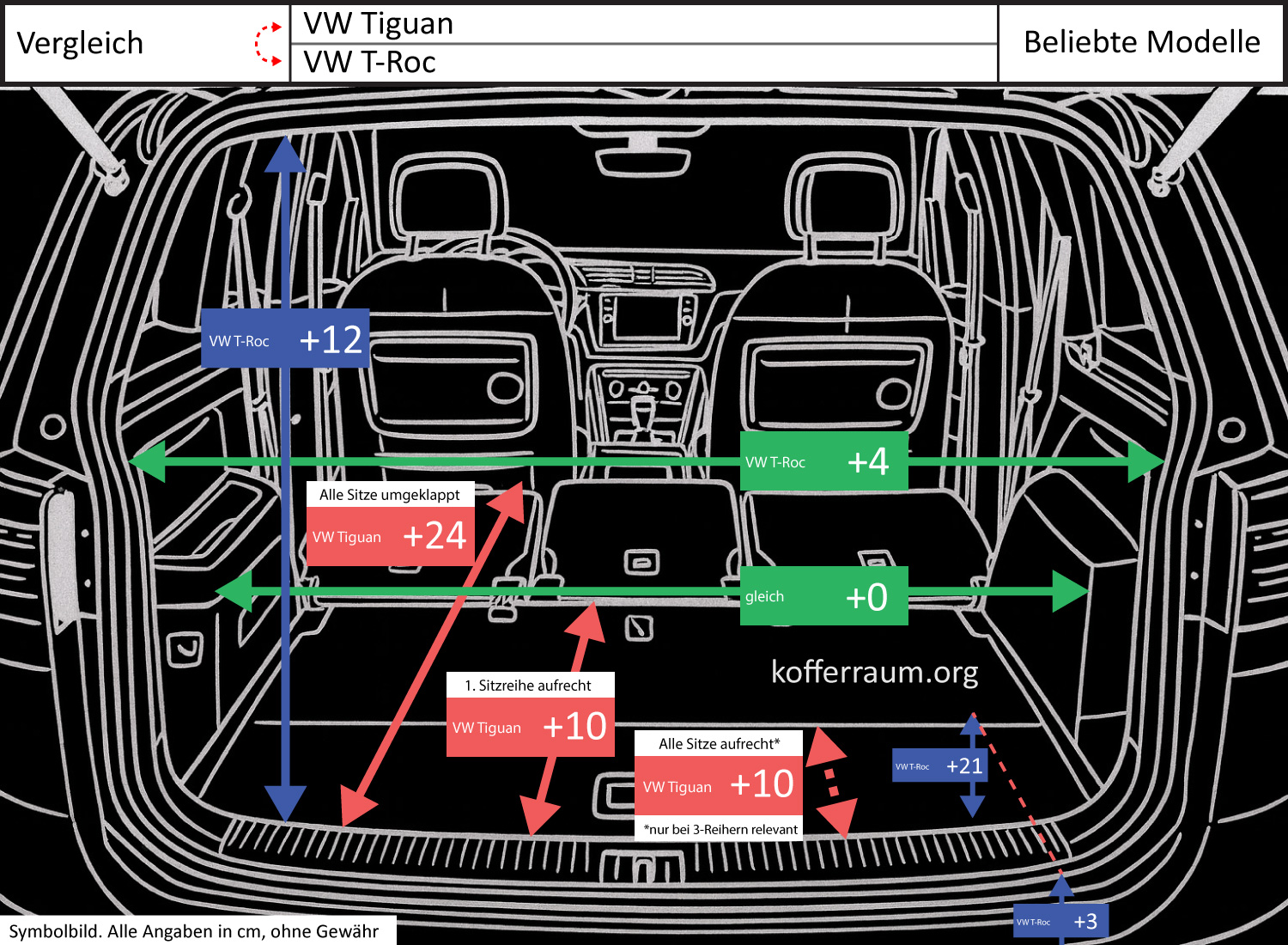
The VW Tiguan offers more cargo length: With the seats folded down, the Tiguan is 9.4 in (16%) longer, and with the first row upright, it is 3.9 in (13%) longer than the T‑Roc. Both differences exceed 10% and are therefore relevant for transport length.
The VW T‑Roc has a higher trunk opening and significantly more trunk depth: The opening height of the T‑Roc is 4.7 in (16%) greater. The depth (distance from loading edge to trunk floor) is 8.3 in (2100%) greater in the T‑Roc — a very large difference.
Other smaller deviations: The loading edge of the T‑Roc is 1.2 in (4%) higher above the ground, and the width of the trunk opening is 1.6 in (4%) larger. The narrowest width inside the trunk is the same for both models.
What do these differences mean in practice?
Transport length: Due to the longer loading area, the Tiguan clearly has the advantage if you frequently transport long items (e.g., skis, slats, furniture parts). It offers more usable length both with folded seats and with the seat row upright.
Height and volume in depth: The T‑Roc is better suited for tall or bulky cargo and stacking because the trunk opening is higher and the interior is significantly deeper. This makes it easier to accommodate bulky, tall items and increases usable volume vertically.
Handling when loading: The significantly greater depth in the T‑Roc can strain the back more because lifting requires a higher range of motion; the loading edge itself is only minimally (1.2 in) higher, which is hardly noticeable in practice.
The slightly larger opening width of the T‑Roc (+1.6 in) helps when loading wider parts but is not a major advantage.
Width limitations: Since the narrowest point in both models is the same, particularly narrow passages during loading are equally challenging for both.
Practical recommendation
If you regularly transport long items or value maximum cargo length: Tiguan. If you more often have tall, voluminous, or stackable cargo and need a higher opening: T‑Roc.