
Dog Crate in the Car: Safety, Comfort, Costs – and Which Cars Are Suitable
A suitable dog crate in the car is more than "just a box": it determines how safe and stress-free your dog is while traveling in the car – and whether you can even fit the crate sensibly.
This guide helps you with the selection (without specific product names) and shows which body types are especially suitable for a dog crate in the trunk. Note: Before committing to a crate model, it’s worth taking a look at typical trunk dimensions by vehicle class – especially opening width, opening height, depth, and loading height are often more decisive for dog crates than the pure trunk volume.
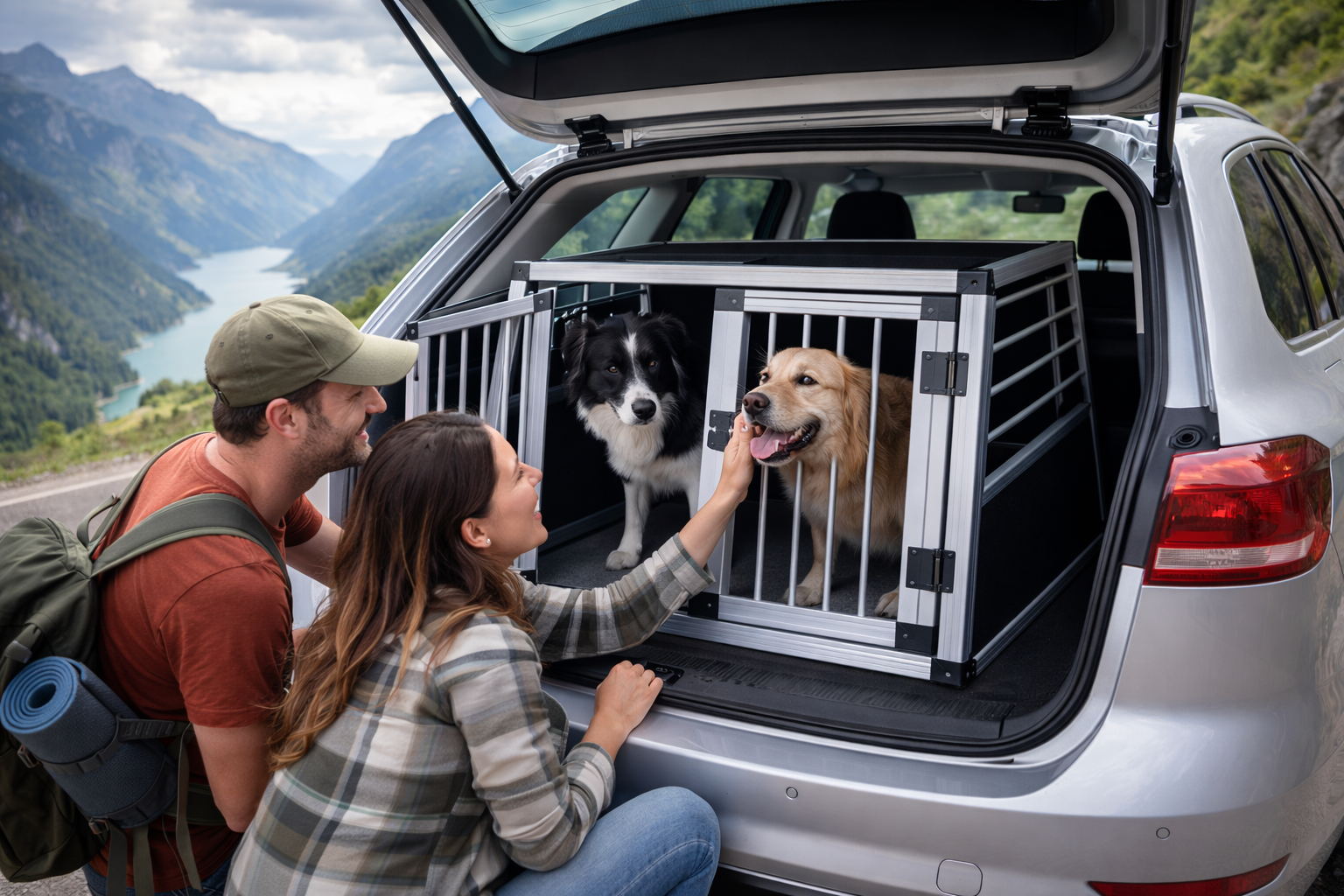
Why Dog Transport Should Always Be Secured
An unsecured dog in the car can become a danger during emergency braking or evasive maneuvers – for the dog itself and all passengers.
In Germany, animals in cars are generally considered "cargo" and must be secured so they do not slip, fall over, or fly around.
- Safety risk: In a collision, enormous forces act. Without securing, a dog can become a "projectile."
- Driver distraction: A freely moving dog can disturb you while driving (e.g., jumping on your lap, being near the steering wheel/shifter).
- Stress for the animal: Unstable, slippery surfaces and loud noises increase stress and nausea. A stable, well-placed crate can have a calming effect.
In short: "dog transport" is best when it is planned, stable, ventilated, and cleanly secured.
Types of Dog Crates and Transport Solutions (without product names)
There is no "one perfect" dog crate. Important factors are: the dog's weight, driving profile (short trips vs. highway), available space, installation and removal, and how consistently you can securely strap the crate.
1) Rigid Metal/Aluminum Crates (often the safest category)
Rigid crates with metal frames are considered especially stable in many tests. Good models have reinforced doors, solid locks, smooth edges, sufficient ventilation
and can be additionally fixed in the trunk with straps (using tie-down points).
- Advantages: very stable, durable, easy to clean, often good air circulation.
- Disadvantages: more expensive, heavier, requires precise measurements (does not fit every car), less flexible in everyday use.
2) Plastic Transport Crates (often good value, but must be properly secured!)
Plastic crates can be useful for small to medium-sized dogs if they are well-made and securely positioned in the vehicle.
Important: They should be additionally secured in the trunk, otherwise they can slide around during a sharp evasive maneuver.
- Advantages: usually cheaper, lightweight, easy to clean, often quickly available.
- Disadvantages: often less stable in crashes than high-quality metal crates; quality varies greatly.
3) Foldable Fabric Crates (for stationary use, not for hard driving maneuvers)
Fabric crates are comfortable, lightweight, and practical for hotel/training/indoor use. However, in cars they are usually not the best choice under strong forces.
For slow trips in calm environments, they can serve as a comfort solution but do not replace a real safety crate.
- Advantages: very light, quickly foldable, comfortable for the animal (soft surfaces).
- Disadvantages: usually much less protection in accidents/driving maneuvers; can collapse, zippers/meshes are critical points.
4) Securing on the Back Seat: Harness or Crate (Dog Crate for Back Seat)
If the trunk is unsuitable, a dog crate on the back seat is an option – or alternatively a tested restraint system (dog seatbelt).
Important are stable belt routing, correct fit (no twisting), and that the dog cannot get forward into the driver's area.
5) Partition Grille/Partition Net + Cargo Area
An alternative to a crate is a stable cargo area with a partition grille (dog in the rear area, separated from the passenger compartment).
This can work – especially in large station wagons/SUVs – but is only sensible if the dog cannot slip and the area is well secured.
Safety: What You Should Really Look for in Dog Crates
"Safe" means in everyday use: the crate stays in place, does not open unintentionally, has no sharp edges,
and protects the dog as best as possible during sudden maneuvers. These points help you check:
Checklist: Safety Features
- Fixation in the car: Use tie-down points and straps. A crate that only "stands" can slide.
- Stability: Frame, door, hinges, locks – if the door wobbles, that’s a warning sign.
- Test marks: Look for reputable certifications (e.g., GS mark) and whether it has been tested according to relevant standards.
- Fit: Too large is not automatically better. Too much "air" in the crate can cause the dog to slide uncontrollably during braking.
- Ventilation & temperature: Enough air openings, no heat traps – in summer, shade/fresh air is crucial.
Tip: If manufacturers or dealers talk about crash tests, look closely at which tests are meant and whether there are verifiable details about testing standards.
Reputable references include standards like ECE regulations or relevant standards for cargo securing/crash testing.
Comfort: How to Make the Dog Crate a "Safe Den"
A good dog crate is not only safe but also comfortable – otherwise every trip becomes a stress test.
Comfort arises from a combination of habituation, interior fittings, and climate management.
- Non-slip, washable base: A thin mat or washable cushion prevents slipping and dampens vibrations.
- Quiet location: Position as stably as possible against the backrest in the trunk, not "floating free."
- Habituation: Set up the crate positively at home (treats, short stays, door initially open).
- Ventilation: Air must circulate; in summer possibly sun protection, never leave in direct sunlight.
- Entry and exit: Especially with high SUVs: consider loading height, possibly a ramp for older dogs.
Costs: What Dog Crates & Securing Systems Typically Cost
The price range is large. Without specific model names, it can roughly be divided into three categories:
- Budget (approx. €40–150): simple plastic crates or soft solutions. For small dogs and short trips – but observe safety limits.
- Mid-range (approx. €150–350): solid plastic crates, simple metal frames, sometimes better locks/material.
- Premium (approx. €350–900+): very robust rigid crates, elaborate constructions, often with certifications/crash test focus.
Additionally, you should budget for straps, possibly trunk protection (non-slip mat, tray), and if needed a ramp.
Dog Crate Trunk: Thinking Dimensions Correctly (and Avoiding Typical Mistakes)
When it comes to dog crate trunk, details often decide that get lost in sales descriptions:
Not only "crate length" is important, but also the trunk opening and the shape of the cargo area.
The 5 Most Important Dimensions for Fit
- Opening width: Does the crate fit through the tailgate? Wheel arches and trim can narrow the space.
- Opening height: Especially with hatchbacks/compact SUVs, the tailgate can limit the height.
- Depth to backrest: How much "flat" floor space is available before it slopes?
- Loading height: High loading edges (often SUVs) = harder entry, ramp may be needed.
- Width between wheel arches: Many trunks are narrower at the bottom than at the top.
Practical rule for crate size (without dogma)
The dog should be able to stand comfortably, turn around, and lie down – but the crate should not be so large that the dog slides unnecessarily during braking.
If unsure, it helps to test the floor space with cardboard/templates or use typical dimensions on your vehicle class page as a guide.
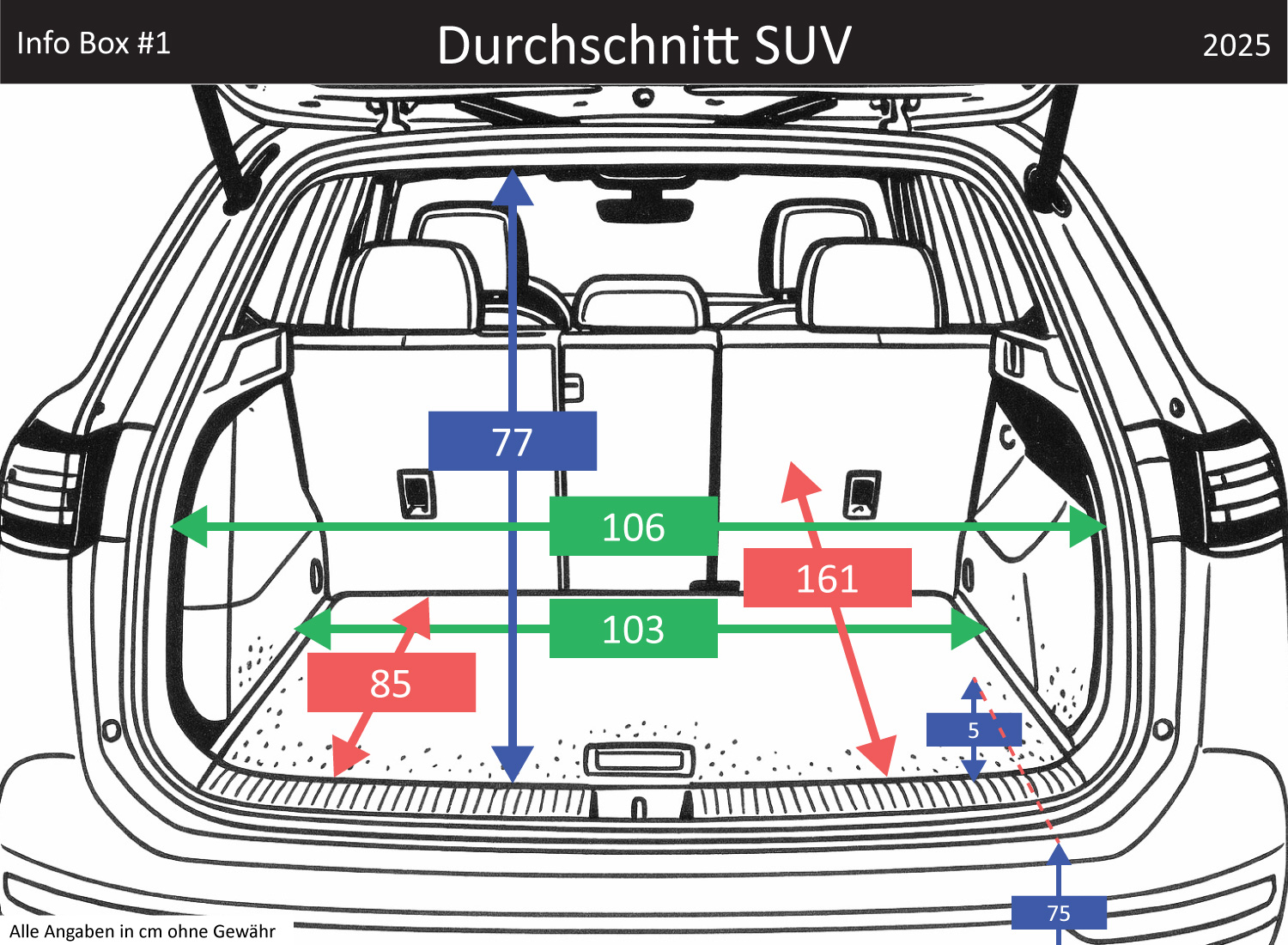
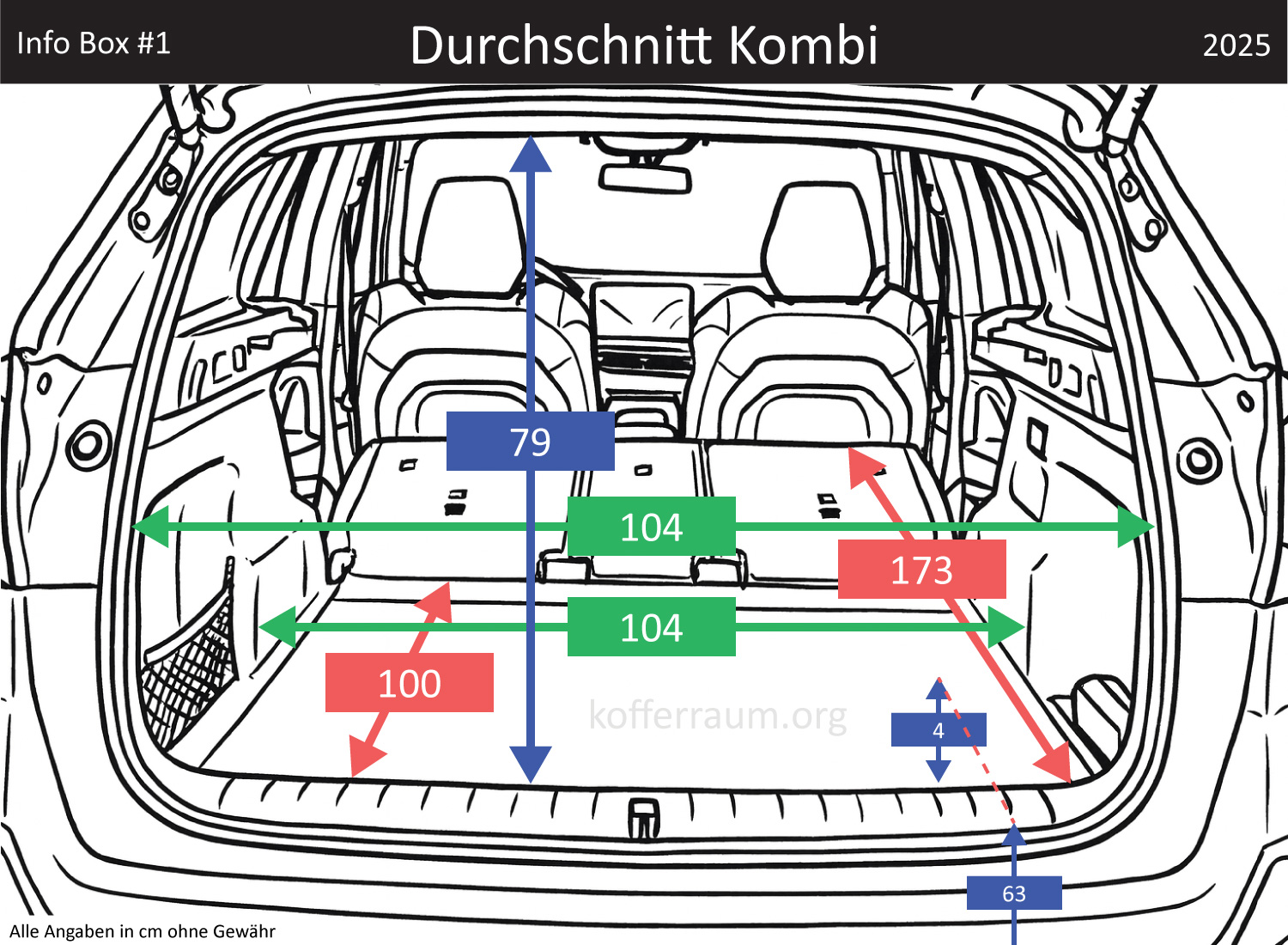
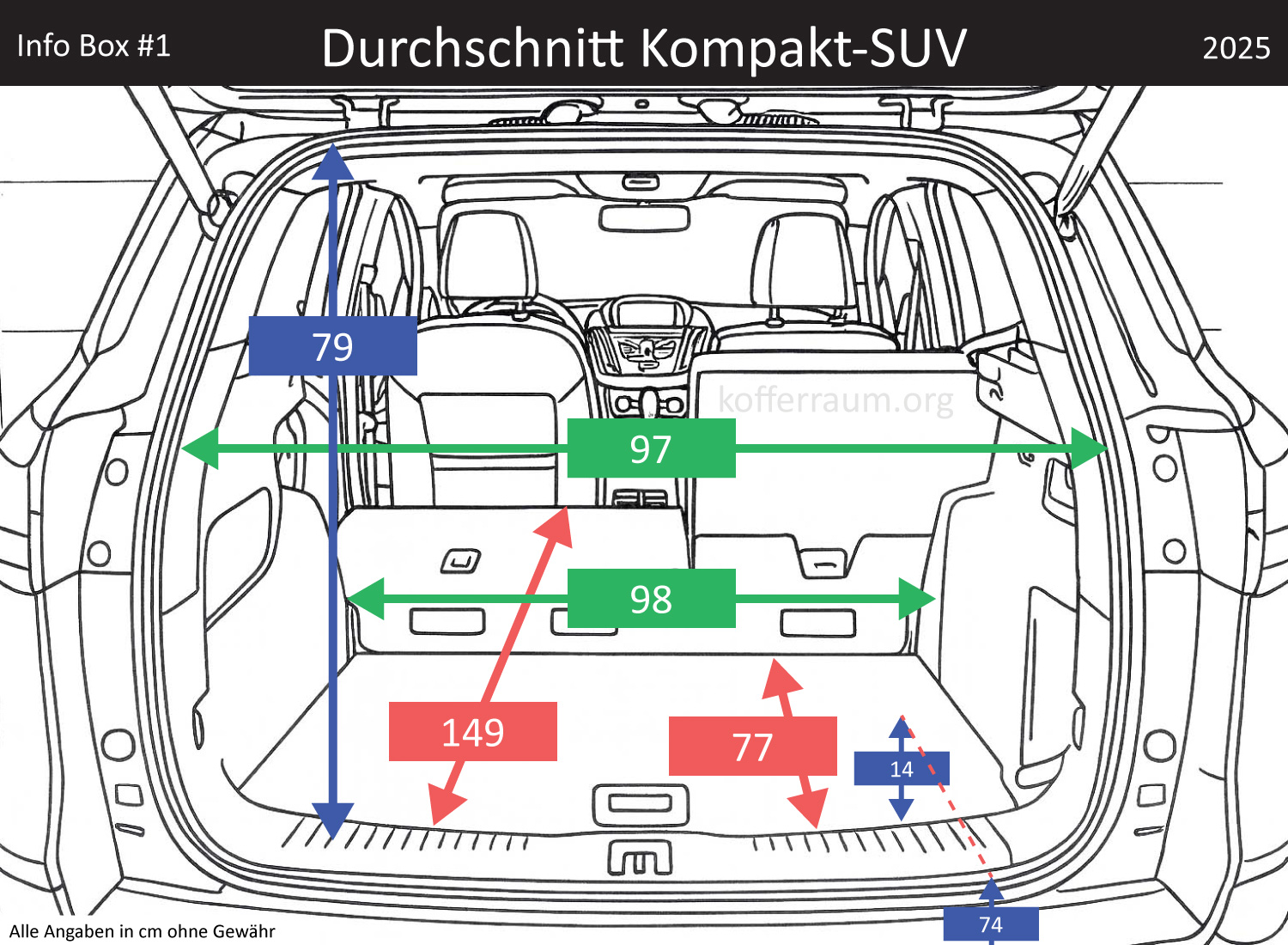
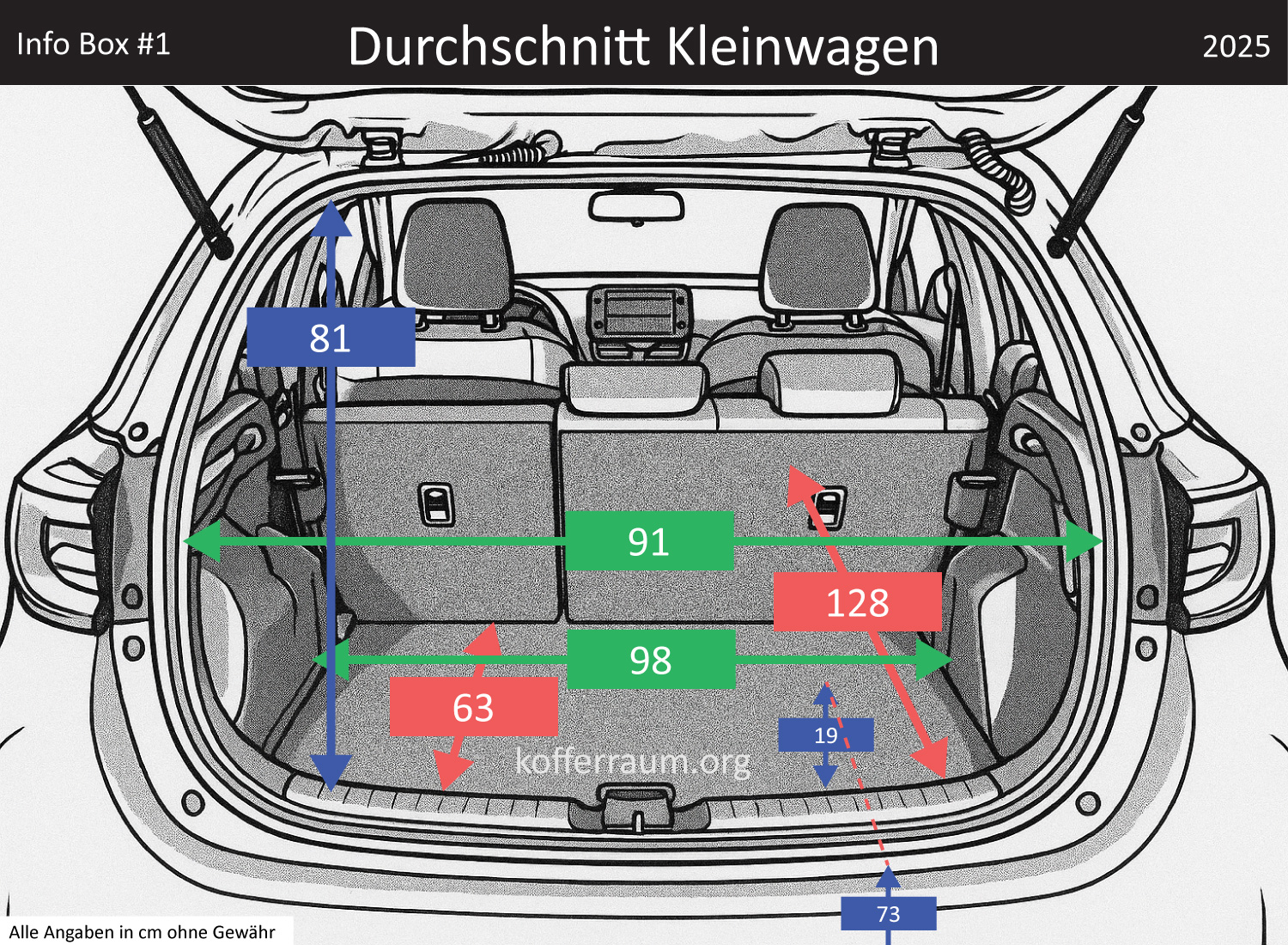
Average Trunk Dimensions by Vehicle Type (Image Gallery)
To help you assess which vehicle class is especially suitable for dog crates, here are typical trunk dimensions as a quick overview.
For details and explanations of the individual classes, you can jump directly to the average pages:
SUV,
Station Wagon,
Compact SUV.
Which Car Types Are Suitable for Dog Crates? (Small Cars, SUVs, Station Wagons, Hatchbacks, Sedans & More)
Station Wagon: Often the Best "Dog Crate Platform"
Station wagons almost always score with a long, relatively flat loading surface and a large tailgate opening.
This often allows rigid crates to fit without "Tetris." If you drive regularly, this is often the most comfortable and safest solution.
Check typical dimensions: Average Station Wagon Trunk.
- Strengths: lots of depth, wide opening, usually good tie-down options.
- Watch out for: wheel arches, step to folded rear seat, position of tie-down points.
SUV: More Height, but Watch Loading Height & Shape
SUVs often offer more interior height – practical for taller crates. At the same time, loading heights are often higher,
which is relevant for older or heavy dogs. Also, some SUVs may have shorter trunks than they appear.
Use typical values as a guide: Average SUV Trunk.
- Strengths: height, overview, often good for medium to large dogs.
- Watch out for: high loading edge, sloping tailgate (opening height), trunk depth to backrest.
Compact SUV: Good Everyday Usability, but Opening & Depth Are Critical
Compact SUVs are popular, but crate fit is often a stumbling block here:
The exterior dimensions seem large, but inside wheel arches, sloping tailgates, and shorter depths limit space.
Check typical dimensions: Average Compact SUV Trunk.
(Here you also find a second reference to the same overview page:
Compact SUV Dimensions Overview.)
- Strengths: higher entry than compact class, often sufficient for a single crate.
- Watch out for: opening height, loading floor steps, available depth with rear seat upright.
Small Car: Possible – but Usually Only with Compact Solutions
A dog crate in the trunk of a small car often works well for small dogs – for medium-sized dogs it quickly becomes tight.
Often it’s not the floor space that’s the problem, but the tailgate opening (width/height) and usable depth.
If you have a small car, plan especially carefully and prefer simple, well-strapped crate geometries.
- Strengths: practical for small dogs, often lower loading height than SUVs.
- Watch out for: opening dimensions, sloping tailgate, wheel arches, rear seat position.
Hatchback: Flexible Opening, but "Slope" Is the Enemy
Hatchbacks often have a good tailgate opening, but the roofline slopes downward at the rear.
This can prevent tall crates even though the base area is okay. Here a lower but stable crate or a back seat solution is worthwhile.
Sedan: Often Difficult for Trunk Crates
Sedans often have a smaller trunk opening (separate lid), even if the trunk volume is large.
Rigid crates sometimes simply do not fit through the opening. In such cases, the back seat variant (dog crate back seat) or a tested restraint system is often more realistic.
Van / High Roof Station Wagon: Top Class for Space and Everyday Use
If you regularly transport large dogs, vans/high roof station wagons often offer the most relaxed solution:
high, boxy trunks, large openings, and lots of usable depth. This facilitates safe, robust crates and reduces compromises.
Transporting a Dog in the Trunk – Is It Possible Without a Crate?
Many search for "dog in trunk transport without crate" – usually because the right crate is expensive or does not fit in the car.
Basically: without securing, it’s not a good idea. A dog standing or lying freely in the trunk can slip, hit walls, or get forward.
Sensible Alternatives if a Crate Does Not Fit
- Partition grille + non-slip cargo area: The dog stays in the rear, separated from the passenger compartment. Station wagons/SUVs are best suited for this.
- Tested restraint system on the back seat: A very practical solution for many vehicles if the trunk is unsuitable.
- Securing the cargo area: Non-slip mat, side padding, clear boundaries so the dog doesn’t "wander" on every curve.
If you want to "transport dog in trunk", the safest and most practical variant is usually:
crate or clearly separated, secured loading zone.
Dog Crate Back Seat: When It’s Better Than the Trunk
The dog crate back seat is especially useful when:
- the trunk opening is too small (often sedans),
- you have a second person sitting in the back and still want to limit the dog,
- you want to keep an eye on the dog (e.g., with anxious dogs),
- you often only drive short city trips and need a quickly installable/removable solution.
Back Seat Checklist
- Belt routing: The belt must not be twisted; carabiners/adapters should fit properly.
- Stable seat: Crate or dog should not tip sideways – a non-slip base helps.
- Airbags/crash zones: Depending on the vehicle, the safest position may vary (check manual).
- Interior protection: Seat protection, but so that belts still function correctly.
For many, this is the best solution when "dog crate trunk" simply isn’t feasible.
Practice: How to Find the Right Dog Crate for Your Car in 7 Steps
- Measure your dog: length (nose to tail base), shoulder height, weight.
- Realistically assess your car: measure not only volume but also opening and wheel arches.
- Decide: trunk or back seat? Depending on body style/opening (see above).
- Choose crate type: stability needs vs. everyday use (metal/aluminum, plastic, back seat solution).
- Test fit: cardboard template or tape measure – especially opening height/width.
- Plan securing: tie-down points/straps/partition grille – without fixation you lose safety.
- Start habituation: crate becomes positive in everyday life before it’s "car-only."
FAQ: Common Questions About Dog Crates in the Car
Which dog crate is safest in the car?
In many independent tests, stable rigid crates (especially robust metal constructions) perform better than soft systems.
However, fit and fixation are always decisive: a top crate that stands loose can be dangerous.
How should a dog crate be positioned in the trunk?
Ideally, it stands stably directly against the backrest (so it doesn’t move forward) and is additionally secured with tie-down points/straps.
Make sure the crate does not wobble and doors lock securely.
Is "dog in trunk transport without crate" allowed?
Legally, it is decisive that dog transport is secured so that no danger arises and the driver is not impaired.
Without a crate, you should at least use a clear separation (e.g., partition grille) and a non-slip, limited loading zone – otherwise the risk is high.
What is better: dog crate trunk or dog crate back seat?
It depends on the car and the dog. Station wagons/SUVs are often very suitable for a crate in the trunk.
With sedans or small openings, the back seat is often more practical. In both cases, stable positioning + clean securing is important.
Which dimensions are more important: crate dimensions or trunk dimensions?
Both – but trunk opening dimensions are most often underestimated. Many crates fail not because of floor space,
but because they don’t fit through the tailgate opening or hit wheel arches.
Can I just "place" the crate in the trunk?
Better not. Even if it stands still in everyday use, braking and evasive maneuvers can shift it.
Plan fixation (tie-down points/straps) from the start.
How do I prevent my dog from overheating in the crate?
Good ventilation, shade, breaks, and never leave the dog "briefly in the car" in warm temperatures. A light-colored, well-ventilated crate and an airy location help.
In station wagons/SUVs, a slightly open window (safely!) can additionally improve air circulation.
Conclusion: The Best Dog Crate Is the One That Fits – and Is Properly Secured
Whether dog crate car in the trunk or dog crate back seat: safety arises from stable construction, correct size,
real fixation, and a crate your dog accepts.
If you’re unsure, start with the trunk orientation values by vehicle class
(especially station wagon and SUV)
and then check opening, depth, and loading height on your specific car.
This way, dog in the car does not become a risk but a relaxed travel companion – and "transport dog in trunk" succeeds safely and comfortably.
Notes & Sources (for further reading)
- ADAC: Information on transport systems and crate securing
- TÜV SÜD: Recommendations on certifications/testing standards (e.g., GS, ECE/DIN references)
- Stiftung Warentest: Overview of crash test results of various securing systems (paywall possible)
- Police Prevention Portal: Securing animals as cargo safely
- ACV: Background on cargo securing and risks with unsecured animals
Note
This page contains affiliate links to our selected partners. By using them, you support the operation of kofferraum.org. No additional costs will be incurred for you.