
Trunk comparison: Audi A4 Avant vs Ford Escape

Summary of the biggest differences
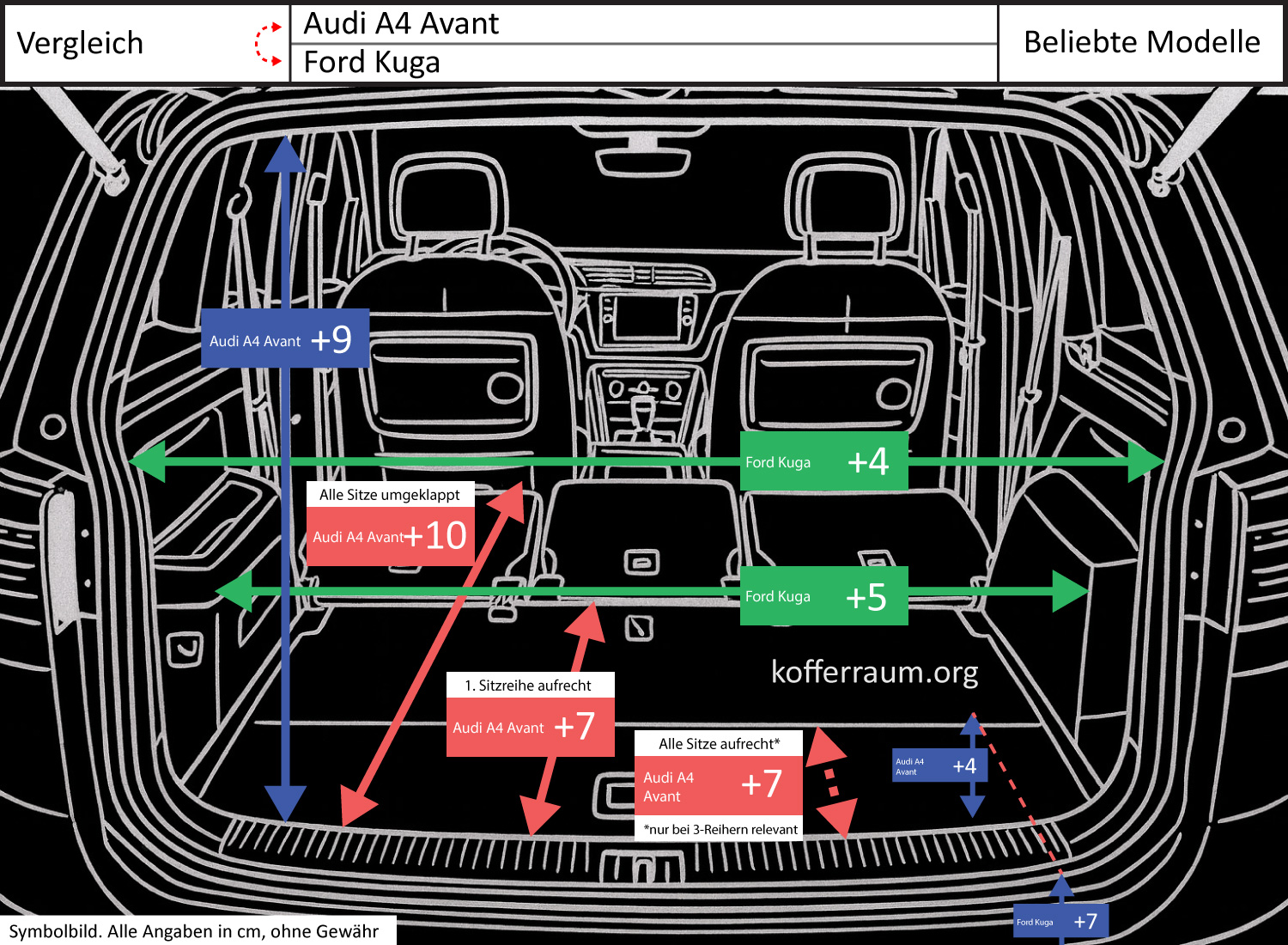
The Audi A4 Avant offers a higher trunk opening and significantly more interior depth, while the Ford Kuga has a higher loading edge. Specifically:
- Trunk opening height: Audi is 3.5 in (+12%) higher — better vertical cargo space dimension.
- Trunk depth (loading edge → floor): Audi is 1.6 in (+400%) deeper — significantly more usable interior height/depth in the cargo area.
- Loading edge height above road center: Ford is 2.8 in (+11%) higher — higher lifting height when loading.
What impact do these differences have on usability?
Advantages of the Audi A4 Avant: The higher opening (+12%) and significantly greater interior depth (+400%) make the A4 Avant more practical for tall or stacked cargo (e.g., boxes, upright furniture pieces, bicycle with partially mounted front wheel).
The lower loading edge makes it easier to slide and lift heavy items, as less lifting is required.
Advantages of the Ford Kuga: The higher loading edge (+11%) means more effort is needed to lift bulky or heavy items over the threshold — this can make loading more difficult.
In return, the width at the narrowest point (+5%) and the opening width (+4%) are slightly larger in the Kuga (below the 10% mark), which can facilitate loading very wide items. However, the overall slightly lower interior height/depth limits the volume for tall or stacked cargo.
Conclusion: For users who frequently transport tall or stacked cargo or value the most usable interior space, the Audi A4 Avant is more advantageous.
For those who want to load rather wide, flat, or bulky items through a wider opening, the Ford Kuga can be more practical despite the higher loading edge. Smaller length differences with folded or upright seats (6–7%) are generally less decisive for everyday usability.