
Trunk comparison: Audi A6 Avant vs BMW 3 Series Touring
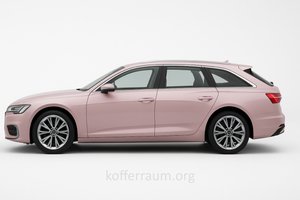
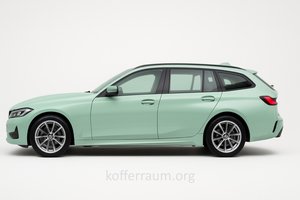
Key Differences
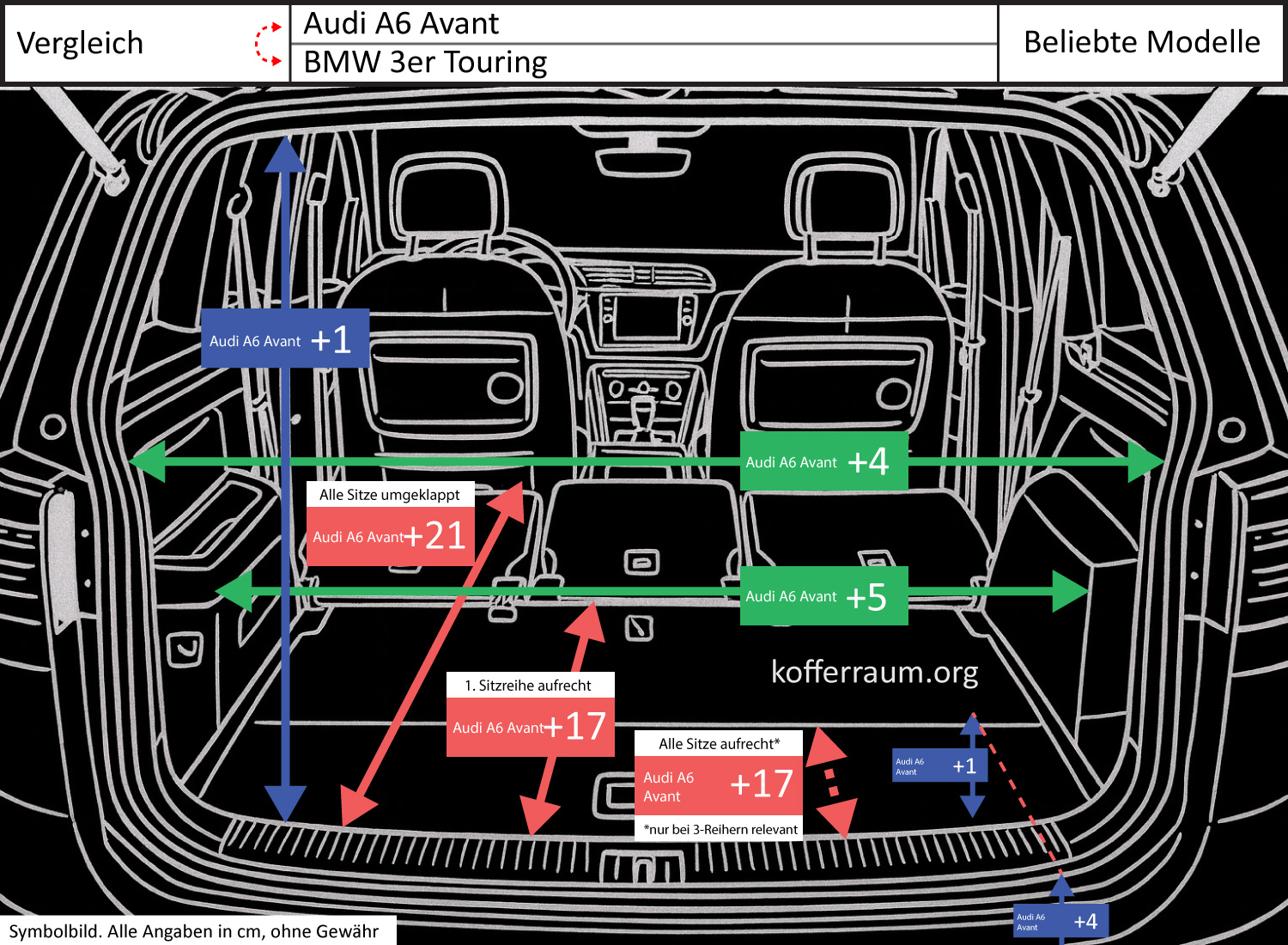
The Audi A6 Avant offers a 8.3 in (12%) longer cargo area with the seats folded down compared to the BMW 3 Series Touring. With the front seats upright, the Audi still leads with a 6.7 in (17%) longer trunk depth.
Additionally, the trunk depth (loading edge to trunk floor) is listed as 0.4 in (100%) greater in the Audi.
Smaller differences include: the Audi's loading edge is 1.6 in (7%) higher, the narrowest trunk width is +2 in (5%) wider, and the opening width is +1.6 in (4%) larger; the height of the trunk opening differs by only 0.4 in (1%).
Impact on Usability
The significantly longer loading length with folded seats (+8.3 in / 12%) makes the Audi more practical for long items such as furniture parts, long sports equipment, or building materials; items that could not be laid flat in the BMW are more likely to fit in the Audi.
Even with the front seats upright, the additional length (+6.7 in / 17%) improves everyday usability: longer suitcases, strollers, or bulky shopping can be stored more easily without folding seats down.
The greater depth between the loading edge and trunk floor (+0.4 in / 100%) means more usable floor space or a slightly deeper cargo compartment — this helps to store flat or slightly elevated items neatly and prevents them from protruding over the loading edge.
The higher and wider dimensions in the Audi (loading edge +1.6 in, width at the narrowest point +2 in, opening width +1.6 in) are minor advantages and affect practical use less strongly: they slightly ease loading and unloading but make lifting heavy loads a bit more difficult due to the higher loading edge.
Overall, the Audi A6 Avant is more flexible for longer and bulkier loads; the BMW 3 Series Touring remains competitive for more compact, everyday transport tasks.