
Trunk comparison: Audi A6 Avant vs Mazda Mazda CX-5

Biggest Differences
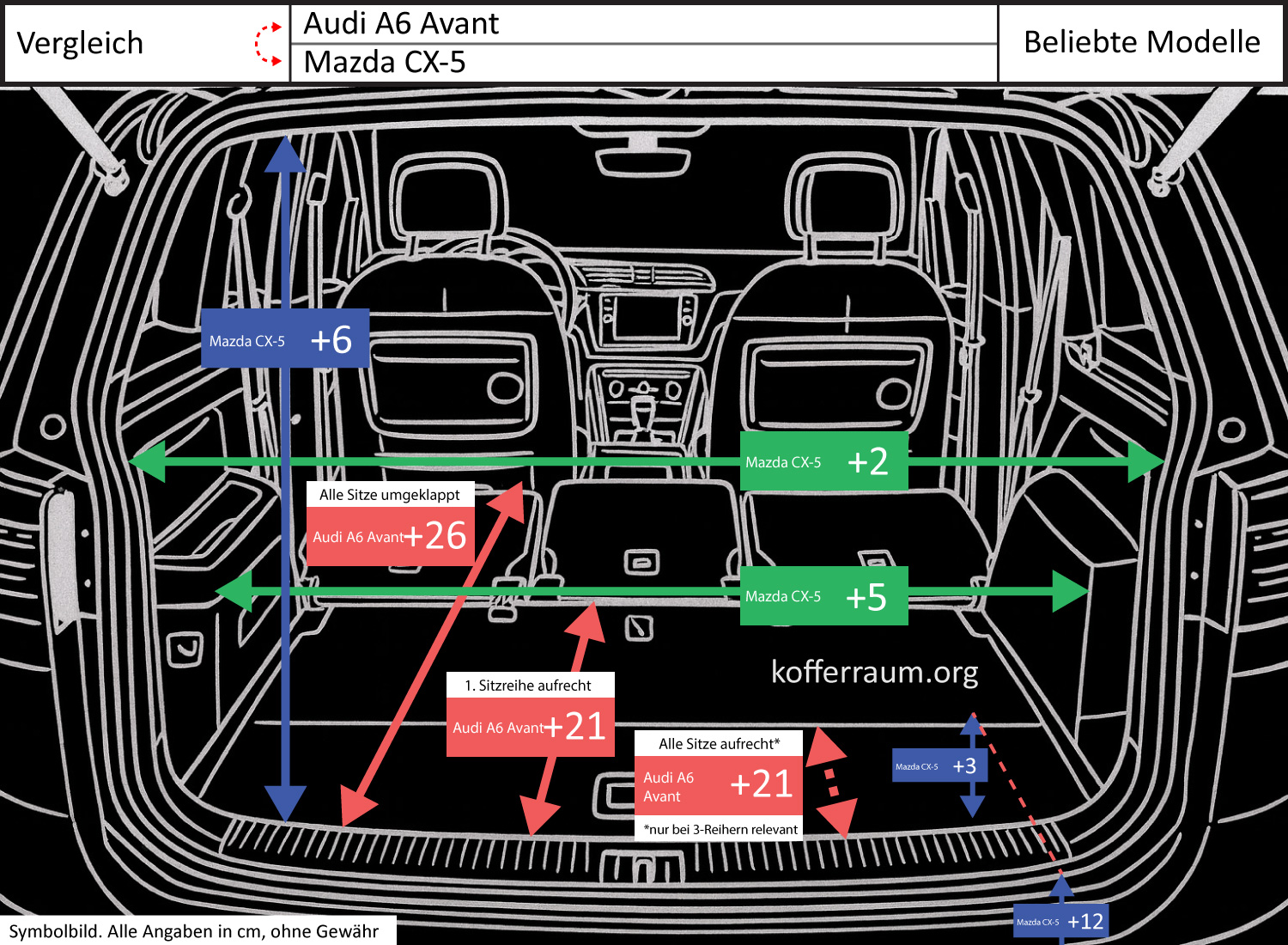
The Audi A6 Avant offers a significantly longer cargo space: with the seats folded down, it is +10.2 in (15%) longer, and with the first row upright, +8.3 in (22%) longer compared to the Mazda CX‑5. On the Mazda side, two measurements are noticeably larger: the distance between the loading edge and the trunk floor is +1.2 in (150%) higher and the loading edge itself is +4.7 in (19%) higher above the road than in the A6. Smaller differences under 10% (e.g., width at the narrowest point +2 in / 5%, opening width +0.8 in / 2%, opening height +2.4 in / 8%) are less decisive.
Implications for Usability
The longer cargo space of the A6 Avant makes it more practical for long items (skis, slats, furniture parts) and overall provides more usable loading area, especially when the rear seats are folded down. For frequent transport of longer or flat cargo, the A6 is clearly advantageous.
The higher loading edge of the Mazda (±19%) means more lifting is required when loading — this complicates placing heavy or bulky items and makes lifting in and out more strenuous.
At the same time, the greater depth between the loading edge and trunk floor (+1.2 in) results in a noticeably different loading geometry: items must be lifted over a higher edge and then lowered or pushed further in, which makes handling heavy or awkward cargo less favorable.
In short: Those who often transport long or many items benefit from the Audi A6 Avant. Those who prefer higher ground clearance/loading edge and thus tend to favor better off-road capability will find these qualities in the Mazda CX‑5 — however, the higher loading heights worsen the handling of heavy cargo.