
Trunk comparison: Audi Q2 vs BMW 5 Series Touring
Key Differences
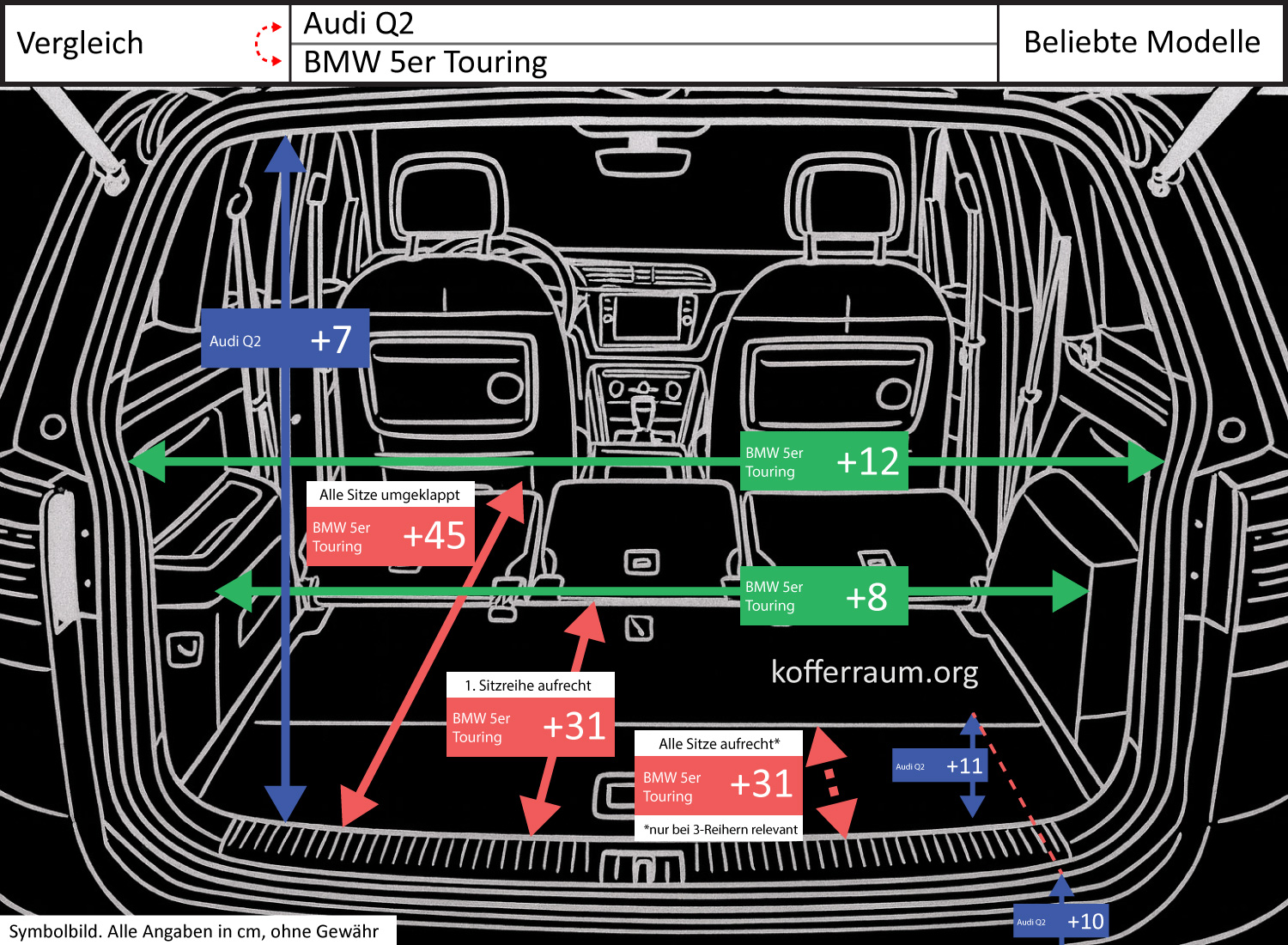
According to the data, the BMW 5 Series Touring mainly differs in usable cargo space: with the seats folded down, the BMW is 17.7 in (+31%) longer, and with the front seats upright even 12.2 in (+40%) longer than the Audi Q2. The Audi Q2, on the other hand, has a significantly greater trunk depth (distance from loading edge to trunk floor): here the Audi is 4.3 in (+1000%) deeper.
Additionally, the Audi's loading edge is 3.9 in (+15%) higher above the ground. In terms of trunk opening width, the BMW leads: the opening is 4.7 in (+13%) wider than the Audi's.
What are the implications for usability?
The longer cargo area of the BMW makes it significantly more practical for long items (e.g., skis, long furniture parts, lumber) and for luggage on family or long-distance trips — more length means more usable storage space, especially when seats are folded down.
The wider trunk opening makes loading wide or bulky items easier because it requires less maneuvering.
The deeper trunk floor of the Audi, on the other hand, creates a kind of loading tub: shorter but tall or items fitting into the recess can be stored compactly. This can be advantageous for shopping bags or boxes, which then stand more securely.
However, the higher loading edge of the Audi makes lifting heavier items in more strenuous and limits easily sliding in large, flat loads. Combined, this means: Audi is better suited for compact, deeper-stored loads; BMW is better when length, width, and easier handling during loading and unloading are decisive.
Conclusion: For transport tasks with long or wide items and for maximum flexibility when loading, the BMW 5 Series Touring is the more practical choice. For cross-stacked loads that fit into a loading tub, the Audi Q2 can offer advantages but suffers from the higher loading edge when lifting heavy loads.