
Trunk comparison: Audi Q2 vs Mazda Mazda CX-60


Key Differences (Compact Summary)
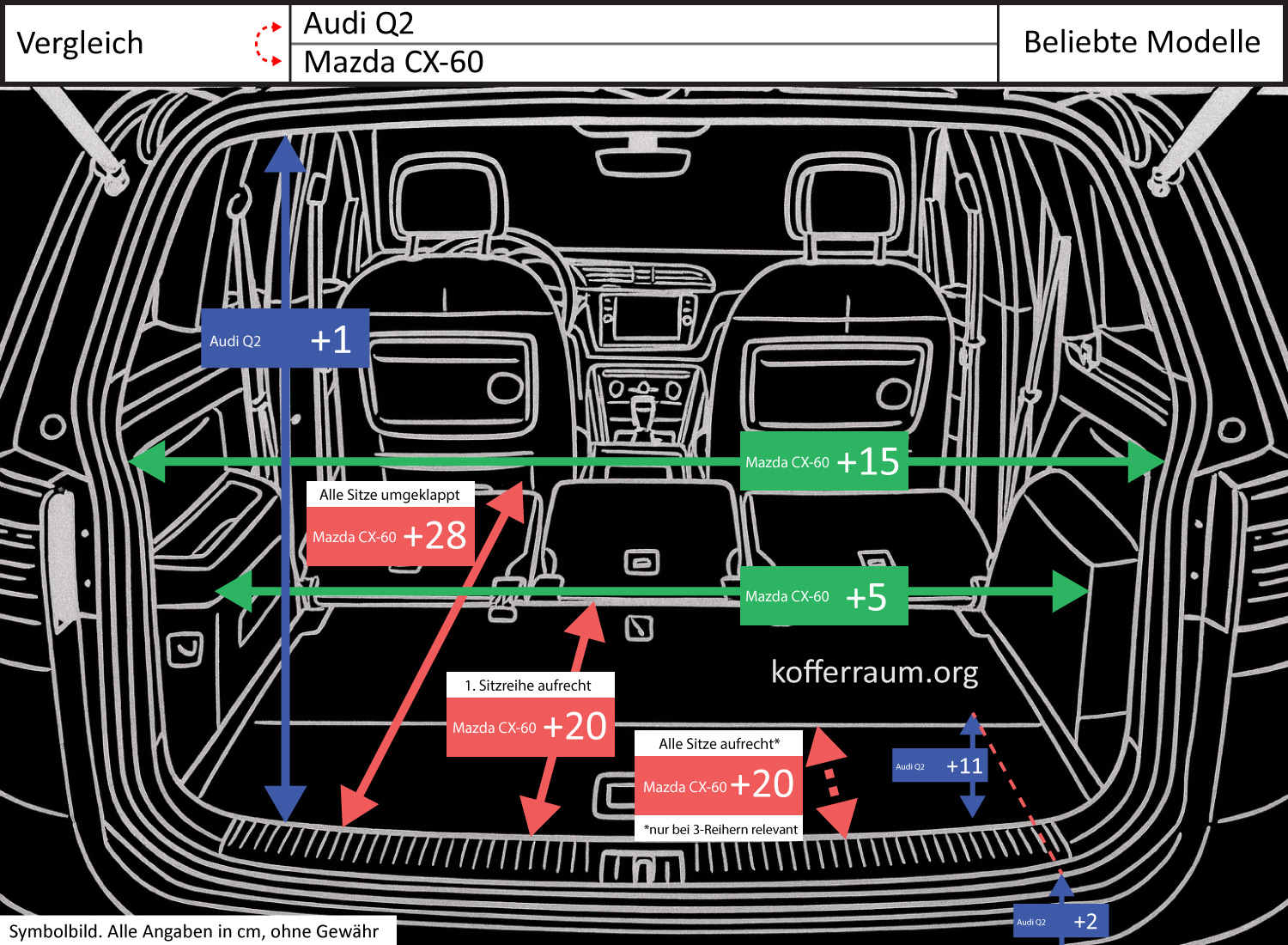
The Mazda CX-60 offers significantly more cargo length and a wider opening: with the seats folded down, the trunk of the CX-60 is 11 in or 19% longer, and with the front seats upright, it is 7.9 in or 26% longer than the Audi Q2. The width of the CX-60's trunk opening is 5.9 in or 16% larger.
In contrast, the Audi Q2 has a significantly deeper loading step between the loading edge and the trunk floor — listed as 4.3 in or 1000% greater — indicating a lower loading floor.
Other differences are minor: the height of the Audi's trunk opening is +0.4 in (1%) higher, the loading edge of the Audi is +0.8 in (3%) above the ground, and the narrowest trunk width of the CX-60 is only +2 in (5%) larger.
What Are the Practical Implications of These Differences?
Practically, this means: The Mazda CX-60 clearly has the advantage for long or wide items.
The significantly longer loading floor (each >10%) and the wider opening make it easier to load furniture parts, long slats, bicycles (depending on shape), or wide boxes and allow for more flexible space usage with the seats folded down. The larger opening simplifies stowing awkward or bulky cargo.
The Audi Q2, on the other hand, scores with a significantly deeper loading well below the loading edge. This creates additional storage space for low-lying, stackable, or loose items that fit well in a deeper loading floor and prevents cargo from protruding over the loading edge.
However, the greater depth can make pulling out heavy items more difficult and, combined with the only slightly higher loading edge (+0.8 in), can make loading somewhat more strenuous than with very low loading floors.
Minor details like the Audi's 0.4 in higher opening height or the CX-60's 2 in wider narrowest width have little impact on everyday use and loading flexibility in practice.