
Trunk comparison: Audi Q2 vs VW Tiguan
Biggest Differences
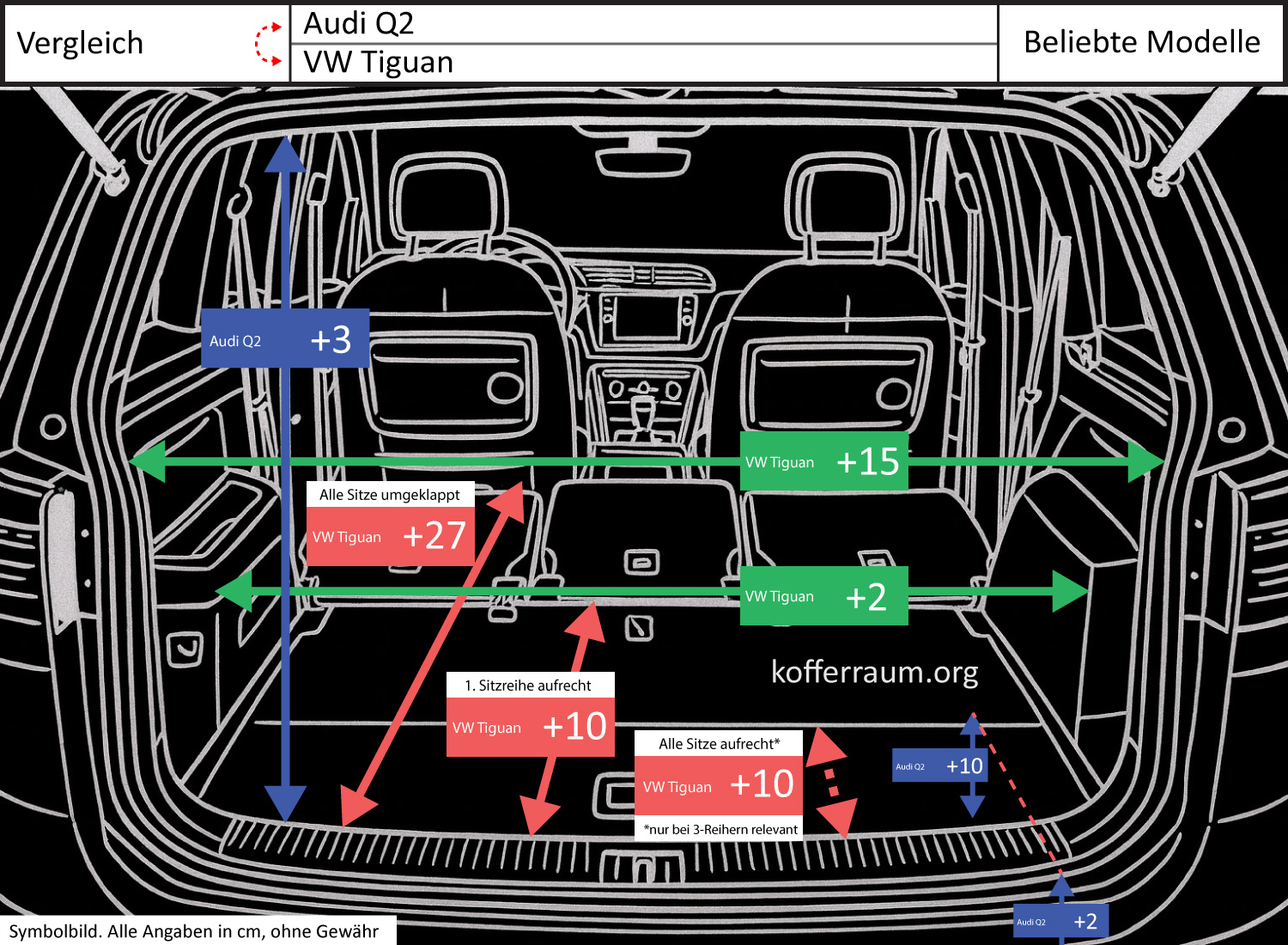
Clear strengths appear on both sides when it comes to cargo volume and accessibility. The VW Tiguan offers a cargo space that is 10.6 in (≈19%) longer with the seats folded down and 3.9 in (≈13%) more length with the first row of seats upright.
Additionally, the width of the trunk opening in the Tiguan is 5.9 in (≈16%) larger.
The Audi Q2 stands out particularly with the depth between the loading edge and the trunk floor: this is 3.9 in (≈1000%) greater than in the Tiguan.
Smaller differences (under 10%) concern the height of the trunk opening (+1.2 in in the Q2), the loading edge height above the road (+0.8 in in the Q2), and the narrowest width of the cargo space (+0.8 in in favor of the Tiguan).
What This Means in Practice
For longer transports and bulky, flat items (e.g., long slats, skis, flat furniture parts), the Tiguan is clearly advantageous due to the greater cargo length: the additional length both with folded seats and with the rear bench upright makes it more versatile for longer loads.
The significantly larger opening width of the Tiguan also makes loading and unloading wider items and boxes easier.
The Audi Q2 scores with the significantly greater depth between the loading edge and the trunk floor. Practically, this means more "vertical depth" directly behind the loading edge, which facilitates storing tall or irregularly shaped items in the front area of the trunk and allows for a deeper cargo compartment.
However, the loading edge of the Q2 is slightly higher above road level, making heavy lifting a bit more strenuous.
In summary: Those who frequently transport long or wide loads clearly benefit from the Tiguan.
Those who need more usable depth immediately behind the loading edge (e.g., tall boxes, bulky shapes that should "disappear" in depth) find an advantage in the Q2. Smaller differences in opening height, loading edge height, and narrow spots only moderately affect everyday usability.