
Trunk comparison: BMW 3 Series Touring vs BMW 5 Series Touring
Key Differences
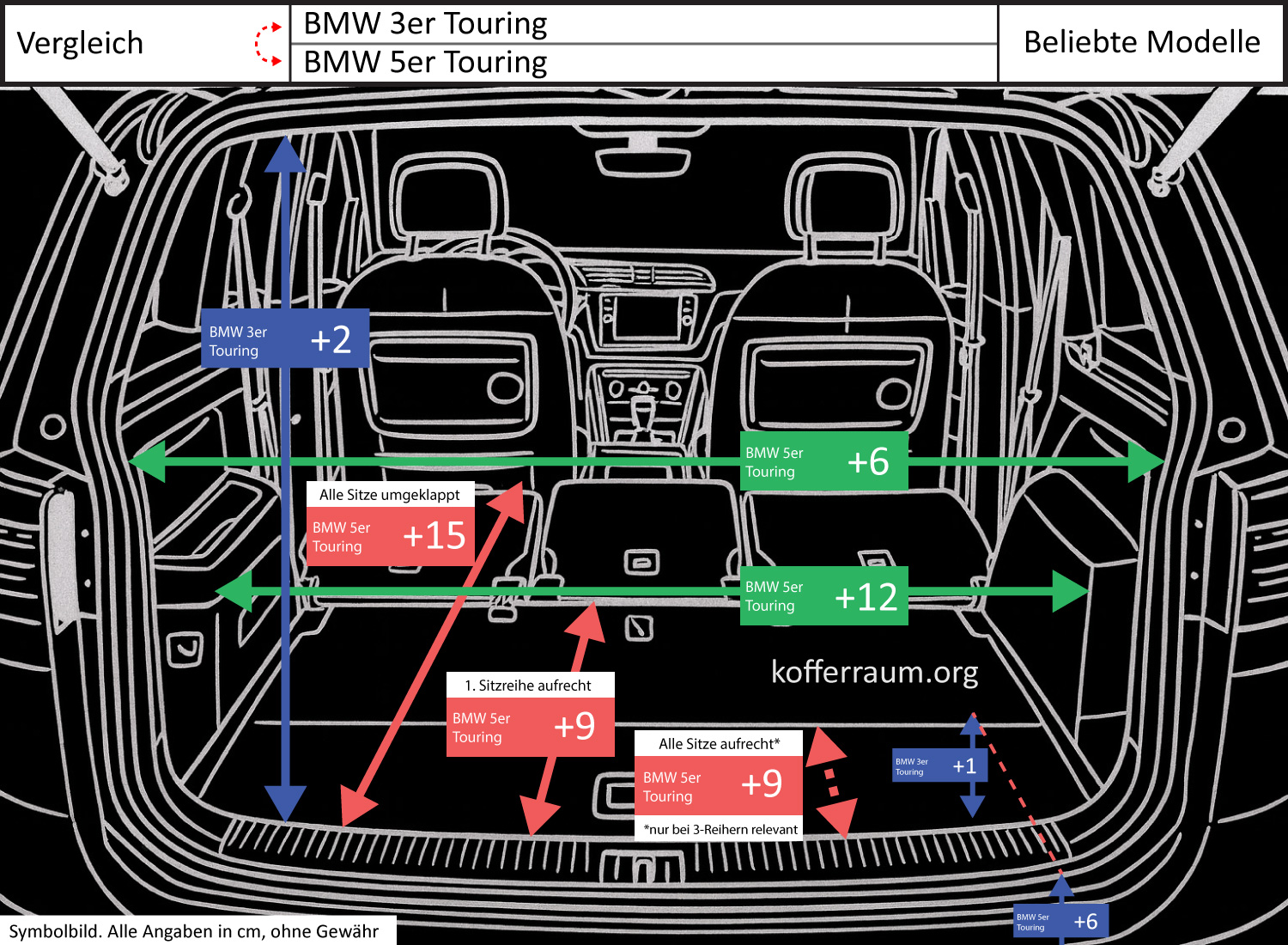
The measurements mainly show differences in length, height, and width of the cargo area. With the rear seats fully folded down, the BMW 5 Series Touring is 5.9 in (9%) longer, and with the first row of seats upright, it is 3.5 in (9%) longer than the 3 Series.
The trunk opening of the 3 Series is 0.8 in (3%) higher, and the depth (from loading edge to floor) is 0.4 in (0%) greater in the 3 Series.
The loading edge of the 5 Series is 2.4 in (10%) higher above the ground. Notably, the width at the narrowest point: the BMW 5 Series Touring offers 4.7 in (13%) more space than the 3 Series here. The width of the 5 Series' trunk opening is additionally 2.4 in (6%) larger.
Impact on Usability
The larger narrowest width (+4.7 in / 13%) in the 5 Series is the most practically important difference: it allows significantly wider or bulkier items (e.g., furniture parts, larger boxes, or luggage) to fit without hassle, reduces the risk that bulky items won’t fit through tight spots, and makes loading overall more flexible.
The longer loading surfaces of the 5 Series (+5.9 in / 9% with folded seats, +3.5 in / 9% with upright seats) increase the usable cargo volume but are under 10% in percentage terms and thus a moderate advantage—noticeable with longer items but not a big leap.
The higher loading edge of the 5 Series (+2.4 in / 10%) makes lifting heavy loads somewhat more strenuous; here, the 3 Series has a small practical advantage due to the lower loading edge when frequently lifting and loading/unloading.
The slightly higher trunk opening and minimal depth advantages of the 3 Series (0.8 in and 0.4 in respectively) are minor and rarely have practical effects.
In summary: Those who often transport wide, bulky loads clearly benefit from the 5 Series Touring due to the significantly larger narrowest width. Those who frequently lift heavy items or value a slightly lower loading edge have a small advantage with the 3 Series.