
Trunk comparison: BMW 3 Series Touring vs BMW i4
Key Differences
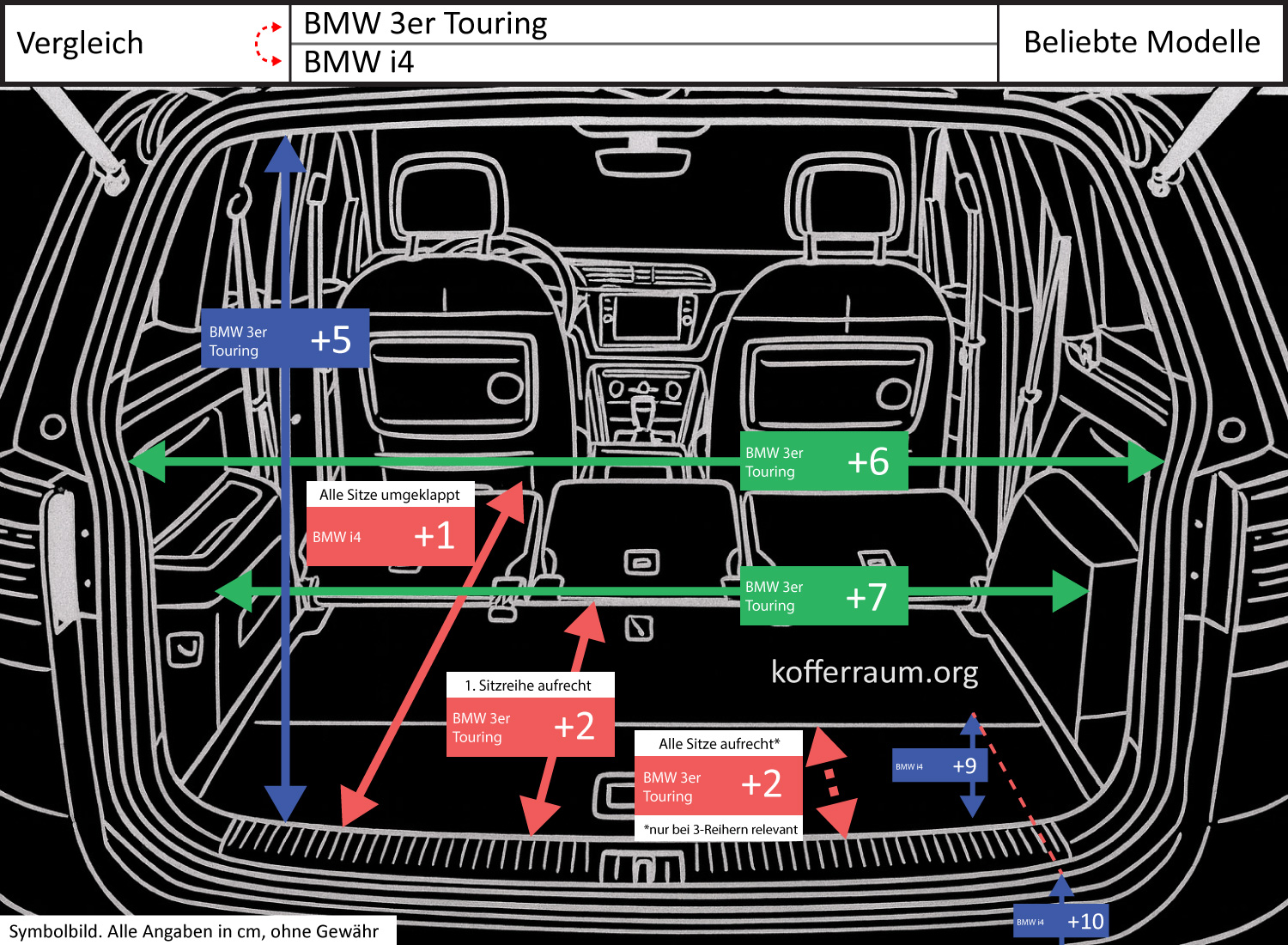
The most notable differences lie in the installation depth of the trunk and the loading edge height: the depth of the trunk (loading edge to trunk floor) is 3.5 in (+900%) greater in the BMW i4, and the loading edge of the BMW i4 is 3.9 in (+17%) higher above the road than in the BMW 3 Series Touring.
All other stated deviations are under 10% (trunk volume with folded seats +1%, trunk with front seats upright +2%, height of trunk opening +7%, narrowest width +8%, width of trunk opening +6%) and thus comparatively minor.
Impact on Usability
The greater installation depth of the i4 means more "depth space" behind the loading edge: this can be advantageous for tall or bulky items because more interior height is available under the loading edge.
At the same time, the loading edge being 3.9 in higher makes lifting heavy items into the i4 significantly more strenuous and less practical—especially during frequent loading and unloading or with heavy suitcases.
Because the width of the opening and the narrowest width are each slightly larger in the 3 Series Touring, wide cargo can be loaded crosswise a bit more easily there; however, the difference is small and only noticeable with very wide loads.
The slightly higher trunk opening of the Touring (also only about 7%) helps a little when handling tall items but is not a major advantage.
Conclusion: For frequent loading of heavy loads and comfortable lifting, the 3 Series Touring is more practical due to the significantly lower loading edge.
For tall items to be stored deep in the cargo area, the i4 offers a benefit through the greater installation depth but causes more effort when loading due to the higher loading edge.