
Trunk comparison: BMW 3 Series Touring vs Dacia Duster

Key Differences (Summary)
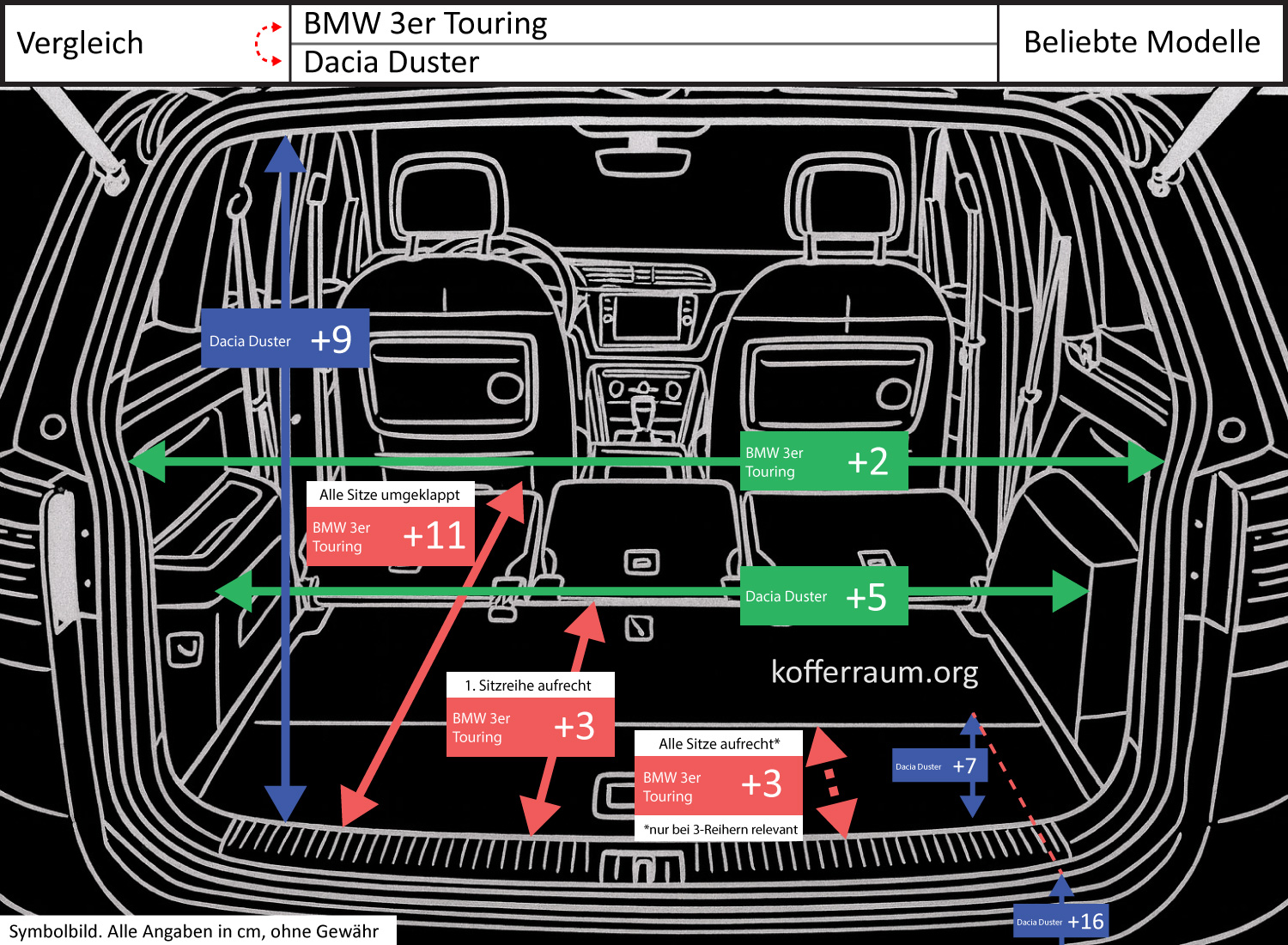
The most noticeable differences concern the height of the trunk opening, the depth of the trunk, and the loading edge height: The Dacia Duster has a trunk opening that is 3.5 in higher (+13%), a significantly deeper trunk recess (loading edge–floor) by 2.8 in (+700%), and a loading edge that is 6.3 in higher above the road (+27%) compared to the BMW 3 Series Touring.
Other dimensions differ only slightly: the BMW offers a longer cargo area with the seats folded down (+4.3 in / 7%) and a slightly wider opening (+0.8 in / 2%), while the Duster is minimally wider at the narrowest point (+2 in / 5%).
Impact on Usability
The higher values in the Duster specifically mean: The higher trunk opening makes it easier to load tall or bulky items (e.g., boxes, furniture parts), the deeper trunk recess provides more usable vertical volume (items can be pushed further down), but reduces the flat loading surface.
The combination of a deeper trunk floor and a higher loading edge means you have to lift heavy items further and higher — increasing the effort required when loading and unloading.
The BMW 3 Series Touring is more practical for long, flat loads (the cargo area is longer with seats folded) and has a lower loading edge, which simplifies handling heavy or frequent loads.
Its slightly wider opening also helps when sliding in wider parts from the side. The Duster scores with volume for tall or irregularly shaped cargo but makes lifting more strenuous and offers less flat loading surface.
Conclusion: Those who often transport tall or bulky but light items benefit from the Duster. Those who frequently carry heavy or long, flat loads and value easy lifting are better off with the BMW.