Trunk comparison: BMW 3 Series Touring vs Durchschnitt SUV

Key Statements
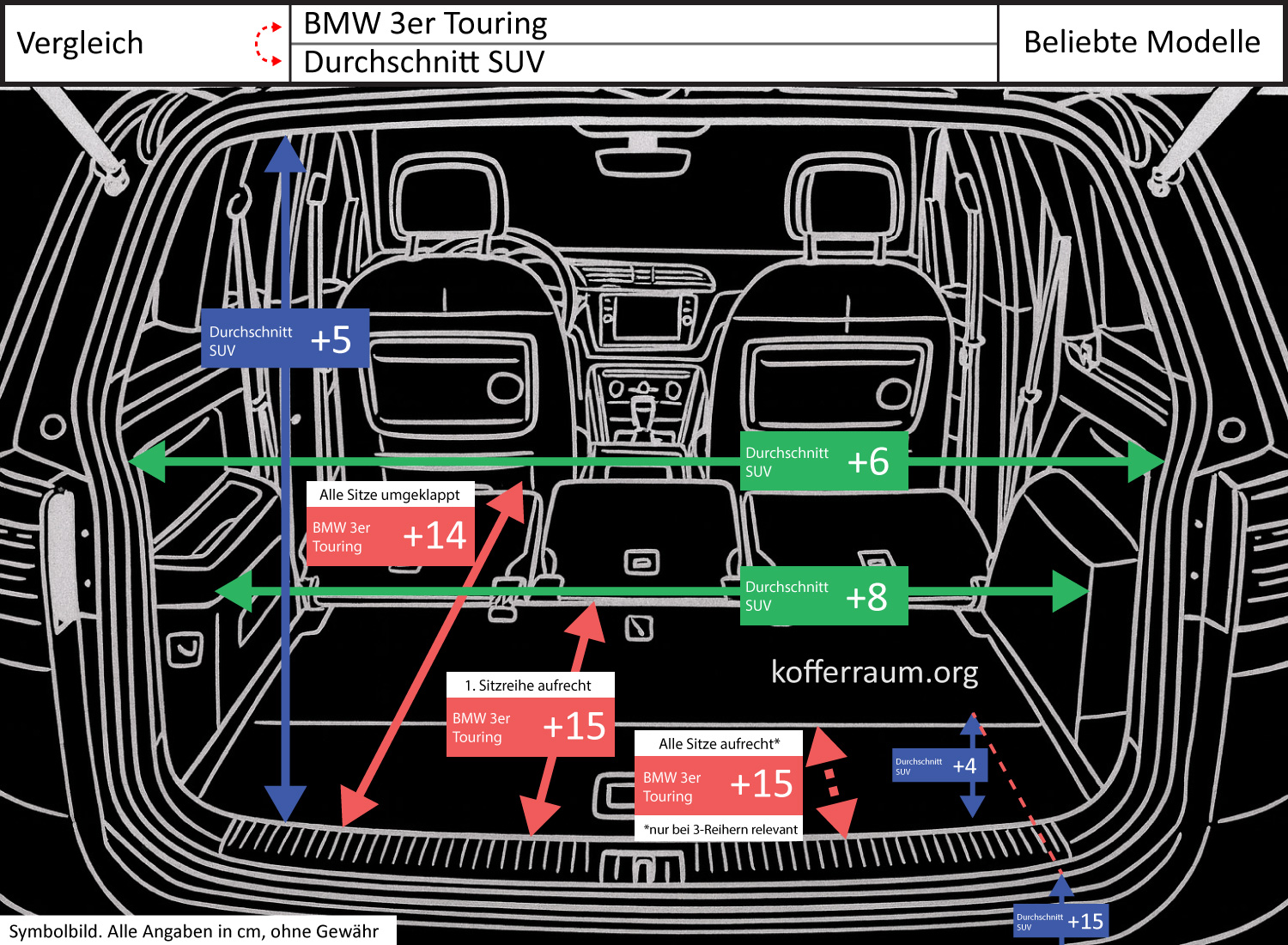
Significant differences mainly concern length with the rear seats upright, loading height, and the depth of the cargo area. The BMW 3 Series Touring offers a longer loading surface with seats upright; specifically, the trunk is 5.9 in (18%) longer than the average SUV.
In contrast, the SUV's loading edge sits significantly higher: the loading edge is 5.9 in (25%) higher above the road. Additionally, the depth of the cargo area (distance loading edge → trunk floor) is 1.6 in (400%) greater in the SUV than in the Touring.
Other measured differences are less than 10%: the Touring has +5.5 in (9%) loading length with seats fully folded down, the SUV has a slightly higher trunk opening (+2 in / 7%) as well as a bit more width at the narrowest point (+3.1 in / 8%) and at the opening (+2.4 in / 6%).
These points are noticeable but less defining than the deviations highlighted above.
Impact on Usability
The 18% longer loading surface of the Touring with the rear seats upright makes it more practical for long items that need to be transported with passengers (e.g., skis, long profiles, window frames). You need to fold down the rear seats less often to accommodate longer cargo.
The 25% higher loading edge of the SUV means more effort is required to lift heavy or bulky items into the trunk. For regular loading and unloading of heavy loads, the Touring is more ergonomic and user-friendly in everyday use due to the lower loading edge.
The significantly greater depth of the SUV cargo area (1.6 in absolute, here with a large percentage) shows that the cargo floor is positioned relatively deeper compared to the loading edge.
Practically, this can mean two things: more usable volume for lower items or a more pronounced edge when pushing/staking cargo—in either case, depending on the shape of the load, this can be an advantage or disadvantage.
However, since the absolute difference is only 1.6 in, the practical effect is moderate; the percentage figure appears large due to a very small reference value.
The slightly greater width and opening height of the SUV (each <10%) make it easier to load wider but not very long items; however, this advantage is small compared to the differences in length and loading edge.
Conclusion: For frequent transport of long items with passengers and for ergonomic loading of heavy goods, the BMW 3 Series Touring is preferable. For slightly bulkier cargo with somewhat more opening space, the SUV can be marginally advantageous, but the practical benefits there are less pronounced.