
Trunk comparison: BMW 3 Series Touring vs Hyundai Elantra GT Wagon
Key Differences
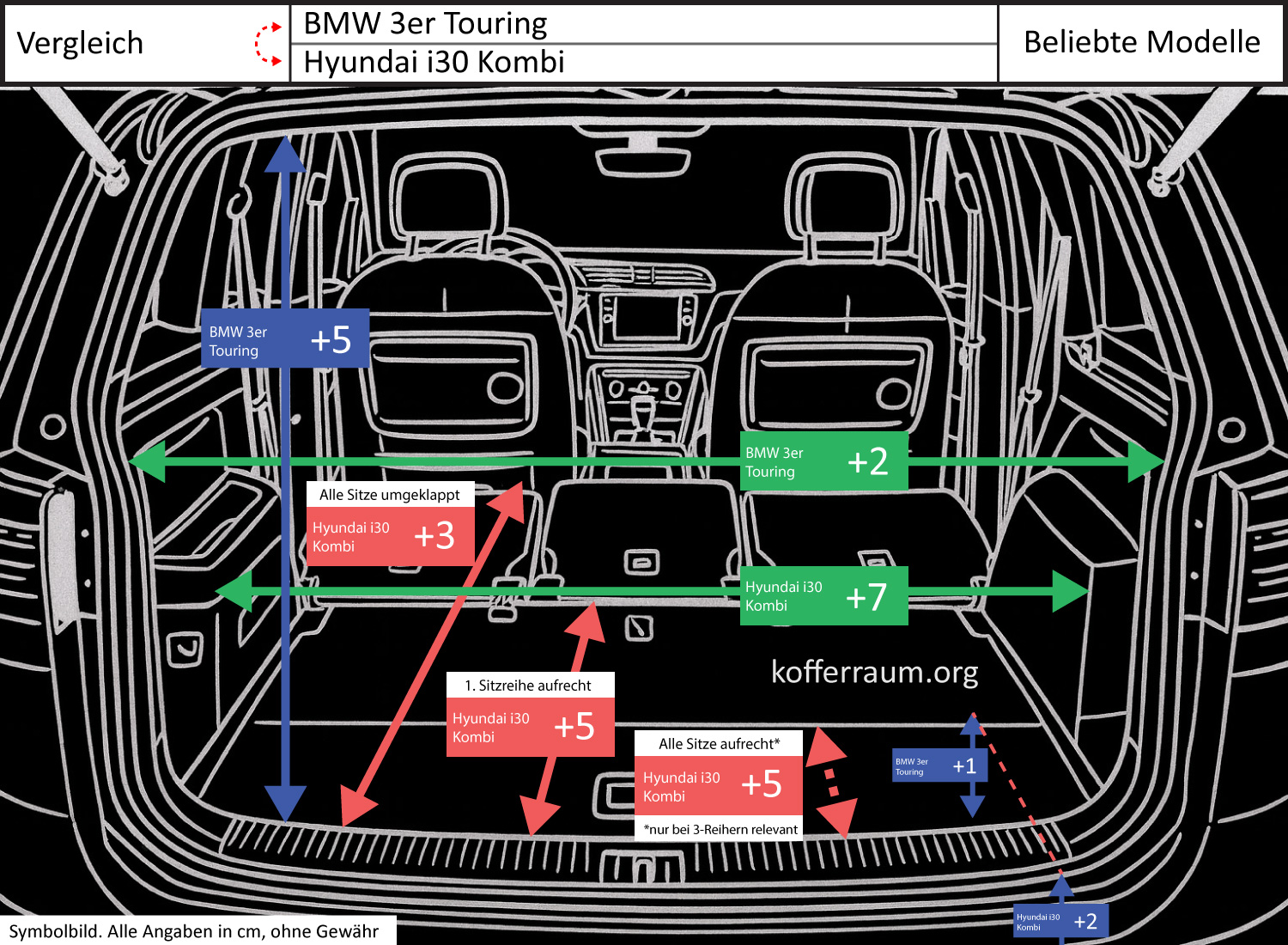
None of the listed differences exceed 10%. The most noticeable deviations are: the Hyundai has a trunk that is 1.2 in (2%) longer with the rear seats folded down and 2 in (5%) longer with the first row of seats upright; the narrowest width in the trunk is 2.8 in (7%) greater in the Hyundai. The BMW has a trunk opening height that is 2 in (7%) greater, an opening width 0.8 in (2%) greater, and a depth (loading edge → trunk floor) 0.4 in (+0%) greater. The Hyundai's loading edge is 0.8 in (3%) higher above the ground than the BMW's.
What impact do these differences have in practice?
- Cargo length (Hyundai +3–2 in): In practice, the difference is small. The Hyundai offers slightly more usable length for flat or long items (e.g., slats, roller shutters), but 3–2 in rarely decides whether something fits or not. - Narrowest width (Hyundai +2.8 in): This is the most significant individual advantage. More width at the narrowest point makes it easier to store wide boxes, plastic crates, or bulky items and reduces turning/manoeuvring when loading. - Trunk opening height (BMW +2 in) and opening width (+0.8 in): A larger opening in the BMW makes loading tall or bulky items easier and reduces the risk of bumping against the frame. This is especially practical for bulky, cumbersome objects. - Loading edge (Hyundai +0.8 in higher): The higher loading edge of the Hyundai slightly complicates lifting heavy items; lifting is somewhat more comfortable with the BMW due to the lower loading edge. - Depth (BMW +0.4 in): Negligible in everyday use. In short: The Hyundai scores more on usable width and slightly more length in the floor area, the BMW on the loading opening and low-level handling. Overall, the differences are moderate — for most everyday users, both wagons are very similarly usable. Those who regularly transport wide, flat loads have a noticeable advantage with the Hyundai; those who more often load tall or heavy-to-lift items benefit more easily from the BMW.