
Trunk comparison: BMW 3 Series Touring vs Hyundai IONIQ
Key Differences
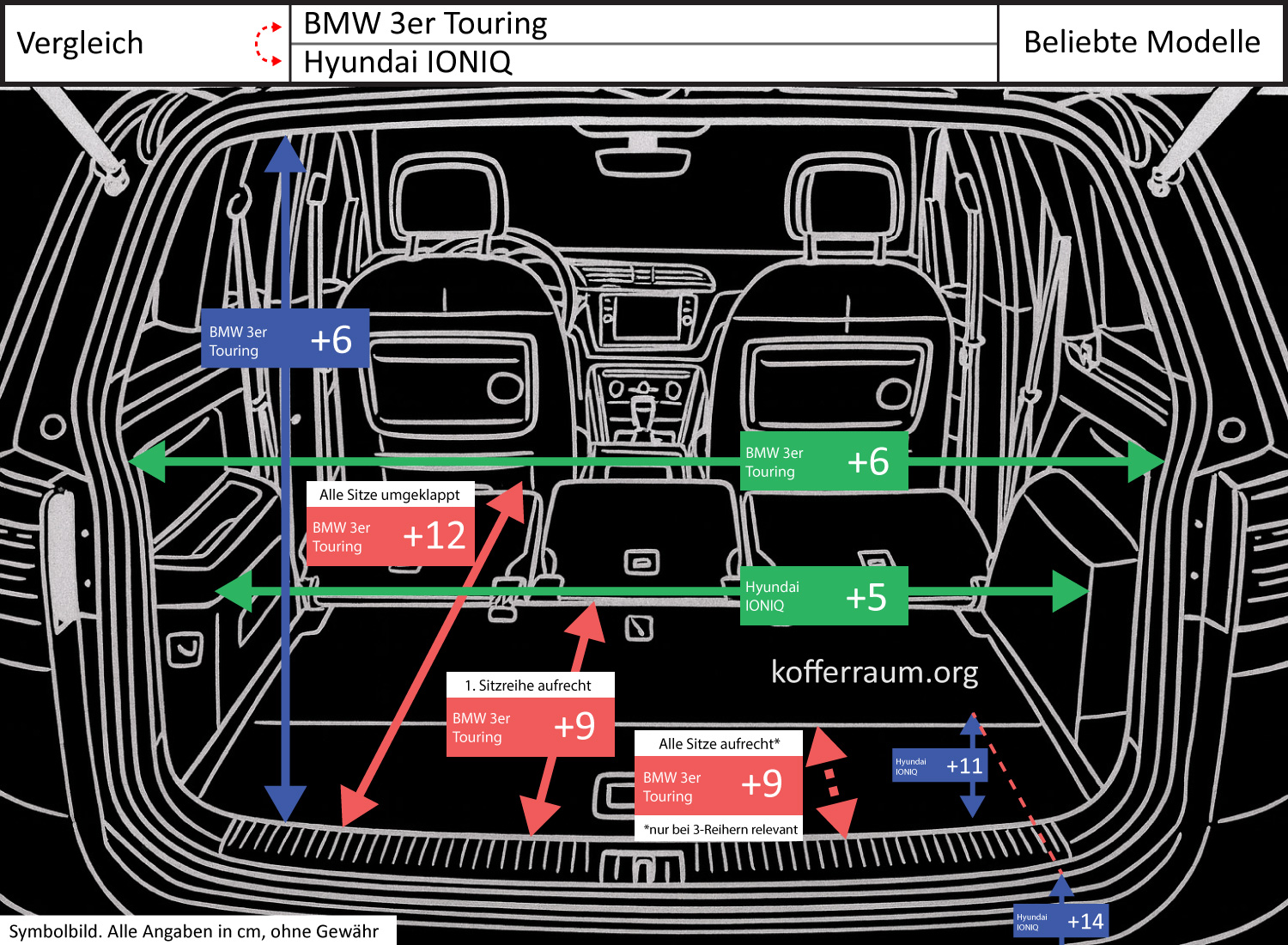
The Hyundai IONIQ shows two significantly above-average deviations: the depth of the trunk (loading edge to trunk floor) is 4.3 in (+1100%) greater in the IONIQ and the loading edge of the IONIQ sits 5.5 in (+23%) higher above the road.
Other differences (≤10%) are: the BMW has a 4.7 in (7%) longer cargo area with folded seats and 3.5 in (10%) more depth with the first row upright; the trunk opening of the BMW is 2.4 in (9%) higher, its opening width is 2.4 in (6%) larger; the IONIQ is 2 in (5%) wider at the narrowest point.
Impact on Usability
The combined features of the IONIQ (much greater interior depth and higher loading edge) practically mean: the trunk forms a deep loading tub that creates more vertical space inside the cargo area, but the loading opening is further above the ground.
This makes lifting heavy items more strenuous (more lift from ground to loading edge) and additionally requires reaching down into the interior. For bulky, tall items, the greater depth can be advantageous; for frequent lifting of heavy loads or easy loading and unloading, less so.
The BMW 3 Series Touring, in contrast, offers a lower loading edge and somewhat larger opening widths as well as a longer loading surface with folded seats.
This facilitates handling wide or heavy items (lower lift, better accessibility). However, the lesser interior depth means less "depth reserve" for very tall or rear-placed cargo.