
Trunk comparison: BMW 3 Series Touring vs Hyundai Kona
Key Differences
The following differences in pure cargo space emerge from the comparison text:
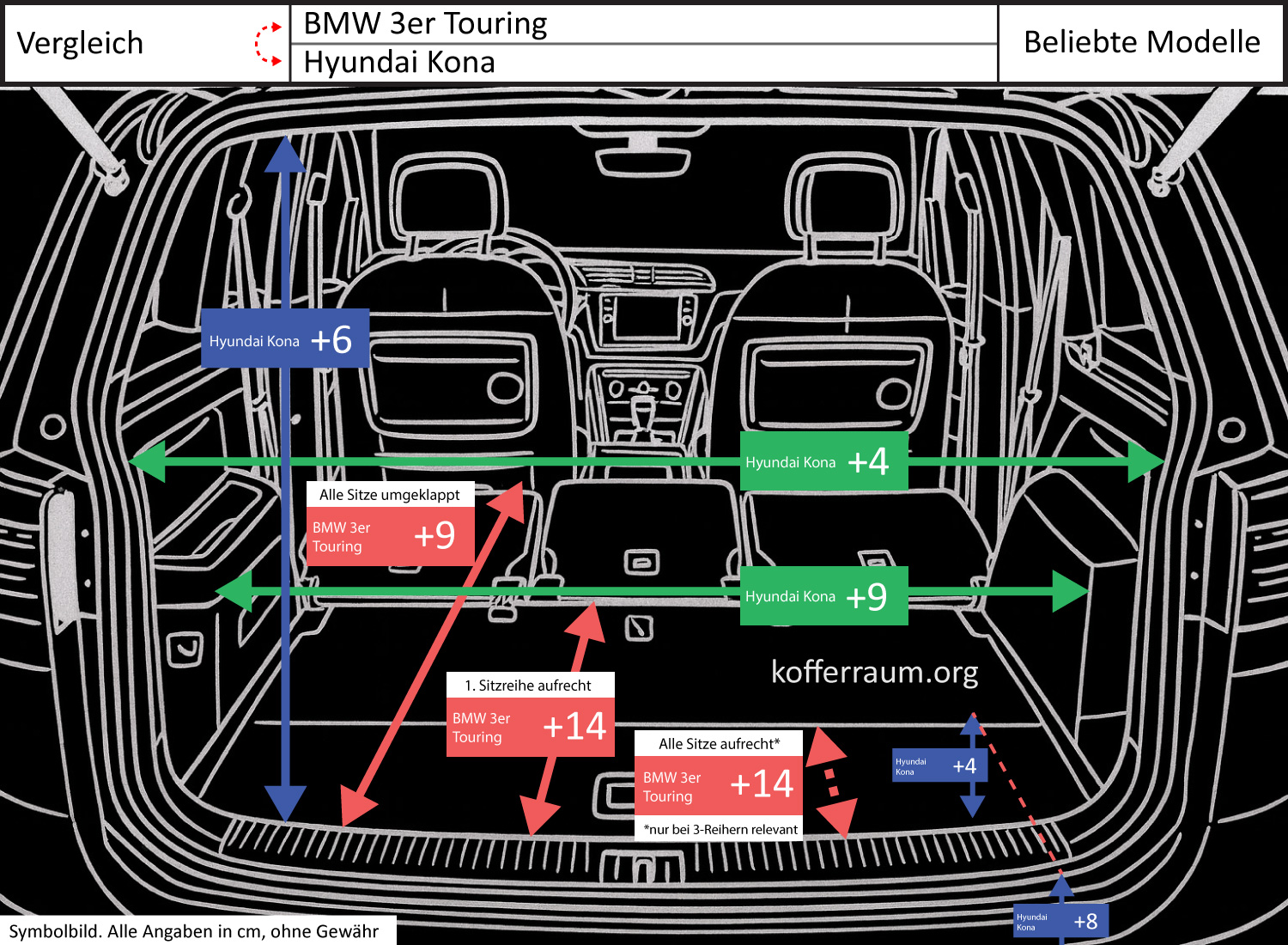
- With the first row of seats upright, the BMW 3 Series Touring has a +5.5 in (+16%) longer trunk than the Hyundai Kona.
- The depth of the trunk (loading edge to trunk floor) is +1.6 in (+400%) greater in the Hyundai Kona than in the BMW 3 Series Touring.
- The loading edge of the Hyundai Kona is +3.1 in (+13%) higher above the ground than that of the BMW 3 Series Touring.
- Other smaller differences (under 10%): BMW is +3.5 in (+5%) longer with seats fully folded down; the Kona has a trunk opening +2.4 in (+8%) higher, at the narrowest point the Kona is +3.5 in (+9%) wider; the width of the trunk opening is +1.6 in (+4%) larger on the Kona.
Impact on Usability
The highlighted differences shape practical use as follows:
- Longer loading floor in the BMW (+16%): In the specified seating configuration, the BMW is better suited for long items (e.g., long furniture parts, skis) that are to be transported without further folding. Those who regularly transport long loads have a clear advantage here.
- Significantly greater trunk depth in the Kona (+400%): The greater depth means more usable vertical distance between the loading edge and floor—practical for tall or irregularly shaped goods, stacking boxes, or large items that need space not only lengthwise. This acts like additional cargo space despite similar floor area.
- Higher loading edge on the Kona (+13%): The higher loading edge makes loading heavy or bulky items more difficult—more effort or aids (like ramps) are needed. For people with limited mobility or frequent lifting of heavy loads, the lower loading edge of the BMW is more comfortable.
- The remaining differences (<10%) have only minor practical impact: with seats fully folded, the models are very similar in length; slightly larger opening width and narrowest width on the Kona help when loading wider goods but are not decisive advantages.
Conclusion
If you frequently transport long items and a lower loading angle is important, the BMW 3 Series Touring is more advantageous.
If, on the other hand, more vertical capacity and the ability to stack bulky or tall cargo are more important, the Hyundai Kona offers more practical use with its significantly greater trunk depth—albeit at the cost of higher loading effort due to the raised loading edge.