
Trunk comparison: BMW 3 Series Touring vs Mazda Mazda CX-60


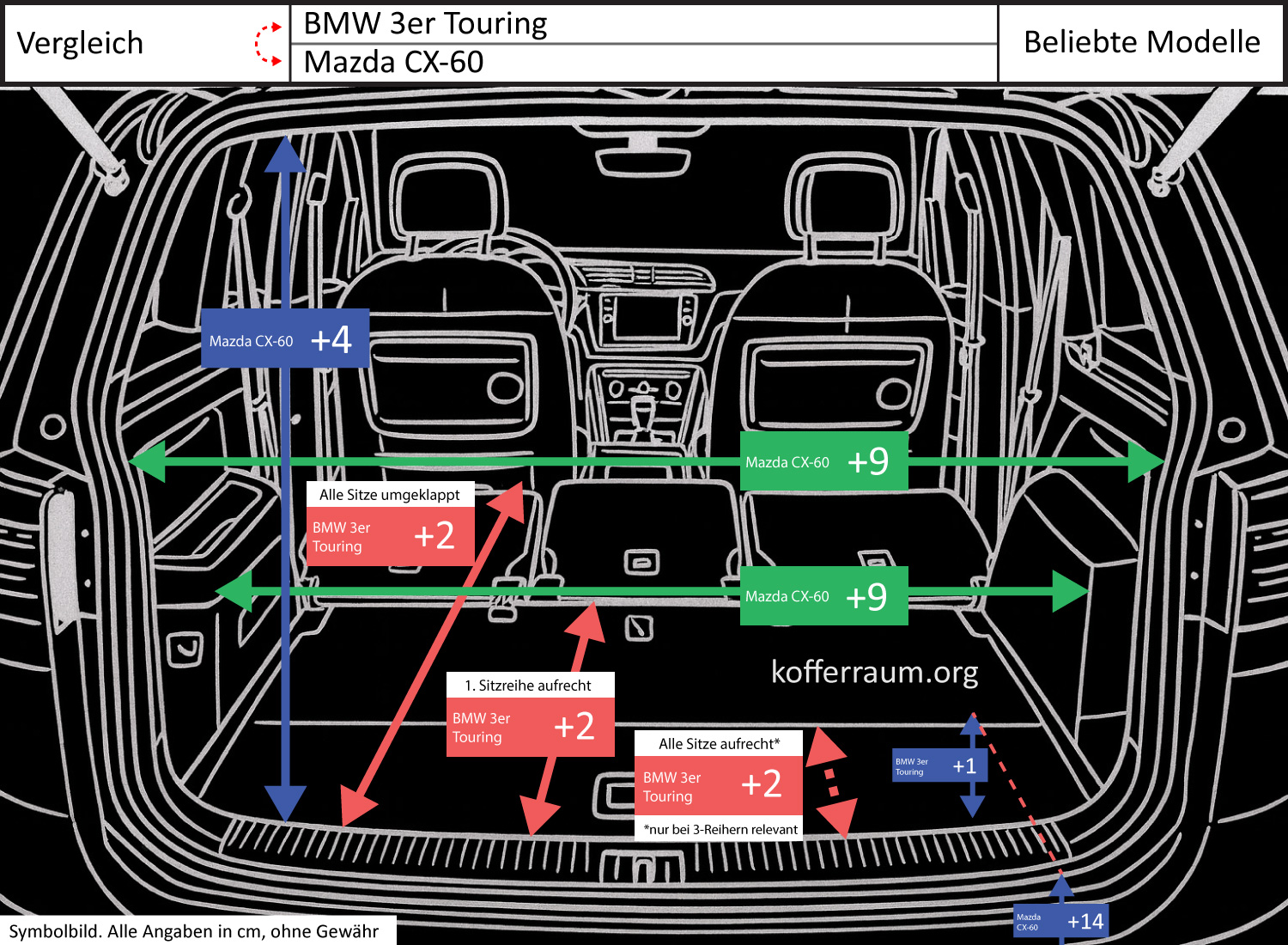
Key Differences
The most noticeable difference concerns the loading edge: the loading edge of the Mazda CX-60 is 5.5 in (+23%) higher above the road than that of the BMW 3 Series Touring.
Other differences are significantly smaller: the BMW offers about 0.8 in more trunk length with the rear seats folded down and with the front seats upright (≈1–2%), the trunk opening of the Mazda is about 1.6 in (≈6%) higher, the width at the narrowest point and the opening width of the Mazda are each about 3.5 in (≈9%) larger, and the depth of the BMW is only about 0.4 in (≈0%) greater.
Impact on Usability
The higher loading edge of the Mazda is relevant in practice: heavy lifting into the trunk becomes noticeably more strenuous, especially with bulky or heavy items. For regular loading and unloading of large, heavy loads, the BMW is more ergonomic due to the lower loading edge.
The greater width of the Mazda at the narrowest point and the wider trunk opening, on the other hand, make it easier to load wide or irregularly shaped items — even though the advantage of +9% is moderate.
The slightly higher opening height of the Mazda (+1.6 in) offers a bit more vertical clearance for tall items but cannot fully compensate for the disadvantage of the higher loading edge.
The slightly longer dimensions of the BMW (about 0.8 in each) and the somewhat greater depth are practically noticeable only with very long, flat loads; in everyday use, these differences are hardly decisive.
Overall, those who frequently load and unload heavy items benefit from the BMW; those who more often transport wide or tall items and prefer a taller vehicle have advantages with the Mazda.