Trunk comparison: BMW 3 Series Touring vs Peugeot 208
Key Differences (highlighted over 10%)
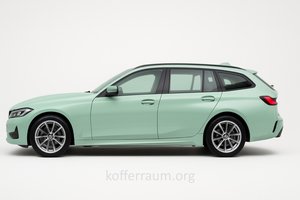
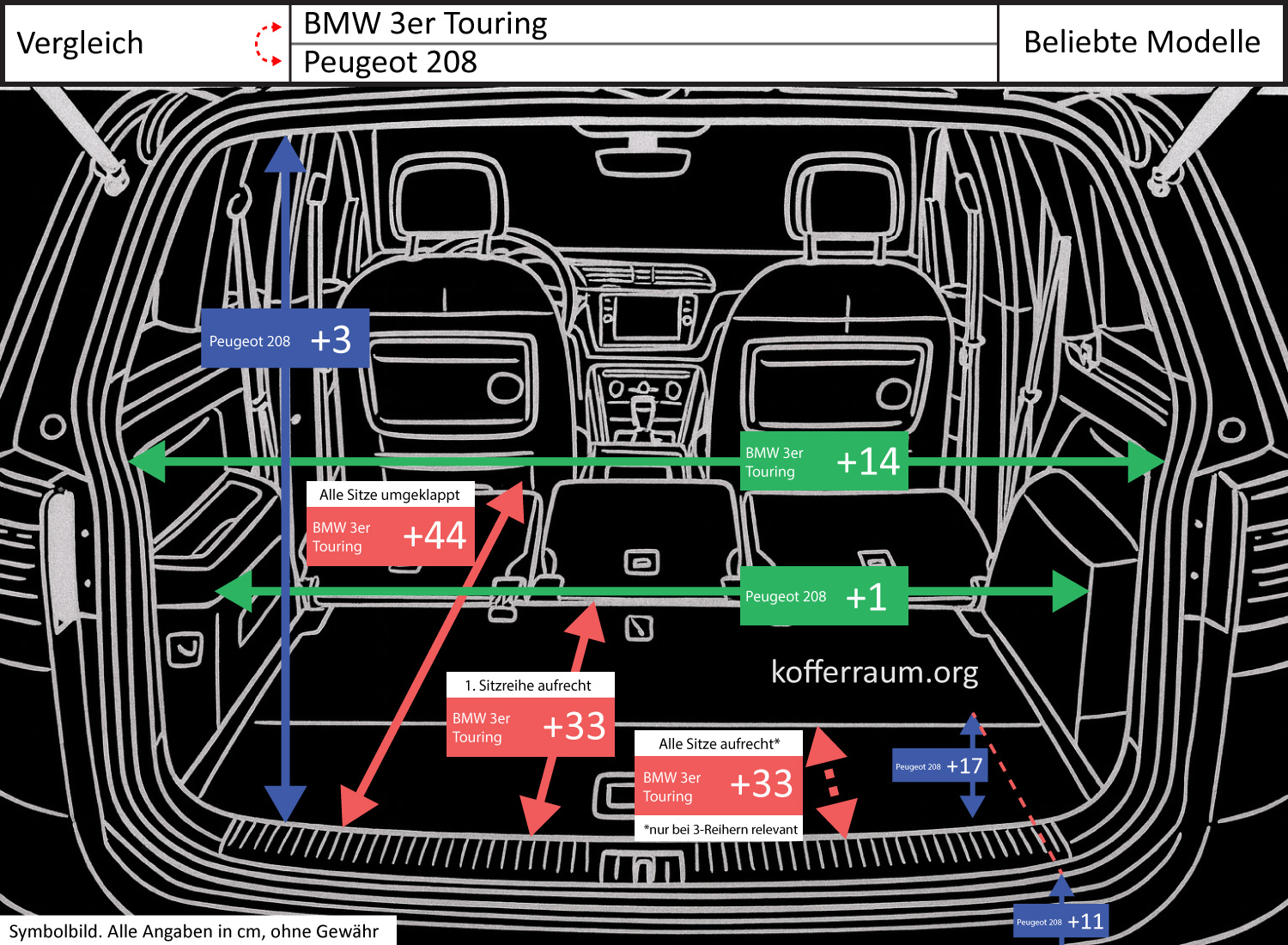
The BMW 3 Series Touring offers significantly more cargo length: with the seats folded down, the trunk is +17.3 in (+34%) longer, and with the first row of seats upright, it is even +13 in (+49%) longer than in the Peugeot 208. The width of the trunk opening in the BMW is +5.5 in (+16%) larger, which makes loading wider items easier.
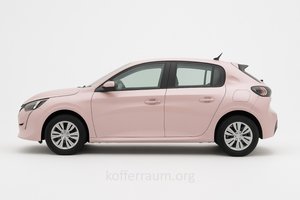
Two values are significantly larger in the Peugeot: the vertical depth from the loading edge to the trunk floor is +6.7 in (+1700%) greater, and the loading edge itself sits +4.3 in (+18%) higher above the ground.
Practical Impact / Usability
More cargo length and a wider opening in the BMW mean that long items (boards, skis, furniture parts) and wide loads can be accommodated more easily and space-efficiently. The greater opening width reduces awkward maneuvering when loading and increases the practical usability of the entire cargo space.
The greater depth in the Peugeot (loading edge → trunk floor) provides a deeper cargo profile, suitable for vertically stackable or bulky but not too long loads; however, combined with the higher loading edge, this results in a disadvantage when lifting heavy items: the loading edge is about 4.3 in higher, making lifting over this edge more strenuous.
In short: Peugeot can accommodate more vertical volume due to the deep well, but is less comfortable when loading and unloading heavier or bulky items.
Other, smaller differences (e.g., opening height +1.2 in in the Peugeot, narrowest width +0.4 in in the Peugeot) are hardly relevant for everyday use.
In summary: for long and wide loads, the BMW is clearly advantageous; for vertically stackable cargo, the Peugeot offers certain benefits, which may be offset by reduced loading comfort due to the higher loading edge.