
Trunk comparison: BMW 3 Series Touring vs Volvo XC40


Main Differences
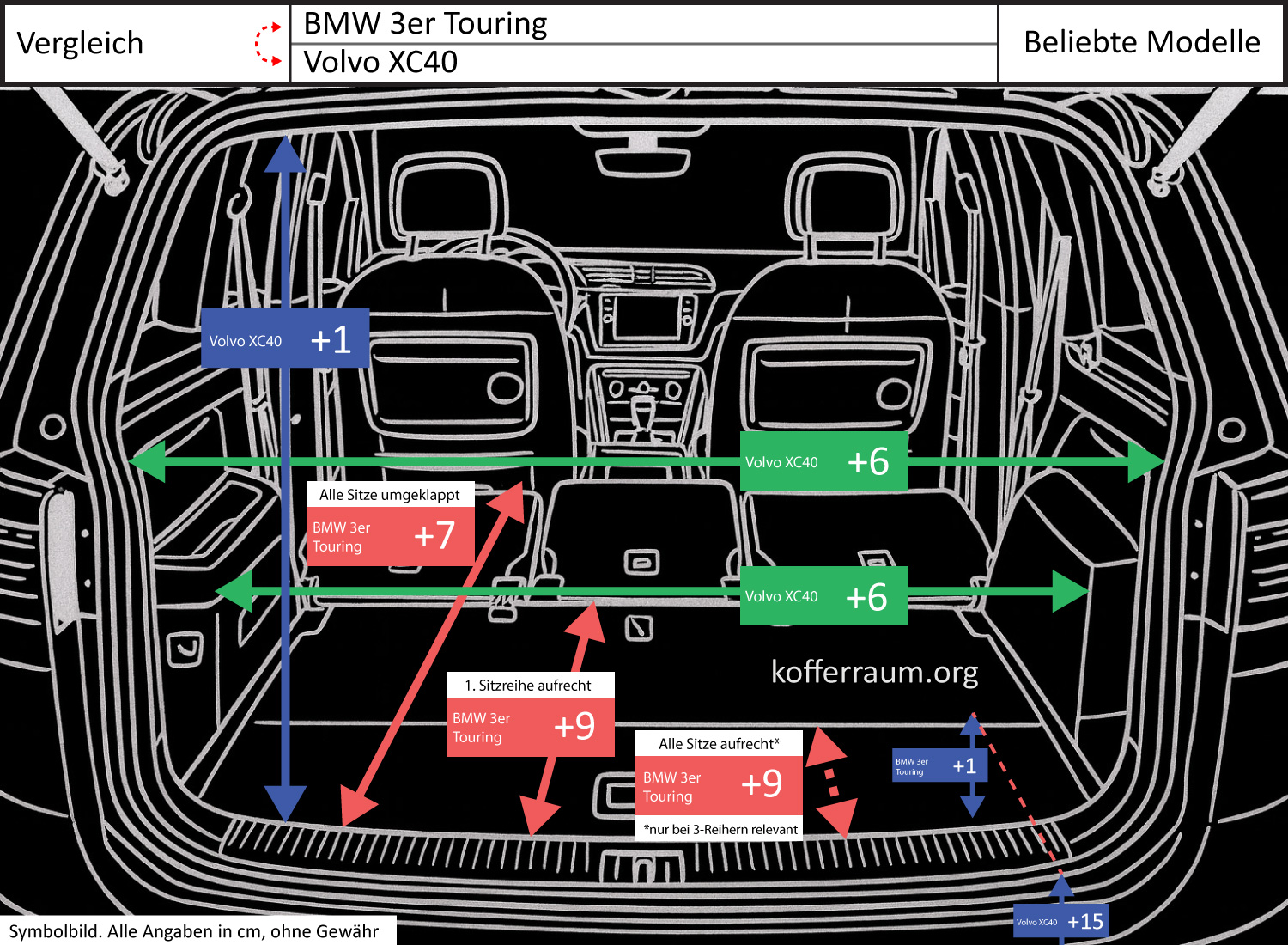
The BMW 3 Series Touring offers a cargo space that is 2.8 in (4%) longer with the seats folded down and 3.5 in (10%) more cargo space with the first row of seats upright than the Volvo XC40. The trunk opening of the Volvo is 0.4 in (1%) higher, and the depth (loading edge to trunk floor) is 0.4 in (0%) greater in the BMW.
However, the loading edge of the Volvo is significantly higher: +5.9 in (25%) compared to the BMW. Additionally, the interior of the Volvo is 2.4 in (6%) wider at its narrowest point and the tailgate opening is 2.4 in (6%) larger than that of the BMW.
Impact on Usability
Crucial for practical use is especially the significantly higher loading edge of the Volvo (+5.9 in / 25%). This means heavier or bulky items must be lifted higher when loading and unloading, making it physically more demanding to load boxes or furniture and more difficult to slide large, heavy items through.
For users who frequently load heavy loads or prefer a low loading edge (e.g., craftsmen, frequent large shopping trips), the BMW is noticeably more comfortable.
The Volvo, on the other hand, scores with a wider trunk opening and more width at the narrowest point (+2.4 in), and the opening is slightly higher (+0.4 in). This makes it easier to load wide or bulky items (furniture parts, strollers), provided the higher lifting to the loading edge is acceptable.
The longer loading options of the BMW (2.8 in more with seats folded, 3.5 in with the first row upright) are advantageous for transporting long items (e.g., slats, skis, long boxes). The other differences (±0.4 in or ~6%) are usually unnoticeable in practice.
Brief conclusion: For frequent lifting of heavy loads and longer items, the BMW 3 Series Touring is more practical. For bulky, wide cargo, the Volvo XC40 may be better suited due to the larger opening, provided the higher lifting is not an issue.
/body>
/html>