Trunk comparison: BMW 3 Series Touring vs VW Passat Wagon
Biggest Differences
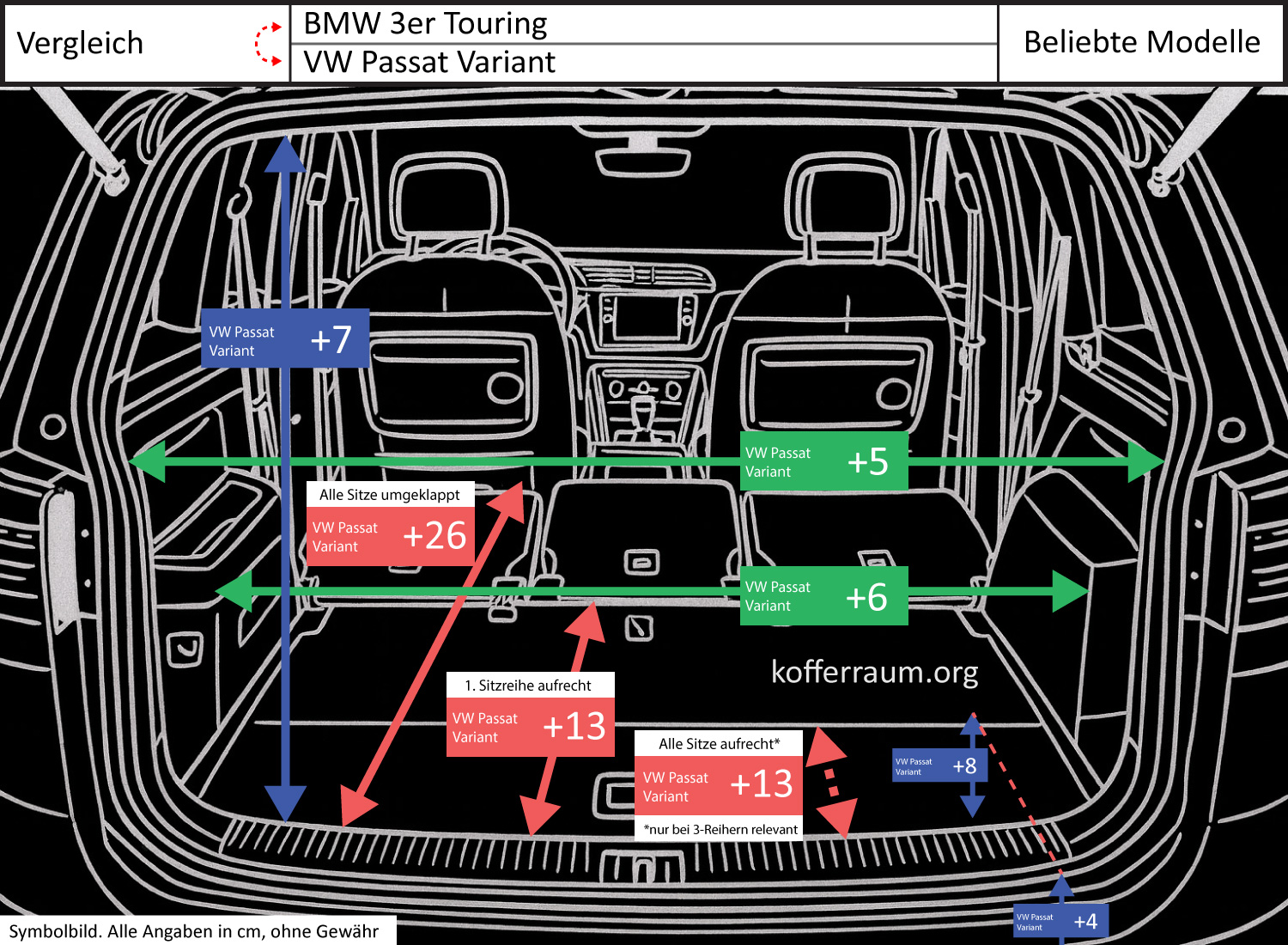
The VW Passat Wagon primarily offers more usable cargo space in length and depth: The folded seats create a cargo area that is 10.2 in (15%) longer, and with the first row of seats upright, the trunk is 5.1 in (13%) longer than in the BMW 3 Series Touring.
Also notable is the significantly greater depth of the trunk (loading edge to trunk floor): it is 3.1 in (800%) higher in the Passat.
Smaller differences concern the height of the trunk opening (+2.8 in / 10%), the loading edge height (+1.6 in / 7%), as well as the widths at the narrowest point (+2.4 in / 6%) and at the opening (+2 in / 5%).
Impact on Usability
The longer cargo areas of the Passat (15% and 13% more length) practically mean more room for long items like slats, skis, or furniture packages.
With the seats folded down, bulky or longer loads can be accommodated more easily; with the seats in normal position, the volume for suitcases and shopping increases noticeably.
The significantly greater depth (3.1 in difference, shown as an extreme percentage in the data) increases usable volume front to back: items can be pushed further into the trunk or stacked higher. This improves everyday practicality for larger shopping trips, luggage, or toolboxes.
Smaller differences have less impact: The 1.6 in higher loading edge in the Passat makes lifting heavy items somewhat more strenuous; the 2.8 in higher opening height can ease loading tall boxes but is moderate in proportion.
Width differences of 5–2.4 in are rarely decisive in practice but can help when loading wider items or placing large suitcases.
Conclusion: Those who frequently transport long or bulky loads benefit noticeably from the Passat Wagon. Differences with the BMW 3 Series Touring are moderate; especially in handling (lower loading edge), it can be easier to load in some everyday situations.