
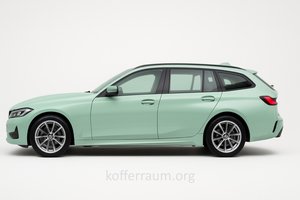
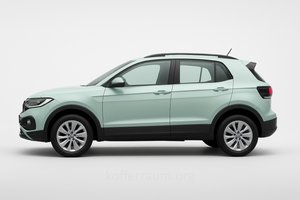
Trunk comparison: BMW 3 Series Touring vs VW T-Cross
Key Differences and Impact on Usability
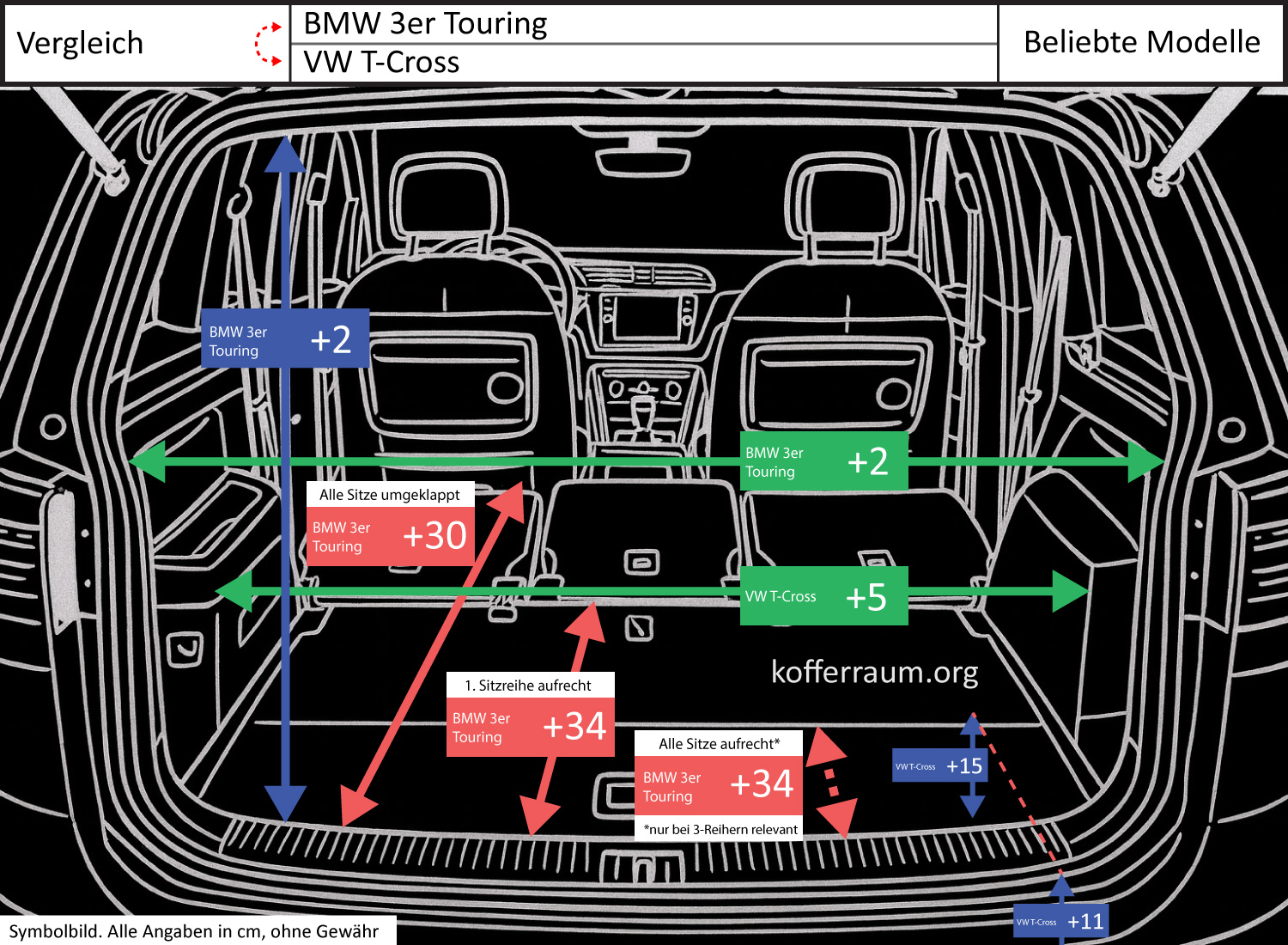
The BMW 3 Series Touring offers significantly more length in the cargo area: With the seats folded down, the trunk of the BMW is +11.8 in (21%) longer, and with the first row upright, even +13.4 in (52%) longer than the VW T-Cross.
This makes the Touring clearly better suited for long items (skis, ladders, long furniture parts) and for users who frequently need to transport long, bulky cargo. In practice, the greater length means fewer restrictions when storing longer packages or placing bulky parts crosswise/diagonally.
The VW T-Cross has a significantly greater depth and a higher loading edge: The depth (distance from loading edge → trunk floor) is +5.9 in (1500%) greater in the T-Cross, and the loading edge is +4.3 in (18%) higher above the road than in the BMW.
This results in more usable vertical height in the trunk and can be advantageous for stacking tall or bulky cargo.
At the same time, the higher loading edge makes loading heavy items more difficult (more lifting effort) and frequent, easy reloading harder. The greater installation depth can also mean that items lie deeper and are harder to access.
Other differences such as the +0.8 in (3%) higher trunk opening height in the BMW, the +2 in (5%) greater minimum width in the VW, and the +0.8 in (2%) greater opening width in the BMW are minor and have little impact on everyday usability.
Conclusion: Those who mainly transport long or flat items and prefer easy, ergonomic access are better served by the BMW 3 Series Touring. Those who want to stack higher volumes in depth and can manage a higher loading edge will find advantages in the VW T-Cross—albeit at the expense of length and easier loading.