
Trunk comparison: BMW 5 Series Touring vs Mazda Mazda CX-5

Key Differences
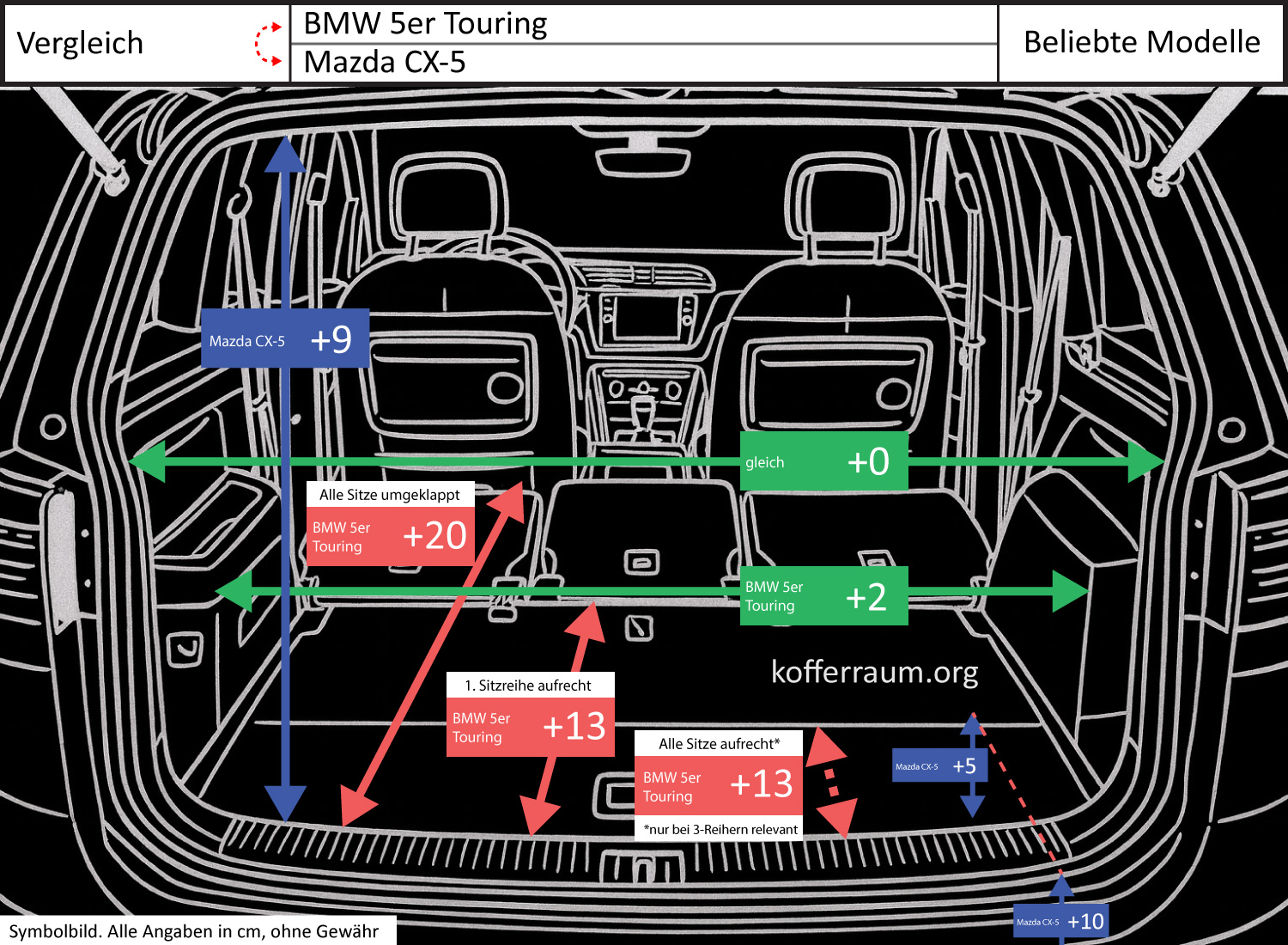
The BMW 5 Series Touring offers a longer cargo floor: with the rear seats folded down, the trunk is 7.9 in (12%) longer, and with the first row upright, it is 5.1 in (14%) longer than the Mazda CX-5. The Mazda excels in trunk geometry in height: the opening is 3.5 in (13%) higher and the depth (distance from loading edge to trunk floor) is significantly greater, specifically 2 in (400%) higher.
Additionally, the Mazda's loading edge sits 3.9 in (15%) higher above the ground than the BMW. The width at the narrowest point differs only slightly (+0.8 in / 2%) in favor of the BMW; the width of the trunk opening is the same for both models.
What are the implications of these differences for usability?
The longer cargo floor of the BMW makes it clearly better for long items (skis, roof box carrier materials, long furniture parts) and for flat-loaded cargo. Combined with the lower loading edge, loading and unloading heavy, long items in the BMW is overall more ergonomic and less strenuous.
The Mazda scores with vertical capacity: the higher opening and greater depth between loading edge and trunk floor create more space for tall or bulky items (large boxes, plants, bulky crates).
However, the loading edge in the Mazda is significantly higher, making lifting heavy items into the trunk more tiring and loading heavy cargo less comfortable than in the BMW.
In summary: For elongated or flat-stowable cargo and easier handling of heavy items, the BMW 5 Series Touring is advantageous. For tall, bulky, or "boxy" cargo, the Mazda CX-5 offers more interior vertical space, at the cost of a higher loading edge and thus more difficult lifting when loading.