
Trunk comparison: BMW i4 vs Mazda Mazda CX-5


Key Statement
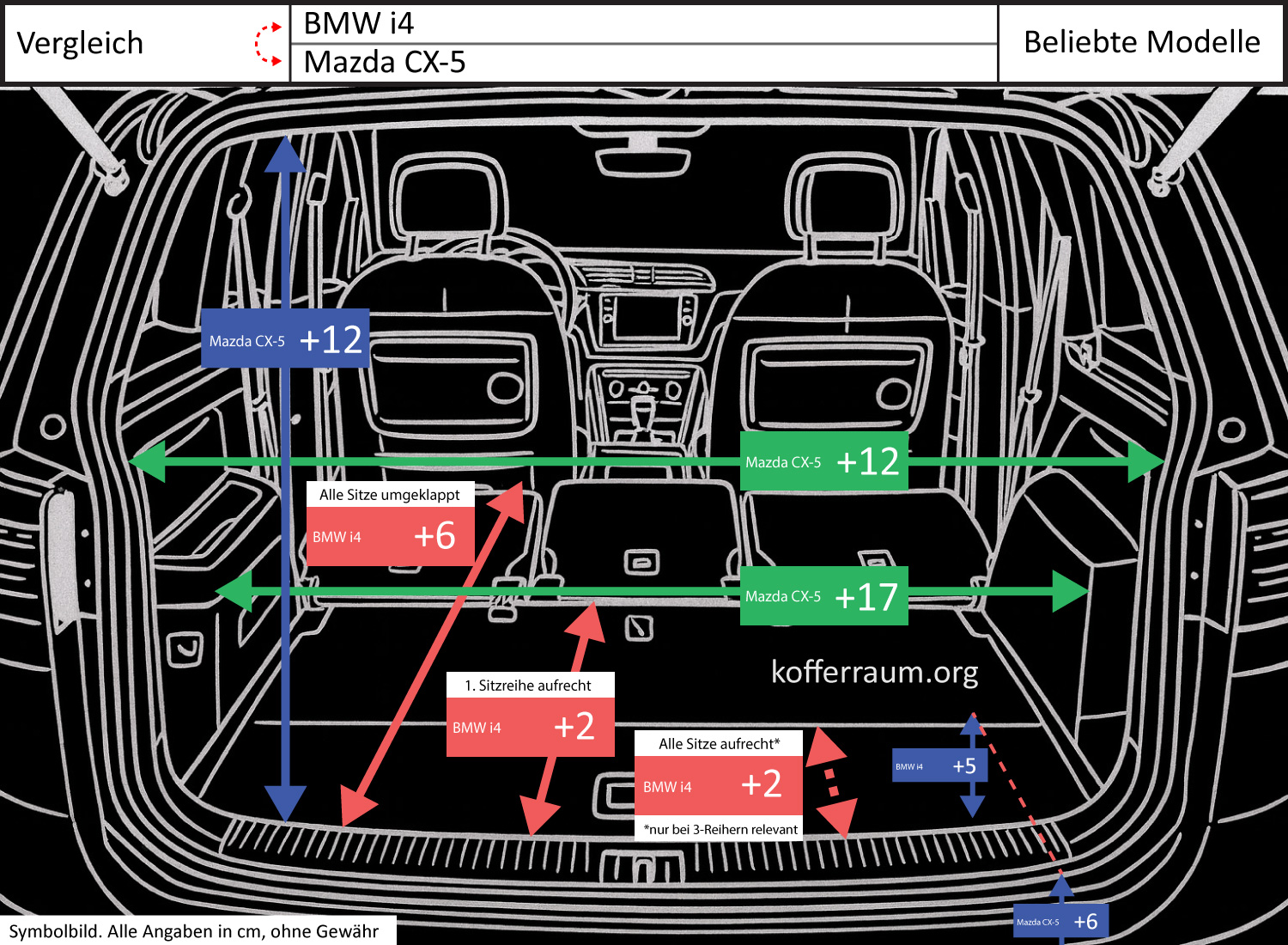
Both models mainly differ in the shape and access of the trunk: The BMW i4 offers more depth behind the loading edge, while the Mazda CX‑5 has significantly greater widths and a higher trunk opening. Minor length differences in cargo volume (whether seats are folded or upright) exist but are negligible.
Main Differences (highlighted)
Height of the trunk opening: The opening of the Mazda CX‑5 is 4.7 in (+18%) higher than that of the BMW i4. This makes loading tall items and access during upright loading and unloading easier.
Depth of the trunk (loading edge → floor): The BMW i4 has a significantly greater distance here (+2 in, stated as +100%), meaning more vertical space directly behind the loading edge for stackable or taller cargo.
Width at the narrowest point and width of the opening: The Mazda is 6.7 in (+19%) wider at the narrowest point and the opening itself is 4.7 in (+13%) larger. This clearly makes the CX‑5 superior for transporting wide items.
Impact on Usability
For bulky, wide items (e.g., furniture parts, wide boxes, bicycles without front wheel), the Mazda CX‑5 is better suited: the larger opening width and overall greater interior width reduce problems when inserting and maneuvering wide cargo.
The higher trunk opening also facilitates loading tall items and improves access.
The BMW i4 scores with significantly greater depth behind the loading edge. This means: when loading stackable, longer, or tall packages that should be placed directly behind the loading edge, the i4 offers more usable vertical space.
Combined with its generally lower loading edge (smaller difference but noticeable), lifting heavy items is somewhat easier.
Practical Recommendation
If you frequently transport wide or bulky items, the Mazda CX‑5 is the more practical choice.
If, on the other hand, you value deep, immediately usable space directly behind the loading edge (e.g., for stackable boxes or tall items that don’t need to extend far in), the BMW i4 is advantageous. Minor length differences in total volume play a subordinate role in everyday use.